


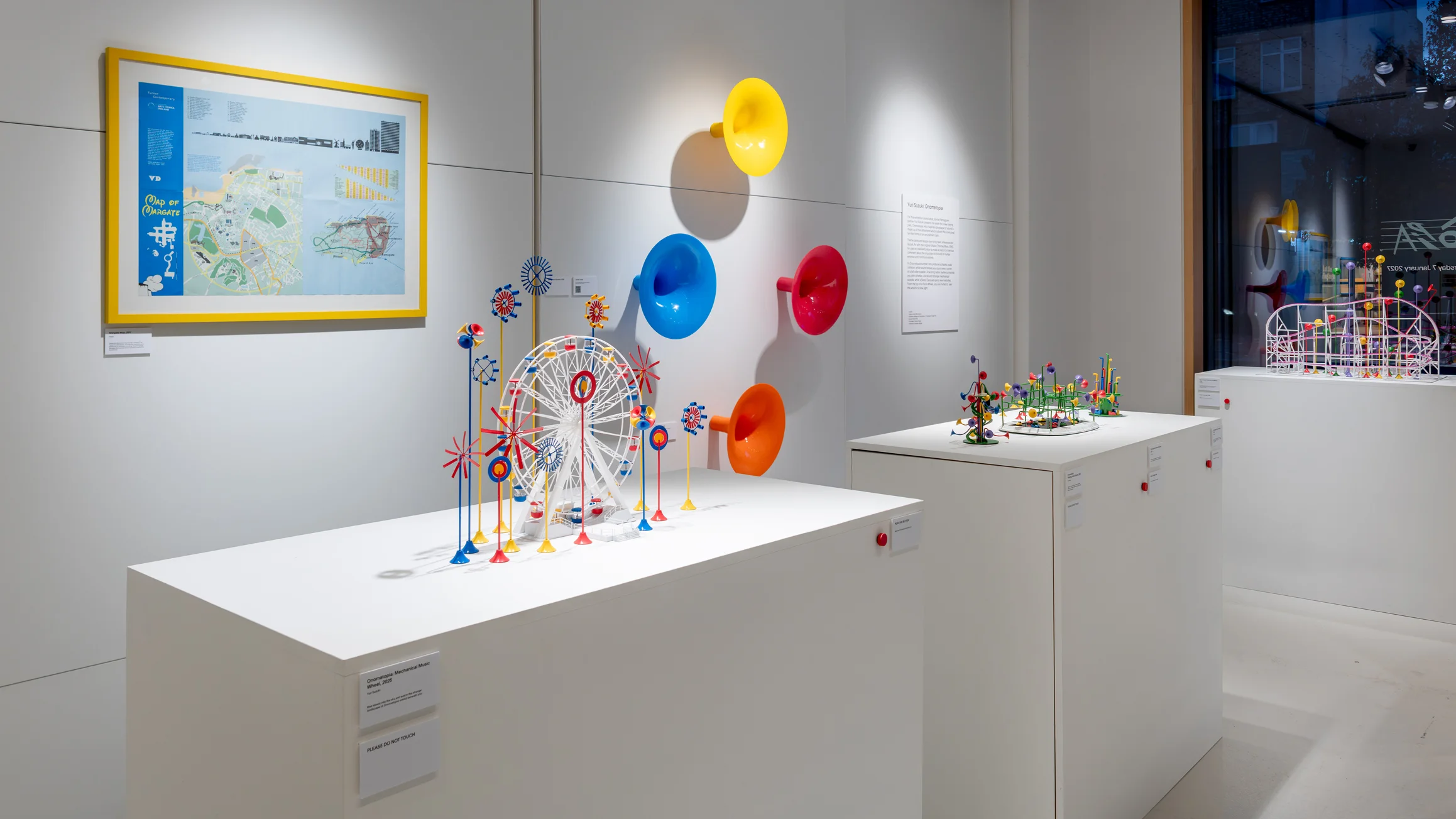
Sound artist, designer, and electronic musician Yuri Suzuki uses ambient noise and miniature rides inspired by theme park attractions to explore the connections between play, sound, and architecture in his new exhibition Onomatopia.
On display through January 7, 2027, in the Osh Gallery at Pentagram’s London headquarters, the exhibition includes five dioramas based on amusement park attractions, world fairs, and expos. It’s a prototype of a theme park built around one’s sense of hearing, as each ride makes its own specific noises. The park in total is designed to evoke a greater appreciation for the role of sound.
Suzuki is a former Pentagram partner who designed a logo for the musical standard MIDI that’s both visual and sonic, and his Ambient Machine lets you customize your own white noise. He’s also designed public multisensory artwork, including for the San Francisco Museum of Modern Art, and a Sonic Playground for Atlanta’s High Museum of Art.
Suzuki’s latest work continues to explore those ideas. There’s a mini roller coaster called “Harmony in Motion” with horns in red, yellow, blue, and green in varying heights sprouting around the tracks, which sound like an organ playing in harmony. A red, yellow, and blue Ferris wheel display named “Mechanical Music Wheel” makes the sound of bright rising and falling chimes.
A bumper cars attraction makes irregular plucking sounds. And there’s a sonic carousel and helter-skelter, each made from multicolored horns. Suzuki tells Fast Company he tends to use primary colors because they are accessible.
“Even color blind people can see the difference in the color,” he says. At the same time, the primary and secondary colors visually simplify what otherwise looks complicated in his work of twisting shapes and horns.
“Sometimes my installation looks very complicated . . . like lots of pipes coming together. But if you divide it by color, it’s a clear division,” he says.