


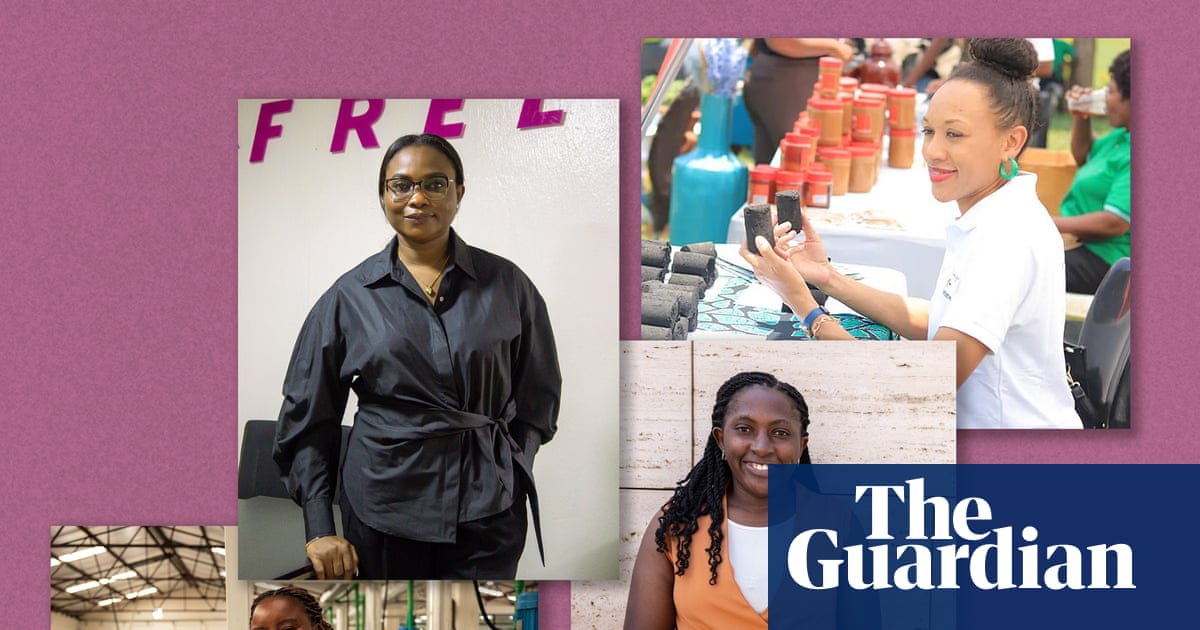
Africa is thought to have a higher proportion of female entrepreneurs than any other continent and yet many still struggle to access financing. Four business leaders from Nigeria, Uganda, Kenya and Malawi tell us about the inspiration behind their success – and the challenges women still face.
Ifedolapo Runsewe, Nigeria: giving waste tyres a new life
On the outskirts of Ibadan in south-west Nigeria, thousands of discarded tyres are fuelling an industrial experiment.
They arrive at Freee Recycle’s factory where they are sorted, shredded and reduced to rubber granules. Some will become playground surfaces. Others will be turned into gym flooring, paving blocks and interlocking tiles.
Ifedolapo Runsewe, the company’s founder, is building an industrial recycling business in a sector where women rarely own factories or lead manufacturing operations.
In Nigeria, women own about 40% of small businesses, but 56% of female entrepreneurs’ last loan applications were denied, compared with 17% for men, according to the World Bank. In capital-heavy fields such as recycling, this financing gap may prevent female entrepreneurs becoming factory owners.
Runsewe has made that leap. She has built a factory that turns one of Nigeria’s most intransigent waste problems into products. The factory employs about 62 people, collecting tyres from four states in Nigeria: Oyo, Lagos, Osun and Kwara.
Nigeria produces millions of waste tyres each year. Many end up in dumps or are burned to recover scrap metal, releasing hazardous pollutants.
“Burning tyres releases a complex mix of toxic chemicals – it’s not just pollution, it’s a direct public health threat,” says Oladele Ogunseitan, a presidential chair at the University of California, Irvine.
After more than 12 years in banking, Runsewe became interested in tyre recycling after seeing first-hand the impact of burning tyres. What convinced her there was a business opportunity was the fact that almost every part of a tyre can be recovered and reused. She started Freee Recycle in 2020.
The challenge has been to convince people that waste can be a business.
Recycling tyres requires substantial capital. Turning the recovered rubber into finished products requires another layer of machinery, expertise and investment. And unlike collecting waste, manufacturing depends on finding customers willing to buy what comes out of the recycling process.
“People view recycling as more of an informal, small-scale activity rather than a serious business capable of generating substantial returns,” she says. “And that is absolutely not true.”
Early on, she encountered another obstacle: the assumption that an industrial recycling business was a man’s domain.
“I’d go into banks and boardrooms, and investors would assume the man next to me is the owner. As soon as I spoke, the question came up: why should we give a woman millions, hundreds of millions?”
Yet she does not want her business reduced to a story about gender. “I don’t think organisations choose to work with us because we’re female-owned,” she says. “They see a brand that is good, transparent, credible and ethical.”
Freee Recycle has secured partnerships with organisations including Michelin, Save the Children and the International Committee of the Red Cross. And she is looking into expanding beyond tyres. “There are plans to set up what would be the first in Nigeria dedicated to recycling aerosols, like insecticide cans and spray containers,” she says.
Through the company’s Freee art residency programme, launched in 2025, discarded tyres have been transformed into large-scale artworks inspired by African history and culture, including the Bata drum, Ikom monoliths and Benin bronze traditions.
The symbolism is deliberate: materials that would otherwise be thrown away are being given another life.
Valentine Benjamin
Kyokushaba Shine, Uganda: building solar-powered irrigation systems
As a little girl, Kyokushaba Shine would watch her mother get up before dawn, labouring hard all day to tend to the acres of onions she had planted near their house in Kabale, southern Uganda.
Often her mother’s harvests – the family’s only source of income – would fail. A lack of water or degraded soil could leave them with almost no yield, making it difficult to put enough food on the table.
Now, as a water engineer and entrepreneur, Kyokushaba, 31, has made it her mission to help farmers like her mother.
“I started my company with the goal of designing small and affordable irrigation systems for smallholder farmers. When I started the business in February 2025, I had neither staff nor capital, but I had a goal in mind and I wanted to work towards it,” she says.
In just over a year, Kyokushaba says Winta Engineering Solutions has installed 30 water systems across Uganda, most of them solar powered, and more than 10 of them for female farmers. Her business employs a team of people, 80% of them women.
The goal, Kyokushaba says, is relatively simple: ensure farmers have reliable access to water using mostly solar-powered pumps, then combine this with modern irrigation technology, such as drip irrigation, that allows water to be used more efficiently. Winta Engineering Solutions designs and installs the equipment, digging boreholes where needed and providing farmers with training on how to operate and maintain the systems.
Kyokushaba has started collaborating with local microfinance providers, connecting them with farmers, who are offered loans of about 5m Ugandan shillings (about £1,000), a sum most do not have readily available, but can usually repay within two years.
She also runs educational programmes that address bigger challenges, including the impact of the climate crisis and soil degradation on farmers’ ability to produce food.
“Farmers want results fast, so they use fertilisers to increase their yields quickly, but sometimes that means they don’t protect the health of their soil,” says Kyokushaba. “It’s not enough to have sufficient water if the soil is degraded, and that’s why we have started working on awareness campaigns.”
There is one other issue that matters deeply to Kyokushaba: creating opportunities for women in a sector still largely dominated by men.
“As a woman, you can show up in spaces where men are trying to push you out, and where men are trying to set the agenda. This needs to change,” she says.
She is also driven by personal reasons. “I have a five-year-old daughter, and it’s just me and her. I want her to see and know that she can do anything she puts her mind to. I want her to know that she’s strong, that women and girls are strong.”
Stefanie Glinski
Wawira Njiru, Kenya: feeding 700,000 schoolchildren a day
From a young age, Wawira Njiru knew she wanted to help people at home in Kenya, but it was not until she was at university abroad that her path to feeding the nation’s schoolchildren began.
While studying for a degree in nutrition in Australia, she raised A$1,200 (£630) and decided to build a small makeshift kitchen in her home town of Ruiru, 12 miles (20km) from Nairobi. In 2012, it started providing 25 children with one school meal every day.
after newsletter promotion
“Teachers said food was the biggest need. Kids were fainting. One teacher said they used to keep packs of glucose in the staff room for when a child faints. I thought that was insane. Why don’t we just feed them?”
Food4Education was born, and nearly 15 years later it has 209 kitchens which feed more than 700,000 children daily. Food is distributed using a fleet of motorbikes and trucks.
For an operation cooking for hundreds of thousands of children, the emissions could be huge. But the flagship kitchen in Nairobi, which feeds about 60,000 children, runs on solar and steam.
Kitchens have been transitioning to use eco-briquettes made in Kenya from sawdust and agricultural waste, including leaves. “If we were to cook for every child in Kenya using firewood, it would be equivalent to 1.1m acres [0.45 hectares] of forest being cut down. That’s about three times the size of London,” says Njiru.
The amount of food waste is small, running at about 2%, because a digital platform verifies who is eating before the next day’s food is produced.
In early 2026, there was a mango crisis in Murang’a county when hot weather meant there was a surplus of the fruit and 5,000 farmers were left with produce they could not sell. “The governor reached out and asked if we could absorb the mangoes,” says Njiru. “We bought 1.3m mangoes over a couple of weeks and distributed them to schoolchildren.” The farmers were paid, children were fed and there was minimal waste.
About 80% of everything Food4Education buys comes from local smallholder farmers. “We make sure we’re aligning what we eat with what’s being grown. When there are more beans, we serve more beans. When there’s more of a certain type of lentil, we serve that,” says Njiru.
She says the organisation now has a huge amount of buying power, given that it buys about 130 tonnes of food a day.
Food4Education, with 6,000 employees, is mostly powered by women. Njiru noticed that men were reluctant to work in kitchens when she started out. “I’ll never forget the man who once told me he’d rather be jobless than work in a kitchen,” she says. Having a predominantly female workforce has affected how the organisation runs, she believes. “I think women want to get things done. I’m not saying men don’t, but it’s very innate to women to focus on what needs to be done and not be paralysed by a big challenge.”
Njiru gets emotional when she talks about the impact on their livelihoods. “I meet women and they say, ‘I was able to build my first home’ or ‘I was able to save up to send my child to university’. Now they’re independent and can take care of themselves.”
Sarah Johnson
Chifuno Stevens, Malawi: turning peanut shells into fuel
When Chifuno Stevens looks at Dedza town, a bustling district in Malawi’s central region, she sees a landscape caught between natural beauty and severe environmental threat.
For years, household waste from the town has been dumped haphazardly across Dedza mountain. At the same time, a heavy reliance on firewood and conventional wood charcoal has rapidly stripped the mountain of its trees.
Deeply concerned by the ecological damage, Stevens, 35, decided to step in.
“I started the organisation in September 2020 to address two massive challenges: poor waste management and rapid deforestation,” she says. “Many households rely on charcoal and firewood for cooking, which puts enormous pressure on our forests. Meanwhile, agricultural waste is discarded and left to rot. I wanted to find a practical way to address both problems while creating economic opportunities for local women.”
Six years later, what began as a community awareness initiative has blossomed into the Chifuno Changa Green Initiative (CCGI), a women-led enterprise that fuses environmental conservation with economic empowerment.
The initiative works directly with 18 local women from the Dauya Ladies Environmental Group.
The enterprise’s core activity revolves around producing and selling eco-friendly charcoal briquettes made from agricultural waste, specifically peanut shells. By converting discarded shells into a clean-burning alternative, CCGI provides families with a viable fuel source that actively reduces the pressure on endangered local forests.
The business has also found creative ways to integrate into the local economy, partnering with its sister business, Dedza Pottery. The pottery workshop uses CCGI’s briquettes as a supplementary fuel when energy supplies fall short.
To build long-term economic resilience, Stevens has expanded the group’s operations beyond green energy. Since early 2026, CCGI has provided sewing classes for its members, enabling them to make and sell reusable tote bags using vibrant local kitenge fabric.
She has also begun offering tours of the briquette workshop to tourists, enabling them to interact with the artisans and have a go at making the briquettes themselves.
“Some people are hesitant to try charcoal briquettes because they are unfamiliar with them,” she says. “We have found that people need to experience using them to trust their benefits, so we are working to carry out more live demonstrations to build that confidence.”
Keeping the products affordable for low-income consumers while trying to grow the business is a delicate balancing act, says Stevens.
“As a woman leading an organisation, I want to ensure that business growth translates into meaningful and sustainable income opportunities for the women involved,” she says. “My ultimate aim is for CCGI to become a financially sustainable business rather than one that depends entirely on external aid.”
Securing a reliable, year-round supply of peanut shells remains a constant puzzle, compounded by a pressing need to invest in specialised equipment to make production processes more efficient. Like many small enterprises, systemic barriers to accessing finance have at times restricted CCGI’s capacity to scale up and meet growing demand.
Despite the uphill battle against these economic and environmental challenges, Stevens’s mission remains unchanged.
“I remain deeply committed to this work because I firmly believe that protecting the environment and creating economic opportunities for women must go hand in hand,” she says. “That is the ultimate key to unlocking a sustainable future.”
Kenneth Zindondo