


You Can See Everything has given America a new villain: Billy Evans. The blockbuster documentary, created by Nathan Fielder and Lance Oppenheim, is about Elizabeth Holmes, the former CEO of the blood-test company Theranos, and the days before she reports to federal prison after being convicted of fraud. But Evans, her partner and the father of her two children, manages to come out of the film looking worse than she does—not because he committed any crime, but because he wanted to get paid for participating in the documentary.
The documentary stages a reenactment of a scene in which Evans negotiates with Fielder and Oppenheim and some A24 executives. Evans is letting a film crew into his home. He’s letting them record his children. He’s even letting them record him in the shower. That degree of access has clear monetary value. But the executives react as if no one in history has ever suggested such an untoward thing. Evans insists, and they begrudgingly agree. The film spends much of its second half interrogating Holmes and Evans’s financial motive, and what that reveals about their honesty and transparency (though a title card at the end reveals that Evans gave up his profit share before the film was released after all).
I get why viewers would find the idea objectionable: How dare Evans and Holmes profit from a documentary that exists only because she was convicted of a crime? Reason called the deal a “crooked bargain.” The Los Angeles Times explained to readers that paying documentary subjects is unusual under “traditional journalistic standards.” It is, of course, true that introducing a pay-to-play dynamic to a truth-seeking mission has the potential to warp the incentives of everyone involved. But all of this is more complicated than it appears. For a film devoted to questioning both the honesty and transparency of its subjects and of the project of filmmaking itself, it’s surprising how little scrutiny this central plot point has received.
[Read: How did Nathan Fielder pull this off?]
I, too, have sat in front of documentary cameras in studios. I’ve invited filmmakers and journalists and photographers into my home maybe a dozen times. But these occasions are the exception. I have no idea how many nonconsensual photographs have been taken of me since I was first arrested in Italy in 2007 on the murder charge that took me more than seven years to beat. I wouldn’t be surprised if that number topped 1 million. Thousands of these photos are available for licensing. On Getty Images alone, a search for my name returns nearly 5,000 results. These pictures are of my face, but they are other people’s property. If I want one of these photos of myself, I have to pay for it like anyone else.
What I’ve learned is that standards of journalistic integrity can be used to ensure that, in cases of “public interest,” money flows to everyone but the “person of interest.”
Earlier this year, Hulu released a documentary directed by my husband, Christopher Robinson, called Mouth of the Wolf: Amanda Knox Returns to Italy. It’s an intimate film about my attempts to reconcile with the Italians who misunderstood me, the media that vilified me, and, most of all, the prosecutor who threw me in prison and later agreed to meet with me.
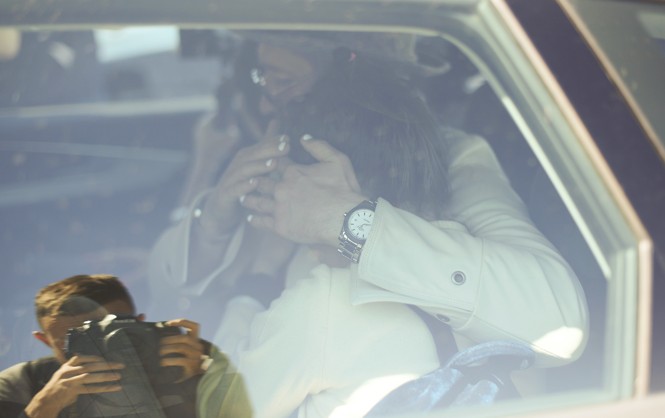
To tell this story, Christopher had to provide some background on the case, which required licensing images and footage of me as a 21-year-old on trial for murder. He also wanted to convey the ongoing media trauma I was confronting by returning to Italy. On my first trip back, in 2019, the paparazzi swarmed me at the airport, shouting my name, clambering over one another to get at me as Christopher helped me into a car. One tripped and fell to the pavement. I didn’t love the idea of funneling money toward some of the very people who’d traumatized me, but one photo in particular—of Christopher shielding my face inside the car while the paparazzo is reflected in the window—was too evocative not to include. We paid Reuters $408 to license the photo. The Atlantic paid $75 to include it in this article. I don’t know what the photographer received.
One of Christopher’s primary motivations to make this film was to reveal the version of me he knew—the wife and mother struggling to make sense of her past, as opposed to the “public figure,” the subject of a true-crime story that had been told many times before.
In 2016, Netflix had released a documentary about my case. I gave the filmmakers hours of interviews. I invited them into my home—basically a run-down shack where I lived alone with four cats—and gave them access to a trove of personal archival material they couldn’t have obtained anywhere else. I wasn’t paid for any of that, though countless people have assumed, and suggested to my face, that I was richly compensated. Judging by the film’s success (including two Emmy nominations), plenty of people saw monetary returns on that creative effort. I was not one of them. At the time, I was told that the rule was that documentary subjects couldn’t be paid, and that the rule protected the film’s integrity. I believed it. When a friend told me afterward that I should have been compensated, I remember thinking that he just didn’t understand how documentaries worked.
What I know now, after years of working in film and television myself, is that subjects get paid all the time; they just don’t get paid as subjects. A production licenses their home videos; a studio options the rights to their memoir, or hires the subjects as consultants. Everyone in the television and film industry knows of these arrangements, but almost no one explains them to the person whose life is on camera, who is usually the least experienced and most desperate person at the table. Today, when someone—in many cases, a wrongly convicted person—comes to me for advice because a documentary filmmaker has approached them, the first thing I say is: Get paid. Don’t give away your family photos for free. Write your story down and self-publish it so the studio can purchase the IP.
Very few people in the film industry actually believe that money corrupts a documentary. If they did, they wouldn’t have built so many loopholes for money to slip through. What they do believe is that openness about money corrupts the appearance of integrity. The “traditional journalistic standards” are there to manipulate the audience’s impression of a film.
These standards are by no means culturally universal. I’ve been on Good Morning America many times over the years. ABC has never paid me for an appearance. I’ve also been on Good Morning Britain, which has paid me for my time. Same type of show, same kind of segment, same person on the couch. It’s a bit like tipping at a restaurant: In the United States, it’s expected that you add 20 percent to the bill for the service. In Japan, leaving a tip is often seen as an insult. In Britain, it’s more common for TV guests to be compensated for their time and exclusivity, and many documentary filmmakers pay “disturbance fees” for the inconvenience of filming in people’s homes and workplaces. Although these countries do have very different approaches to press freedom that affect how journalism is carried out, in many cases the custom tells you a lot more about the culture than about the ethics.
[Amanda Knox: Who owns Amanda Knox?]
The best argument against paying documentary subjects is that doing so motivates them to say what sells, to become the character the film needs. In my experience, however, money is rarely the biggest incentive for the subject. When I was interviewed for the Netflix documentary, I did so without compensation because I had something far more valuable at stake. I was being retried in absentia for the crime I’d already been acquitted of, I was facing potential extradition, and I worried that it might be my last chance to tell my side of the story. I desperately wanted to be believed, to be seen and judged for who I really was. I was about as motivated as a subject could be, and nobody paid me anything.
Every subject walks in with stakes. So does every filmmaker. A film maintains its integrity by acknowledging both. Christopher opened Mouth of the Wolf by introducing himself as my husband, before exploring my wrongful conviction and my confrontation with my prosecutor. As my partner, he could not pretend to be objective, and so he owned his subjectivity from the start.
Essayists, too, should acknowledge any potentially relevant context that might inform how their writing is received, and in that spirit, I will share this: About a month before Fielder showed up to interview Holmes and Evans, I connected with the couple over Zoom. Holmes was preparing to go to prison and wanted advice on what to expect and how to hold her family together. I did not need to have an opinion on her guilt or innocence to offer whatever wisdom I had about the painful journey ahead. I don’t think that information compromises the integrity of this essay, but revealing it gives you more context to make your own judgments.
What has made the shallowness of this whole debate about Evans’s profit-sharing request so strange, for me, is that no one understands better than Fielder that objectivity is a fiction. Across all of his major works—Nathan for You, The Rehearsal, The Curse—Fielder deconstructs the myth of neutrality, exposing how human bias or the presence of a camera inevitably distorts reality. That project is one of the things I most admire about You Can See Everything. Holmes and Evans invite a crew to live with them as an act of radical transparency, and Fielder, suspecting that their transparency is a performance, delivers his own performance of radical transparency. Every cut is intended to shape what you, the audience, should think and feel. That thin, ominous string note playing under Evans and Holmes’s meet-cute story is meant to manipulate you. No matter how much Fielder pulls back the curtain, it’s still a performance.
All filmmakers have a point of view, and Fielder has built a career on exposing that fact. So I found it strange that this story about money is the only one he asks viewers to take on faith, without ever interrogating their first assumptions.
When Evans pointed out that other documentary subjects have been paid, citing the Sussexes’ deal with Netflix that resulted in the Harry & Meghan series, Oppenheim brushed the comparison aside, saying, “That’s not a real documentary.” What is a “real documentary”? An objective one? You can’t spend three hours showing that objectivity is a pose and then argue that paying the subject would compromise the film’s objectivity.
You Can See Everything earned $15 million in its opening weekend. A24 made money. Fielder and Oppenheim made money. When Fielder first objected to Evans’s request, he did so on the grounds that it was unethical. Later, he argued that it made the couple look greedy. When his pressure campaign worked and Evans forfeited his share—expanding the pool of profits available to the film’s other stakeholders—the film cast Evans and Holmes as greedy and suspicious anyway. Which only goes to show that Evans never had a say in what mattered most: creative control over the film itself.
Five years ago, I wrote for The Atlantic about the ways my name, my face, and my story have been used without my consent: the Lifetime movie made while I was still in prison; the network drama pitched as “What if Amanda Knox became a lawyer?”; the Matt Damon film, Stillwater, that fictionalized away my innocence. My essay was about consent. I said very little about money. I should have said more, because the flow of money reveals whom a story truly belongs to.
This was made clear to me in 2021, when my husband and I introduced our newborn daughter to the world through a feature in The New York Times. We knew that the tabloids would send paparazzi out for photos of me with babe in arms, and publish stories saying what it meant for the notorious murder suspect Amanda Knox to give birth. We wanted to tell our own story first, on our own terms. So we sat for a long interview in which I talked about new motherhood and the invasions of my private life, and we gave the Times exclusive photos of me holding our daughter, her face turned away from the camera.
Soon after, that photo—and another from the shoot that the Times had not published—appeared in the Daily Mail alongside an article accusing me of duplicity for not revealing my daughter’s birth on the day she was born, as if I owed that information to the world. I was shocked, furious, confused. Had the Times been hacked?
We ran it up the chain as high as we could, looking for answers, until the executive editor reached out to us. He told us that he took our child’s privacy seriously, and that the photos had now been removed from the Redux database that had made them available to license to whoever paid. When asked to comment by The Atlantic, a spokesperson for the Times described such licensing as “common practice for news organizations.”
The Times would never, because of journalistic integrity, pay a source for an interview or a photograph. And yet it sold pictures of my infant to a tabloid in direct violation of my stated desires.
[Amanda Knox: My last trial]
I bring this up not out of spite for The New York Times. I bring it up to point out that even “ethical” media are entangled with “unethical” media, and that who gets paid is a poor measure of what makes a piece of journalism ethical. I’m getting paid to write this. I’m guessing you’d feel weird if I told you I was kicking Billy Evans a share. (I’m not.) We have strong intuitions about such things, but they aren’t always reliable guides.
A norm against “checkbook journalism” makes sense; you can’t hold truth to power when you have to pay power for access. But that standard collapses when a “public figure” has less power than the journalists dissecting her. Being wrongly accused of murder did not make me powerful, but it did limit my right to privacy. There are no contextual rules or expiration to public figuredom, so I have no legal recourse when TMZ stakes out my wedding. Even musicians and movie stars, who have immense cultural influence, have zero power to stop paparazzi from hounding them. In Holmes’s case, she is a publicly disgraced convicted criminal who has been ordered to pay back $452 million. Who has more power, her and Evans, or A24, Fielder, and Oppenheim? That power differential matters to the question of how ethics, money, and objectivity should be judged in a documentary film.
I doubt there exists a perfect system that balances the public’s need—or at least desire—to know about people in the news, and those people’s right to protect their own privacy or profit from their own exposure. What I do know is that, in a more ethical system, a subject who agrees to give journalists exclusive access should have some say over where her images wind up. And if a family agrees to let a documentarian into their home, no one should think it’s strange for them to want something in return.
“Traditional journalistic standards” don’t ensure that a documentary film is objective. They merely ensure that the person in front of the camera is the only one whose financial incentives are not shaping the outcome.