


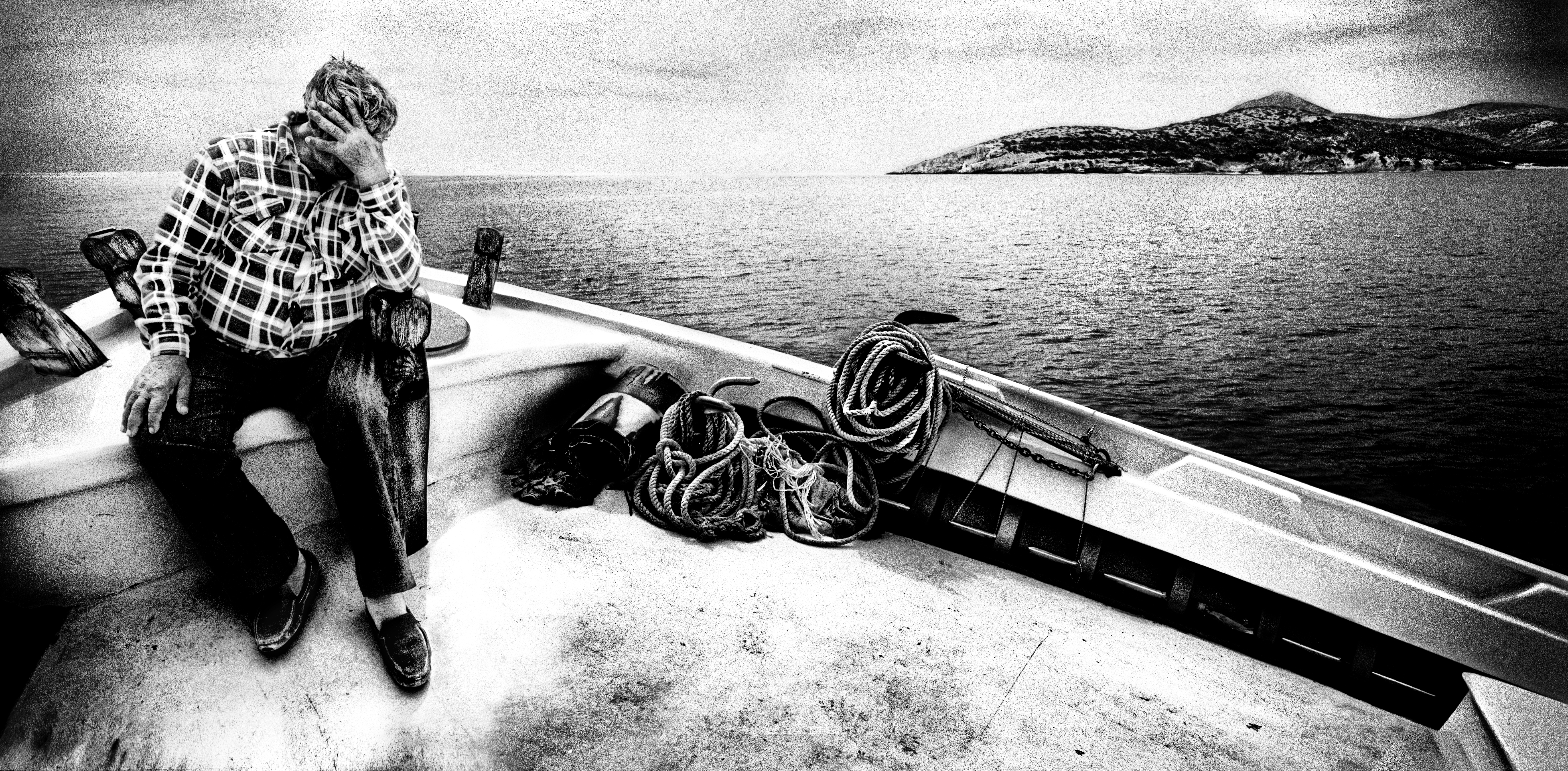
Lefkés, a mountain village on the Greek island of Paros, is named after white poplars that once surrounded it. Beyond a cluster of houses, a Byzantine footpath meanders toward the Aegean. According to village lore, the path is not visible from Paros’s shoreline to protect Lefkés from pirates.
In the late 1960s, my Uncle Stelios bought a dilapidated house in Lefkés and, with my father’s help, rebuilt it into a majestic dwelling. This place became our family haven.
Lefkés took to modernity late. Narrow streets, built centuries ago, honored human scale and could never be claimed by cars. Corners of buildings were rounded so that donkeys laden with fruits and vegetables could make sharp turns. I remember when electricity first lit up the streets, the day we first had running water, and when the only phone line was in the post office, which also served as the social club for the yiayias—matriarchs who listened to every call. Word would be passed from window to doorway until the entire community knew your business. One of these ladies was known as “Mrs. Postman.” She hand-delivered everyone’s letters after reading them first, carrying the open envelopes in her leather handbag. Years later, I would photograph her clutching this precious purse on her lap.
My father’s family had left Greece when he was a young boy, after World War II, fleeing a German concentration camp. When I was still a baby, my family moved back for my father’s work as an architect. I’d peer over his drafting table while he sketched street scenes and villagers in black ink. He never used gray—only uncompromising black and white. I’m still searching for the simplicity of my father’s eye—brightness and contrast.
I would emulate him and sketch the village elders, learning to study posture and character. In 1986, I discovered photography, and the camera became my sketchbook. I returned to Paros several times a year to practice. Over time, I photographed everyone—village elders, children, priests, fishermen, farmers, shopkeepers, and the last donkey man.
Uncle Stelios loved to help me find new subjects. We traveled across Paros and her small sister island, Antiparos, to find “good quality people,” as he would say. One of my first photographs is of an old man he knew called Pandelis, who was born around 1915, though he didn’t know his birthday or exact age. I took a picture of the back of his weather-beaten neck. I also took a portrait of him sitting inside his house. Three objects hung on the wall behind him: an empty picture frame, a pincushion storing needles that he used for repairing his work clothes, and a pack of AA batteries he had found on the beach. Pandelis had no idea what the batteries were for, but because the package had a hole in it, he assumed that it was an ornament, so he hung it on a hook for display.

Efthemios, Uncle Stelios’s closest companion, also helped me find more subjects for my portraits. I photographed his parents, and his daughter as a little girl, wearing a headscarf during a festival—then, decades later, his grandson in church among a group of altar boys.
On a recent trip, I took my wife and my teenage children, armed with Super 8 cameras—as well as a producer and a videographer—to make a film about Paros. Monique, a ceramicist on the island, led us to a house where a woman named Katerina lived with her husband, known as “the tailor.” His sewing machine had repaired villagers’ clothes since World War II.
He had a noble face. Sadly, he was bedridden and had not left his house in years. He was overwhelmed with emotion as his small house filled with a young, appreciative film crew. I took a portrait of the two of them, Katerina’s head resting on his shoulder. She whispered, “There is no happy life. There are only happy moments.”