All posts tagged: emotions

When Are Your Feelings Really Yours?

When Are Your Feelings Really Yours?

Until the fall of 2008, I would have said I wasn’t afraid of mice. But then, in that fateful autumn, I went to my kitchen one night to investigate strange sounds. As I stepped across the threshold and flipped on the light, a mouse dashed across my bare foot. I unleashed the loudest and most panicked scream I’ve ever unleashed (my poor sleeping spouse thought I was being murdered). It’s the only time in my life I have ever been literally paralyzed from fear. Nothing about my biography leading up to the night mouse would have suggested that I was afraid of mice at all, much less panic-stricken around them. I am not afraid of other rodents or reptiles. I’m an animal lover, and I even kept a mouse as a pet when I was a child. My fear of the mouse in my kitchen was a complete shock to me. I never would have predicted that emotional response, and yet there I was, hysterically screaming and shaking in the middle of my kitchen. Our …

What Your Emotions Are Actually For

What Your Emotions Are Actually For

“Although many of us may think of ourselves as thinking creatures that feel, biologically we are feeling creatures that think.” –Dr. Jill Bolte Taylor, neuroscientist and author of My Stroke of Insight. Stupid, sappy, mushy, melodramatic, insipid, tiresome, wimpy, lame. These are all words that I have heard people use to describe their own emotions. As a psychologist, I see in our society a poor tolerance for something that’s a deeply personal, biological part of who we are as humans: our emotions. Indeed, if you grew up in one of the many, many households where emotion was discouraged or poorly tolerated (childhood emotional neglect), you may now, as an adult, have a negative connotation to feelings of all kinds. You may see emotions as a sign of weakness. You may hide your feelings from yourself and others, even the people you care about the most. You may regard the expression or sharing of feelings as maudlin, illogical, or just plain useless. You may have no idea what you feel or why, because you have buried …

How to De-escalate Your Heightened Emotions at Work

How to De-escalate Your Heightened Emotions at Work

According to the U.S. Bureau of Labor Statistics, the average worker spends more than 1,800 hours yearly at work. Some reports put that at over 2,000 hours.1 Two Scottish entrepreneurs, devoted to mindfulness meditation and one training to become a psychologist, created a health business called Buddhify. Rohan Gunatillake, author of Modern Mindfulness,2 together with Lucy Gunatillake, created The Work Mindfulness Deck.3 Calling for a redesign of mindfulness, Rohan Gunatillake writes, “A growing base of scientific research is providing substantial evidence for its benefits and effects. Leading companies teach it to employees to manage stress. Elite athletes use it to stay calm and perform under pressure. Celebrities take it on as a must-have lifestyle accessory…” Despite the endorsements, most who profess an interest in mindfulness are held back by a perceived lack of time, rejection of spirituality, and the belief that they cannot unplug digitally long enough to be mindful. Indeed, research published by the National Institutes of Health dovetails with this, as anxiety, stress, and depression are among the top reasons why people use …

What if Your Boss Monitored Your Emotions?

What if Your Boss Monitored Your Emotions?

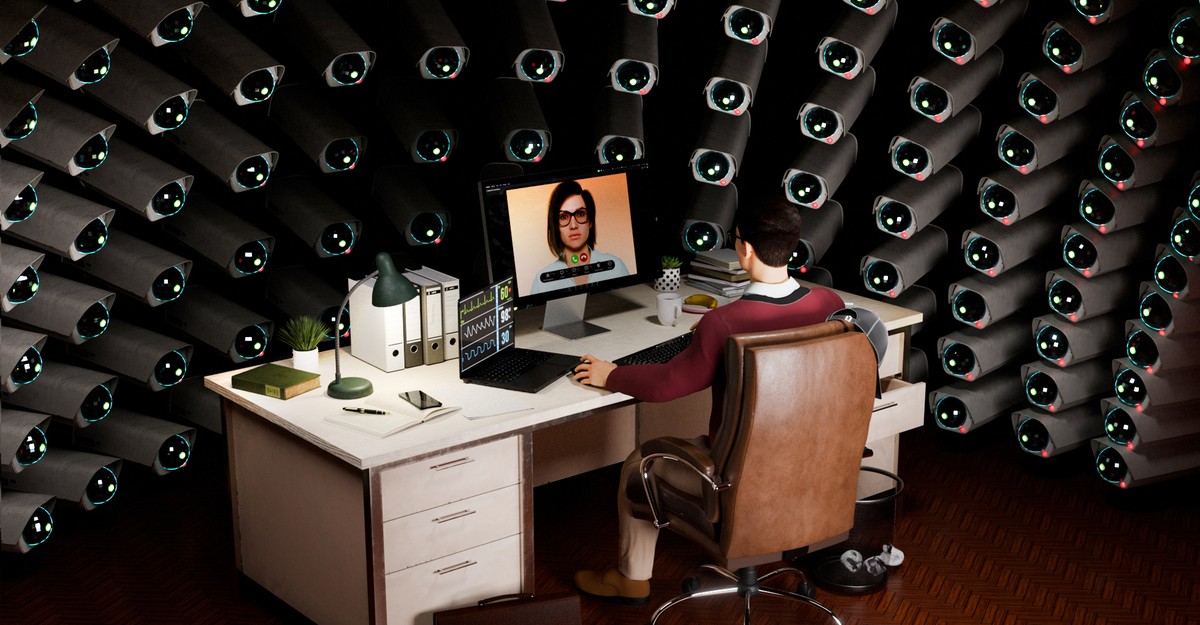
The good news, for me at least, is that the computer thinks I have a nice personality. According to an app called MorphCast, I was, in a recent meeting with my boss, generally “amused,” “determined,” and “interested,” though—sue me—occasionally “impatient.” MorphCast, you see, purports to glean insights into the depths and vagaries of human emotion using AI. It found that my affect was “positive” and “active,” as opposed to negative and/or passive. My attention was reasonably high. Also, the AI informed me that I wear glasses—revelatory! The bad news is that software now purports to glean insights into the depths and vagaries of human emotion using AI, and it is coming to watch you. If it isn’t already: Morphcast, for example, has licensed its technology to a mental-health app, a program that monitors schoolchildren’s attention, and McDonald’s, which launched a promotional campaign in Portugal that scanned app users’ faces and offered them personalized coupons based on their (supposed) mood. It is one of many, many such companies doing similar work—the industry term is emotion AI …

The Emotions Behind Forgiveness

The Emotions Behind Forgiveness

As a moral virtue, forgiveness encompasses motivations to do good, thoughts that do not condemn the offending person, softer emotions, and, as far as possible, cooperative behaviors toward that person. See, for example, Song et al. (2025), in which the wholeness of forgiveness is described. In this essay, we examine one part of the overall moral virtue of forgiveness: the emotions. Fostering these feelings can help soften your heart toward the one (or ones) who were unjust to you. This heart-softening can have significant benefits for the forgiver because it tends to lower the resentment that can lead to fatigue, sadness, and, eventually, anxiety and even depression if the resentment lingers and is intense for a long time. Consider five points about the emotions of forgiveness. 1. For most people, the emotions of forgiveness emerge after the cognitive work has commenced and progressed. We find that, in the process of forgiveness, it is easier for people to do the cognitive work than the emotional work because we are more in control of what we think …

Why Avoiding Your Emotions Makes Them Stronger

Why Avoiding Your Emotions Makes Them Stronger

Have you ever tried to make yourself stop thinking about something uncomfortable? Or suddenly found yourself cleaning the bathroom instead of starting the work task you’re stressed out about? If you answered yes to these questions, you’re like most of us. Humans are hard-wired to maximize pleasure and minimize pain, so it makes sense that our first instinct would be to avoid negative or uncomfortable experiences, emotions included. Unfortunately, that approach to dealing with our emotions and the situations that provoke them tends to backfire. The Paradox of Avoidance: See for Yourself Let me illustrate this for you with an exercise. Bring to mind an embarrassing or cringe memory that you’d prefer not to think about. For me, this would be the time I walked around my college campus with staticky underwear (clean, at least) clinging to the back of my pants (my face is getting hot just typing this). Once you’ve got the memory locked in, set a timer for 60 seconds, and don’t let yourself think about it until the timer goes off. …

How different negative emotions change the size of your pupils

How different negative emotions change the size of your pupils

When people feel disgust or sadness, their pupils involuntarily widen. Conversely, feelings of anger are associated with a narrowing of the pupils, setting it apart from other negative mental states. These distinct physical responses occur even when individuals experience mixed feelings at the exact same moment. The research was published in Biological Psychology. The size of the human pupil is controlled by the autonomic nervous system, which governs involuntary body functions. Pupil dilation reflects the activation of the sympathetic nervous system. This is the same biological network responsible for the body’s fight or flight response. When this system springs into action, it engages a specific muscle in the iris that pulls the pupil open. A wider pupil increases a person’s overall field of vision, allowing them to scan the broader environment for potential threats. Pupil constriction relies on the parasympathetic nervous system, which usually helps the body rest and digest. When this system takes over, the dilating muscle relaxes and another muscle pinches the pupil shut. A smaller pupil narrows the field of view. This …

Health, Music, Executive Function, and Emotions

Health, Music, Executive Function, and Emotions

The rhythm of life may shift suddenly. A senior hears words like blockage, plaque, or monitoring. A mother hears a doctor say, “We’re not sure yet.” A teenager encounters the word idiopathic, that maddening medical term that essentially means we don’t know why. Our steady internal rhythms, our assumptions about our bodies, our stamina, and our future begin to feel off. Sound becomes strangely vivid. A hospital hallway that might otherwise feel quiet reveals a whole orchestra of small noises: beds rolling down polished floors, rubber soles on tile, nurses speaking softly to one another. A heart monitor keeps time with a steady electronic pulse. For families waiting through procedures or tests, that sound becomes its own metronome. When human hearts feel fragile, the mechanical rhythm of the monitor fills the space. Each pulse reassures that, at least for now, everything is still moving forward. Rhythm becomes noticeable during stressful moments. When certainty disappears, the brain looks for patterns that can stabilize attention and breathing. The nervous system naturally entrains to predictable sounds, whether they …

Attachment anxiety shapes how emotions interfere with self-control

Attachment anxiety shapes how emotions interfere with self-control

Attachment anxiety shapes how people handle emotional conflict, and brief reminders of security or threat can shift that balance, according to research published in Cognition & Emotion. Everyday life requires us to focus on what matters while ignoring emotionally distracting information; this is known as emotional conflict control. Previous research shows that people differ in how well they manage this kind of emotional interference, and attachment theory suggests that these differences may stem from how secure or insecure people feel in close relationships. Individuals with anxious attachment, for example, tend to be highly sensitive to emotional cues, whereas avoidantly attached individuals often suppress emotional information in favor of control. Drawing on the functional neuro-anatomical model of attachment, Mengke Zhang and colleagues conducted two experiments to examine how attachment styles and short-term attachment “priming” experiences relate to emotional conflict control. In Experiment 1, 225 Chinese undergraduate students completed the Experiences in Close Relationships questionnaire, which assesses two core dimensions of adult attachment, including attachment anxiety and attachment avoidance. Participants then completed an emotional face-word Stroop task …

“Mixed emotions”: US Olympians wrestle with patriotism

“Mixed emotions”: US Olympians wrestle with patriotism

Several U.S. Winter Olympians have openly admitted feeling conflicted about representing the country amid ongoing domestic unrest, highlighting the tension between national pride and personal values. Freestyle skiers Hunter Hess and Chris Lillis, competing in Milan, told reporters that wearing the American flag feels complicated given recent political controversies, particularly immigration enforcement actions. Speaking at a press conference in Milan, Team USA freestyle skiers Chris Lillis and Hunter Hess said the actions of ICE agents do not reflect the country they represent https://t.co/w4qci0dk8g pic.twitter.com/3I9rVnB1Hd — Reuters (@Reuters) February 6, 2026 “It brings up mixed emotions to represent the U.S. right now,” Hess said. “Just because I wear the flag doesn’t mean I represent everything that’s going on back home.” Lillis echoed the sentiment, noting that he is proud to compete but feels “heartbroken” over current events. The remarks come amid high-profile criticism of the U.S. government’s immigration policies, including controversial raids by Immigration and Customs Enforcement (ICE), and broader public debates over the nation’s values and international image. While athletes generally avoid political commentary during …