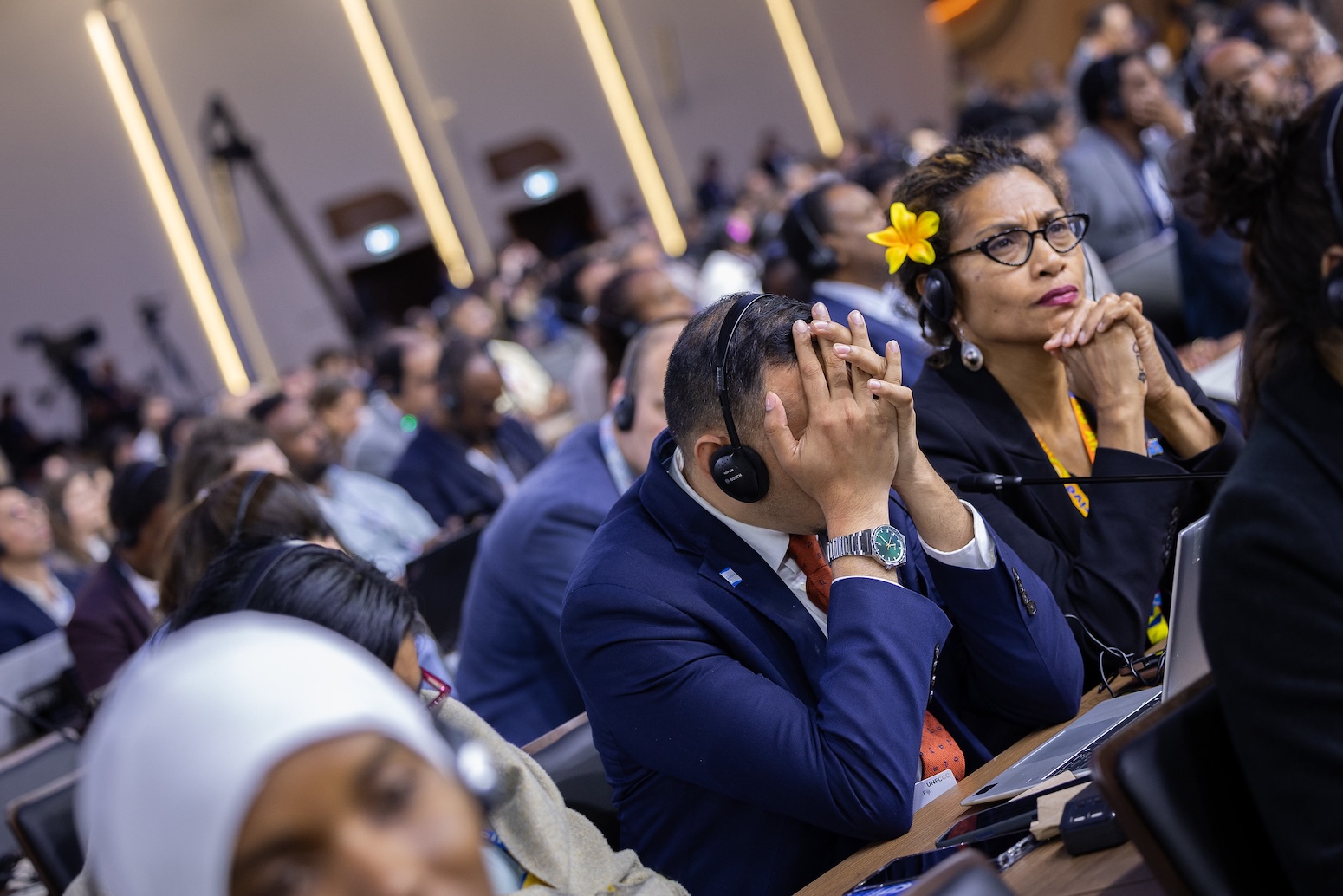
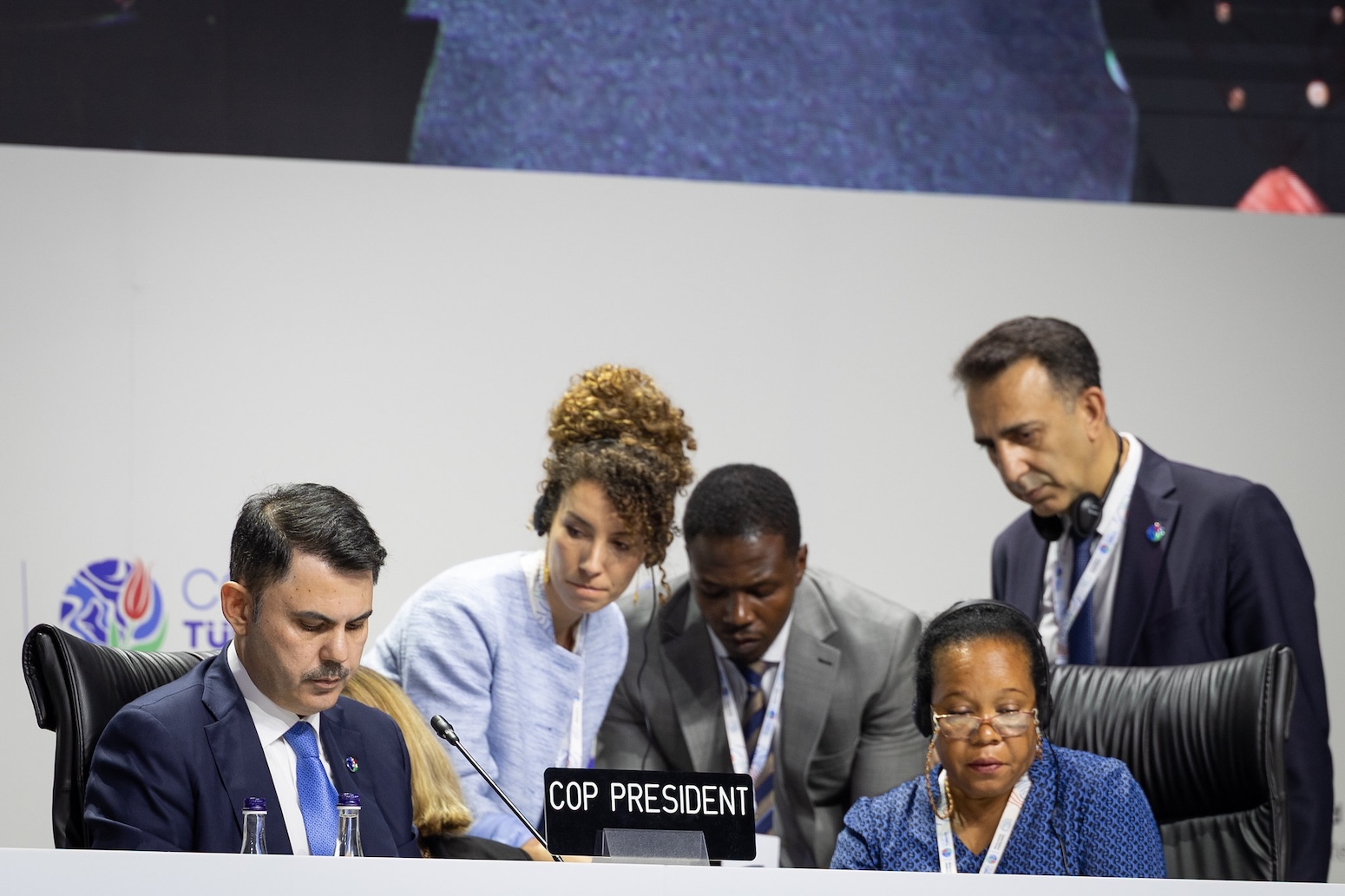
COP31 came to a dramatic close last weekend when a coalition of nations rejected the proposed “Antalya pact”, citing its failure to mention fossil fuels.
The tense final moments and lack of a much-anticipated “pact” have sparked extensive media coverage around the world.
Many commentators have rushed to label the COP31 outcome a “failure”, questioning what it means for the future of the UN climate process and a “divided world”.
There has been much finger-pointing, with some outlets attributing COP31’s “collapse” to “oil-rich nations”, while others blame Europe’s “reluctance” to provide more climate finance.
While it is not accurate to say there was “no agreement” at COP31, the media response demonstrates the complexity of the divergent views on display at the Antalya conference.
In this article, Carbon Brief draws together media reactions from around the world to show the diversity of responses to the COP31 outcome.
What happened at COP31?
COP31 ended without agreement on a proposed “Antalya pact”, which had been pushed by the Turkey-Australia presidency.
The final text was rejected by at least 32 countries, including the EU, the UK and some climate-vulnerable countries, in chaotic scenes as the talks overran by two days.
An Irish Times editorial said the outcome was an “unprecedented ending of a COP without any agreement or roadmap forward”.
This view, while commonly expressed in the media, is incorrect.
As veteran “COP-watchers” explained for an article on CB Connect, the summit reached agreement on many decisions, even though the presidency’s “cover decision” failed.
Referring to the rejection of the cover decision, Melbourne University climate researchers Prof Jacqueline Peel and Prof Kathryn Bowen wrote in the Conversation that “these texts have always been add-ons to the formal negotiation process”.
They noted that there was “progress in a few areas” at COP31, including negotiations on supporting a just transition via a “phased approach” and “improving alignment in climate adaptation”.
For a full overview of what happened at COP31 – both inside and outside the negotiations – see Carbon Brief’s “key outcomes” article.
What has the reaction to the presidency been?
In the aftermath of COP31, commentators have critiqued decisions made by the presidency. An editorial in the Hindu noted that “usually, cover texts evolve as a final synthesis of deliberations”, but said the COP31 leadership “thought it fit to push for a cover text early in the proceedings”.
Australian “president of negotiations” Chris Bowen has also faced criticism over how he managed competing interests at the summit. An editorial in the climate-sceptic Australian said:
“One thing is clear: Chris Bowen, who presided over Australia’s $150m investment in the conference, has some explaining to do. International reporting has raised questions about Australia and Turkey, the two nations that co-hosted the summit. Some negotiators have criticised their handling of the talks.”
Similarly, climate-sceptic journalist Graham Lloyd wrote in the Australian that “globally, Bowen has embarrassed himself and diminished Australia’s reputation”.
For Australian news outlet Crikey, journalist Royce Kurmelovs said that Bowen “tried to run the world’s climate talks the way Labor [Australia’s ruling party] runs climate policy at home: quiet, pragmatic and without mentioning fossil fuels”, adding that “in Turkey, it didn’t work”.
A commentary by journalist Xu Luyi in Chinese financial news outlet Caixin said that future COP presidencies should “distinguish achievable implementation measures from ambitions that lack a coalition capable of delivering them”.
Separately, an editorial in the National – a UAE state-owned English-language daily newspaper – said “the next UN secretary general needs to restore the art of diplomacy”.
How has the role of oil-rich nations been portrayed?
In media coverage, much of the blame for the perceived failure of COP31 has been placed on oil-producing nations – particularly with the final cover decision draft containing no mention of fossil fuels.
Even before the summit had finished, Panama’s minister of environment Juan Carlos Navarro warned that the COP process was being “held hostage by the petroleum mafia”.
After the talks had closed without a deal on the Antalya pact, a Guardian editorial said that responsibility lay with “petrostates resisting a transition away from fossil fuels”, along with a lack of climate finance. The “fossil-fuel backsliding” was being led by a “Saudi-Russian coalition”, it said.
A Bloomberg editorial also noted that the omission of fossil fuels from the decision text came “amid pressure from Russia, Saudi Arabia and other fossil fuel producers”. A Times editorial described oil-rich nations, “led by Saudi Arabia”, as the “culprits” for the lack of an agreement, because they “insisted on dropping a reference to phasing out hydrocarbons”.
In the i newspaper, David Shukman, a former BBC News science editor, described a “deception” at the “heart” of the COP process:
“This pattern of lobbying by oil-rich nations has become increasingly blatant and aggressive over more than three decades.”
Despite signing up to the UN Framework Convention on Climate Change (UNFCCC) at the 1992 Earth Summit in Rio de Janeiro, the participation of the “oil-rich minority” has been “in name only”, wrote Shukman:
“At more than a dozen of the UN’s giant conferences, I’ve seen for myself the tactics of trench warfare and how well they’ve worked. It’s why fossil fuels remain so dominant and why the climate is turning so hostile.”
Writing for the Guardian, University College London’s Prof Bill McGuire warned that the COP process had been “deeply compromised” by the “major fossil-fuel producers”. For Al Jazeera, York University’s Prof Ilan Kapoor added that “fossil-fuel power operates well beyond the conference hall”.

(Reuters reported that, according to negotiators from Europe, small-island states, Latin America, Asia and Africa, Saudi officials had “regular access” to the summit’s presidents, “allowing them disproportionate influence”.)
In Australian outlet Inside Story, the University of Sheffield’s Prof Michael Jacobs wrote that since “transitioning away from fossil fuels” language was included in COP28, fossil-fuel producers “have been determined to ensure the phrase would never be used again”.
Nick O’Malley, national environment and climate editor for the Sydney Morning Herald, noted:
“The tension between the action the world knows it must take on climate change and that which a handful of oil-rich nations will allow it to take has been growing for years.”
At the summit itself, shortly after rejecting the cover decision on behalf of the EU, Irish environment minister Darragh O’Brien told Agence France-Presse that the talks had been “hijacked by some oil states”.
The Backchannel substack collated reactions from negotiators and observers. Among them, Dr Mary Robinson – former president of Ireland – warned of the “disturbing politicised attacks on [climate] science from those still clinging to fossil fuels and looking to sabotage climate action”.
In contrast, an editorial in the National loosely described a failure of the talks to “bridge divisions over fossil-fuel language, carbon capture and adaptation finance in the final draft”. It added:
“Unfortunately, the gap between countries – major emitters, energy producers and the more vulnerable nations demanding accessible funding – proved too wide to close.”
How has the role of developed nations been portrayed?
Much of the commentary about developed countries’ role at COP31 focused on the EU and the UK blocking the final “Antalya pact”, due to its lack of language about fossil fuels.
A cover-decision text without such language was “vehemently opposed by dozens of countries, including the EU delegation strongly led by [Irish] minister for climate Darragh O’Brien”, according to the Irish Times.
Similarly, an editorial in the UK’s Times concluded that “several countries, including the UK, rejected a draft omitting the not insignificant matter of winding down fossil-fuel use”.
Peter Prengaman, climate news director for the Associated Press, wrote that the EU and its allies “were no longer willing” to leave out fossil-fuel language. (He noted that “top polluter” the US was not present at the summit.)
Other media outlets took a more balanced approach to the role of developed nations at COP31. A Guardian editorial concluded:
“European governments’ objection to fossil-fuel backsliding by a Saudi-Russian coalition was right, but they were wrong to rule out fresh EU funding for developing countries’ climate action.”
Reflecting on the need for “funding to help the poorest countries adapt to global warming”, an editorial in Le Monde noted that “the most developed nations have been reluctant to increase their contributions, despite their historic responsibility for CO2 emissions”.

An editorial in the Hindu stressed:
“It stands to reason that developed countries, which have committed to providing climate finance in recognition of their historical emissions, make good on past promises to shoulder the cost of the carbon emissions that are responsible for warming.”
Writing in US outlet Drilled, reporter Rishika Pardikar noted that “wealthy countries like Japan, the UK and Canada…largely aligned with the EU in opposing support mechanisms for developing countries like long-term finance, adaptation finance and just transition”.
Climate campaigner John Gibbons wrote in the Irish Examiner that the EU was “right to reject” carbon capture and storage in the COP31 outcome, but accused O’Brien of “cosplay[ing] at being a progressive climate leader”, despite Ireland’s poor climate record.
Many developed countries were not particularly vocal at COP31, and an editorial in Japan’s Yomiuri Shimbun lamented a general “low level of interest in and low priority given to global warming”. The editorial concluded:
“It is hoped that Japan will continue to fulfill the practical roles expected of it and contribute to the international community in ways unique to Japan.”
How has the role of developing nations been portrayed?
Equity, historical responsibility for climate change and a need for finance have all been portrayed at the centre of developing countries’ positions at COP31.
A comment in the Hindu said that “India’s insistence on historical responsibility, climate finance and adaptation belongs at the centre of any credible plan to cut emissions”.
It added that India had played a “constructive role” to “provide bridging language” in texts on adaptation and the just transition work programme.
Down to Earth noted that “India has referred to historical responsibility in submissions at previous climate summits, but rarely with the emphasis evident” at COP31.
Harjeet Singh, strategic adviser to the Fossil Fuel Non-Proliferation Treaty Initiative, told Radio France Internationale that those who criticise India’s opposition to fossil-fuel phaseout “need to acknowledge that there has been a lot of mistrust between India and developed countries”.
Other developing countries also held firm, particularly on the issue of finance.
Kenya’s the Star said the country had “drawn a firm line” at COP31 and would not “back down until an acceptable deal is secured on climate finance”. The outlet added that the country had “ruled out walking away from the negotiations”.
Inter Press Service, a global south-focused news agency, noted that the “deadlock” at the talks leaves COP32 host Ethiopia “to pick up the pieces”.
An editorial in the Mexican newspaper La Jornada called the failure to reach consensus “suicidal”, adding:
“The conflict is far more complex than a mere opposition between the global north and south, or between hydrocarbon producers and consumers.”
Indeed, some developing countries sided with developed countries in blocking the final passage of the Antalya pact.
The Fiji Times reported that Fiji “held the line in the final negotiating rooms”, joining the EU, the UK and several other Pacific countries in “refus[ing] to endorse a weakened compromise that avoided to mention fossil fuels [sic]”. It added:
“Yet standing on principle carries heavy practical consequences…COP31’s breakdown is a sobering reminder that, while Fiji must keep fighting in global arenas, its sharpest shield remains regional solidarity and rapid, resilient action at home.”
How has the role of China been portrayed?
Major Chinese news outlets largely portrayed China as a constructive participant in the COP31 negotiations, a defender of multilateralism and an active advocate for international climate cooperation.
State news agency Xinhua reported that “China acted responsibly and advanced the conference process, earning widespread recognition from all parties”.
State broadcaster CCTV similarly said that the “international community recognised the positive role China played in addressing climate change”.
People’s Daily, the official newspaper of the Communist Party of China, reported that China played a “constructive role” in building consensus and promoting cooperation. It quoted COP31 president Murat Kurum as saying that China was a “key participant” in the multilateral climate process and that its support was “crucial to the summit”.
State news agency China News Service said that China demonstrated “ability to act” amid divisions at COP31, highlighting China’s participation in negotiations and initiatives on international cooperation in carbon credits and its climate actions in the global south.
Financial newspaper 21st Century Business Herald said that the Chinese delegation “actively participated in negotiations across all agenda items” and highlighted China’s efforts to advance practical cooperation on climate change.
Three of China’s main state media outlets, Xinhua, CCTV and People’s Daily, covered the COP31 outcome.
Xinhua said that climate multilateralism “moves forward under pressure” as COP31 concluded without a deal.
Citing Chinese experts, Shanghai-based outlet the Paper reported that China, the African group and south-east Asian countries were among the parties “willing to accept a compromise [deal] to uphold multilateralism, despite being dissatisfied with the draft text”.
CCTV reported that, although COP31 ended without adopting an “outcome document”, this did not mean international climate action had “come to a halt” or that previously agreed climate agreements and international promises would “automatically become invalid”.
State-run newspapers China Daily and the Global Times both published editorials on COP31.
China Daily argued that the COP31 “impasse” underscored the “need to strengthen multilateral cooperation”. It continued that China was “committed to addressing the climate crisis through real action.”
The Global Times editorial, meanwhile, responded to criticism that China was “unwilling to take the lead”. It said:
“With its own climate governance arrears unpaid, how can western media expect China to ‘pick up the tab’?”
Regarding China’s role at COP31, several western news outlets’ coverage focused on its approach to climate diplomacy, trade and the proposed final agreement.
Ahead of the summit’s conclusion, Reuters cited diplomats and observers in reporting that China’s envoys to COP31 stuck to the country’s “accustomed low-key playbook”.
The Financial Times reported that China used the climate talks to “complain about tariffs on EVs and green energy products”.
On the final day of the summit, the Guardian said that China was among the parties that “did not object to the deal”.
Bloomberg also reported that while Chinese diplomats maintained a “relatively low profile”, its “world-leading” companies featured in China pavilion events.
Bloomberg continued:
“At a United Nations climate conference that was low on delivery and high on dysfunction, China’s clean-technology companies showed that some aspects of the green transition are persevering despite geopolitical tensions.”
What does this mean for the consensus process and reform?
In the aftermath of COP31, many commentators have called for a reform of the COP process.
The European Commission is “drawing up plans to overhaul the UN climate summit process, warning that the current negotiating system risks becoming ineffective because a single country can block an agreement among nearly 200 parties”, according to Euronews.
Many other commentators shared the view that the COP process must be reformed.
Marco Lambertini, convenor of the Nature Positive Initiative, said in Reuters:
“We must be clear: reform remains essential. COPs are cumbersome, expensive, bureaucratic, environmentally unfriendly and frustratingly slow. The consensus rule – adopted in the climate and nature conferences – allows a handful of countries to dilute ambition in the main plenary deliberations. Too often, fossil fuel and agrochemical lobbies interfere with negotiations and obstruct progress. This must change.”
Similarly, York University’s Kapoor said in Al Jazeera that the current system results in “an international forum in which the most reluctant participants can limit what everyone else is allowed to say, let alone do”.
The Associated Press’ Prengaman wrote that “reforms floated over the years include shortening the conference from its current two weeks, limiting it just to delegates and reducing its overall size”.
The Independent’s climate correspondent, Nick Ferris, said the “collapse” of the talks “represents a shocking nadir in the history of COPs”, adding that “the process requires urgent reform”.
Similarly, Pilita Clark, the Financial Times associate editor and business columnist, said “the disaster that was the climate gathering in Antalya should prompt overdue reform”.
Justin Worland, a senior correspondent at Time, likened this year’s summit to the 2009 COP in Copenhagen. He added:
“Following the defeat, negotiators went back to the drawing board and created the architecture that led to the Paris Agreement. Today, there’s another opportunity for reinvention.”
(For more on COP reform, see Carbon Brief’s interviews with 16 experts on the topic.)
Could COP31 send a ‘positive signal’?
While many editorials lamented the failure of COP31 to agree on the Antalya pact, there were various articles that highlighted a more positive view.
In the Guardian, Dr Bill Hare, chief executive of Climate Analytics, wrote that COP31 was “a line in the sand moment, a victory for multilateralism as countries stood up to the big fossil fuel producers and said no”.
He continued:
“The [cover decision that parties] rejected barely recognised the catastrophic climate emergency we’re facing, let alone signalled a definitive move away from fossil fuels.”
Others shared the view that numerous countries rejecting the cover decision due to its failure to mention fossil fuels could be seen as a significant moment of pushback.
In an interview in Le Monde, Prof Johan Rockström, director of the Potsdam Institute for Climate Impact Research in Germany, said that it is “better to have this kind of crisis and to do something good with it, rather than having a watered-down agreement”. He added:
“It will have a very positive signal: It means that the world is taking risks seriously. The world is taking science seriously.”
An editorial in Bloomberg stated that COP31 should “serve as a call for action”, pushing like-minded governments to continue working together to make progress. It added:
“The outcome at COP31, discouraging as it was, strongly suggests that much of the world remains committed to fighting climate change. More than 100 governments, led by the EU, opposed a final declaration that – amid pressure from Russia, Saudi Arabia and other fossil-fuel producers – omitted any reference to the transition away from fossil fuels.”
In Reuters, columnist Antony Currie wrote that the failure to adopt the cover decision could in fact be “healthy”. Elsewhere, in Inside Story, the University of Sheffield’s Michael Jacobs argued that “this COP’s failure might have been what the world needed”.