


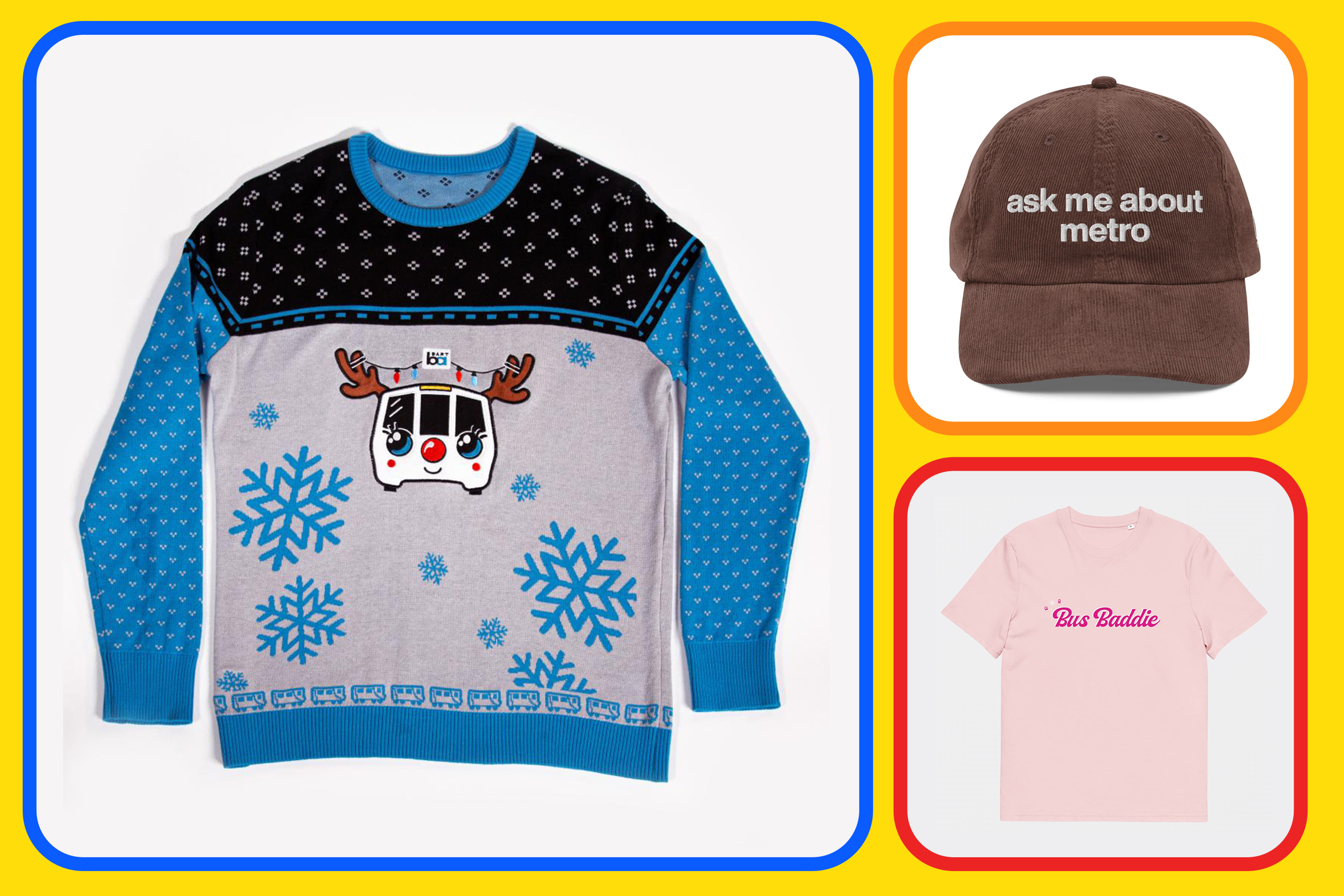
The nation’s transit systems have an unlikely side hustle. The Los Angeles Metro is selling T-shirts that label its riders a Bus Baddie and a Metro Mamí and encourage locals to Ride the D (a suggestive reference to a recent line extension). The NYC Ferry offers hats and shirts that read The People’s Yacht. In Washington, D.C., locals have started wearing the Metro system’s merch like it’s their alma mater. A recent pop-up shop drew some 10,000 visitors with so many offerings that a patron could emerge decked out from head to toe in Metro. “It was mobbed,” Emily Wasek, a think-tank staffer and self-described devotee of D.C.’s Yellow Line, told me. “People were running against traffic in the street to cut in front of people.”
The appetite for transit wear appears to be huge (or at least hugely noticeable on social media). When Amtrak announced a new, limited-edition T-shirt last week featuring trains in the style of superheroes on a movie poster, commenters praised the national rail system for “giving the people what they want.” Then they demanded more.
At their best, transit systems can weave a city’s culture together. As basic public services, however, they are not typically fodder for fashion. But then again, people aren’t ordinarily so isolated from one another, the cost of living isn’t normally this high, and subway systems aren’t usually this savvy at marketing. From talking with transit-wear enthusiasts, I got the sense that a mix of economic and social circumstances has sparked their desire to elevate public transit, an anti-status symbol of sorts, to the front of their clothes. The fact that transit branding tends to have sleek designs and a retro look certainly helps.
Consumers have long made themselves billboards for various brands that don’t necessarily need their help, be it Nike or Costco, and a more cynical take might be that today’s transitphilia really just shows that anything can be commodified.
At the same time, people are not lining up around the block for ride-sharing T-shirts or rental-car Christmas sweaters. Something more substantial is happening here, even if some of the hype might be closer to virtue signalling with an urban-planning bent. Public-transit fans and marketing and design professors I spoke with repeatedly likened transit merch to sports-team apparel: a way for people to signal their ties to a community. With so much talk about affordability and loneliness, a public amenity that physically binds a city together may be the perfect mascot for 21st-century urban life. When people are cheering for a metro system, they’re cheering for connection—even if that connection comes in the form of strangers bumping into one another on rattling cars, 100-something feet beneath the earth.
[Read: Do yourself a favor and go find a ‘third place’]
This may sound like a lot to put on a mere transit system, but conversations about public transportation have a way of getting deep. Samuel Littauer, a 28-year-old in D.C., told me that he sees the subway system as the “great unifier.” At the Washington Metropolitan Area Transit Authority sale, Littauer bought one T-shirt highlighting the system’s modernist architecture and another that shows a vintage Metro bus. He said he hopes that wearing them will allow him to connect with people who love the region like he does. Georgetta Nicol, the director of marketing at WMATA, suggested that the rush for Metro products is linked to a post-pandemic craving to be around others. She (and others I spoke with) were even willing to stretch the definition of third place—which describes spaces outside of home and work where people socialize and build community—to include public transit. One of WMATA’s hats is a bid for social interaction: Ask me about Metro.
For some, an affection for public transit is already a lifestyle of sorts. Wasek hosts a “Metro Gala” each year, where friends dress up as interpretations of Metro stops. The winners for best dressed receive Metro merch. Jerome Horne, who works at the Maryland Transit Administration, owns nearly a dozen public-transit Christmas sweaters (and counting) and maintains a wider collection of transit items that he calls the “International Micro Museum of Transit.” He sees the broad affinity for public transit as part of a resurgence in esteem for public institutions. Transit is also “one of the last places you could go if you’re anyone and just exist,” he told me.
Such appreciation may also be born of changes to how Americans get around: Fewer young people want to drive, cars are expensive, and there may be no more consequential political issue right now than the price of gas. There’s a way in which the rise of transit chic could parallel how recessions can make vintage clothes popular. People are making what they can have trendy. Still, “I think there was always a ‘cool’ there, even if not everyone recognized it,” Horne said.
Public transit occupies a strange, contradictory place in the American psyche. In cities where cars reign, it can be heavily stigmatized. In a few major urban centers, though, it has a kind of cultural cachet. Images of the New York subway are as ingrained in the city’s identity as the Statue of Liberty. The NYC subway map decorates dorm rooms and apartments. Massimo Vignelli’s 1972 redesign, which smoothed the map into a minimalist artwork of straightforward lines and simple labels, is even included in the Museum of Modern Art’s collection, cementing it in design history. The license that Lynne Lambert obtained in the ’90s to produce merchandise with the Metropolitan Transportation Authority’s recognizable colored circles and other logos made the aesthetic into a business (one that’s still running today).
This most recent wave of transit-clothes hype might be traced back to 2021, when Bay Area Rapid Transit, in the San Francisco Bay Area, offered 150 ugly Christmas sweaters for sale online. They were gone in 40 minutes. Eventually, the endeavor earned the transportation authority more than $100,000 in one season. Every year since, BART has offered the signature holiday product and has been joined by a growing number of transit lines in Philadelphia, Toronto, Milwaukee, Chicago, Portland, and more. “It’s now almost become a competition between agencies,” Horne, the sweater connoisseur, said.
Success doesn’t always require tapping the holiday spirit. Many of the items at the D.C. Metro’s recent pop-up were hyperlocal—station-specific hats or quarter-zips color-coded by subway line. Often, systems adapt wayfinding features, such as signs and arrows, into clothing patterns. In Atlanta, the Metropolitan Atlanta Rapid Transit Authority sells “pylon” winter hats that match the blue-yellow-and-orange color scheme used within the system.
Marc Choi, a graphic-design professor at the George Washington University, told me that although wayfinding signs are supposed to be functional and “there but not there,” people build a subconscious relationship with them. In this way, a system’s design features become almost as recognizable as a city’s skyline, but they’re also more personal: They’re the city’s visual language. If you take transit, you’re fluent in it. “People have a very strong relationship with their day-to-day commute,” Choi said. “I think pop-up shops and this merch is just a fun way to channel that.” Sometimes, the offerings go heavy on the fun: Metro sells swimsuits that read Foggy Bottom across the butt. (It’s the name of a station.)
A little personality can give some verve to well-worn systems. But no one is going to buy transit merch if they don’t first enjoy using the system. I was surprised, for instance, to stumble upon a cheerful Christmas sweater for a regional train line that I can describe only as my locomotive nemesis (no thank you). But when the strategy works, it really works. I’ve been given a T-shirt that features a photo of the D.C. Metro’s brutalist “waffle” ceilings not once, but twice. I kept even the second one because I didn’t know how to say I already had it—and because they are both, to use the shirts’ coinage, brutiful.