


There could be more than just ghosts and ghouls lurking in the skies this Halloween! From Saturn’s spectacular rings to shooting stars and even a space station flyover, the night sky has a few treats of its own in store for U.S. skywatchers on Oct. 31.
Based on the latest national forecast, skies will be mainly clear on Saturday evening over most of New York State, northeast Pennsylvania, northern New Jersey and New England as well as a swath of the southern and central Great Plains, central Rockies, a portion of the Pacific Northwest and central and south Florida, as costumed kids arrive at the door looking for candy or some other Halloween treat.
Temperatures will be mostly in the chilly 40s across the Northeast US, upper 50s and 60s for the nation’s midsection, warm 70s to near 80 for the southern US, including Florida and the Gulf Coast, and 40s for much of the western US. Unfortunately, a storm moving across the nation’s heartland may spell rainy skies for parts of Iowa and Nebraska, south to the Gulf Coast.
For those blessed with a generally fair evening, there will be views of mid-autumn stars and constellations plus a bright planet shining prominently in the early evening sky. If you plan to accompany children around your neighborhood, you might want to enlighten them by pointing out some of those objects that will be visible in the sky. Better yet, if you have a telescope, give your visitors a treat of a different kind: Give them a close-up view of some of those celestial sights.
At the top of the viewing list: The lord of the rings
At around 7 p.m. local time, tell your young audience to make a clenched fist with their hands and then hold them out at arm’s length. Now, tell them to go “two fists” up from the east-southeast horizon and they will see a bright star, shining with a yellow-white hue. Now, direct your telescope toward that “star” and when you gaze through the eyepiece, you will not be looking at a star at all . . . but a planet!
Saturn.
And watch out for fireballs!
And for those in the Northeast U.S., a space station!
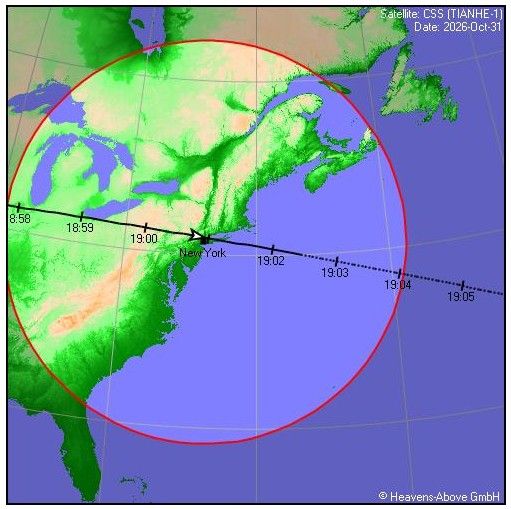
Not the International Space Station, but the Tianhe-1 core module, the first module to launch of the Tiangong space station. It was launched into orbit on 29 April 2021, as the first launch of the final phase of the Tiangong program, part of the China Manned Space Program (Project 921). On Halloween evening, Tianhe-1 will be following a track from Chicago to New York at an altitude of 240 miles (385 km) and should be readily visible to the naked eye across the Northeast US within a few minutes of 7 p.m. EDT, wherever skies are reasonably clear.
The Tiangong Space Station should appear to resemble a very bright star moving across the sky on a general west-to-east course. For places near and along the flight path, the Space Station will appear to pass almost directly overhead. For those situated south of the track, Tiangong will reach its highest point above the northern horizon; those situated north of the track will see the station peak high in the south.
If you see it, tell your young viewers that three astronauts are currently living and working aboard the Tiangong Space Station, of which the Tianhe core module serves as the main living quarters. If you would like specific details on when and where to see the Space Station from your hometown, check out Heavens-Above, a non-profit website and mobile application that tracks satellites, the International Space Station (ISS), comets, and astronomical events in real time.
Another website that provides live information, including an orbit map on Tianhe-1, is NY2O.com. Check its menu list on the right side of the page and look for the blue box: “10-Day Predictions for CSS (Tianhe-1).”
Helpful hints for young telescope viewers
In the September 2019 issue of The Astronomical League Magazine “Reflector,” author Richard W. Schmude Jr., offered some tips for those who plan to do public outreach for astronomy on Halloween:
“Firstly, children sometimes grab or touch the eyepiece, so use an inexpensive one. I gently warn children not to touch the telescope. In my area, parents have learned to tell their children not to touch the telescope. In some cases, a child will grab the eyepiece, causing the telescope to shift. For this reason, a Dobsonian telescope with a good finderscope is a good choice for Halloween outreach. A small stool or booster ladder may help very small viewers. Sometimes, parents hold their children up to look through the eyepiece. One may also place a monitor-connected video camera in the telescope and people can easily see the object on a screen.” “Finally,” adds Mr. Schmude, “I have my bag of goodies next to my telescope so that the children get two treats!”
Whatever your weather, Happy Halloween from all of us at Space.com!
Joe Rao serves as an instructor and guest lecturer at New York’s Hayden Planetarium. He writes about astronomy for Natural History magazine, Sky and Telescope, The Old Farmer’s Almanac and other publications.