All posts tagged: species

New crocodile species found in rocks of Egypt’s Great Sphinx

New crocodile species found in rocks of Egypt’s Great Sphinx

For 4,500 years, the Great Sphinx in Giza, Egypt, has been shrouded in mystery and intrigue. Mysteries still linger and discoveries await deep inside the bedrock of one of Ancient Egypt’s most famous monuments. These discoveries now include a new species of extinct crocodile. And just like the Great Sphinx is missing the tip of its nose,  the fossil crocodile is missing the tip of its snout. The newly discovered species Herugavialis cairensis is described in a study published today in the journal Royal Society Open Science. The Great Sphinx stands at 66-feet-high, with the head of a man and the body of a lion. The lion’s body was used to represent a king as a demonstration of his power in sphinx statues. While we still don’t know exactly who built the Great Sphinx, it was likely carved during the Fourth Dynasty (2613–2494 BCE), during the reign of Khafre. Khafre is known for building the second of the famous Giza pyramids.  Like lions, crocodiles appear throughout Egyptian art and inside tombs. The newly discovered crocodile …

Species Extinction is a Humanist Issue

Species Extinction is a Humanist Issue

It started with either condors or tigers.  I was interested in animals from an early age, and the indelible and existential issue of extinction came to my attention in the early 1980s when I was a high school junior. I did an independent research project and gave a presentation on endangered species with a top-level explanation of the factors that could lead to endangerment and the ways species could be saved from the finality of extinction.  However, like the science of genetics before the early twentieth century grand synthesis of Darwin’s theory of evolution by natural selection with Mendel’s lost study of inheritance and the new science of population genetics, I knew the basic details, what could be seen, but not the mechanisms and drivers of the process. Then I studied biology, genetics, and ecology in college and conservation biology in graduate school. I learned from well-known experts in evolutionary biology, several of them the lights of the 1990s “new atheist” movement, though these old, white men have since become apostates to skepticism, atheism, and …

Congratulations, World: A New Supercute Cat Species Has Been Found

Congratulations, World: A New Supercute Cat Species Has Been Found

In the midst of RAMageddon price hikes and AI doomsday claims, I bring soothing news: A tiny new feline species has been discovered, the first in over 100 years, and it’s amazingly adorable. According to a study published in the Current Biology Journal on Thursday, the spry little feline, who looks ready for a drink out of a nice, heated cat water fountain, is called Leopardus tilcayo and hails from the cloud forests of the Bolivian Yungas in South America. You may know Leopardus from other American cat species, like the ocelot and colocolo. The discovery was made from a collaboration between scientist Jonas Lescroart and Paola Nogales-Ascarrunz, head of the Programa de Investigación de Félidos Bolivia conservation program (among other researchers). They not only spotted this dashing little fellow, but they also made all-new discoveries about tiger cats, including a new subspecies. The researchers didn’t need an AI pet camera to spot the new cat species, although Leopardus tilcayo is even smaller than the common house cat. Nogales-Ascarrunz, whose work is funded by National …

Gabe Newell’s Submersible Uncovers Unknown Species in the Hadal Zone

Gabe Newell’s Submersible Uncovers Unknown Species in the Hadal Zone

Gabe Newell, co-founder of Valve and creator of the gaming platform Steam, has expanded his interests into deep-sea exploration through his marine research organization, Inkfish. His team, equipped with the DSSV Pressure Drop and the submersible Bakunawa, has explored the hadal zone, where pressures exceed 1,000 times those at sea level. Among their discoveries are translucent snailfish, carnivorous sponges and other organisms that defy existing scientific classification, challenging current frameworks for understanding marine biodiversity. Discover the unique adaptations that enable life to thrive under extreme pressure and darkness and learn how seismic activity shapes the ecosystems of the deep ocean. Gain insight into the impact of human pollution on remote marine environments and what these findings reveal about the interconnectedness of global ecosystems. Exploring the Hadal Zone: Earth’s Deepest Frontier TL;DR Key Takeaways : Gabe Newell, co-founder of Valve, leads deep-sea exploration through his marine research organization, Inkfish, uncovering new species and the impact of human activity on remote ecosystems. Research focuses on the hadal zone, the ocean’s deepest region, using advanced vessels like the …

Asexual lizards, virgin births and clones – the all-female species of the animal kingdom

Asexual lizards, virgin births and clones – the all-female species of the animal kingdom

It may sound too bizarre to be true but the Amazon molly (Poecilia formosa), a fish that inhabits rivers, lakes and swamps in Mexico and Texas, exists over much of its range in populations that are 100% female. In 1932, the Amazon molly became the first known vertebrate to reproduce by cloning itself, producing all-female populations. A new genetic study has given scientists insights into the longstanding mystery about how and why this happens. The proportion of females in the human population is roughly 50%. A few countries such as Maldives (38% female) and Moldova (54% female) diverge from this, but these differences can largely be explained due to male immigration and emigration. However, much more dramatic sex ratios are found in the animal kingdom. Kentish plover bird populations, where males care for offspring, comprise only 14% female, and sea turtle populations, where sex is determined by temperature often exceed 75% female. Most animal species reproduce sexually. This involves the fusion of two gametes, the sperm and egg, that develops into an embryo. A process, …

New ladybug species is the size of a grain of sand

New ladybug species is the size of a grain of sand

Get the Popular Science daily newsletter💡 Breakthroughs, discoveries, and DIY tips sent six days a week. Ladybugs are famously harbingers of good luck, and the trait proved consistent at a university in Japan when researchers found a new species of the iconic insect directly on the campus.  Ladybugs, also known as ladybird beetles or lady beetles, consist of the family Coccinellidae within the order of beetles (Coleoptera). The newly identified member is a  black Parastethorus pinicola, and researchers discovered it on a pine tree at Kyushu University’s Hakozaki Satellite. In fact, its species name means “pine dweller.” The identification of the tiny species—barely more than 0.039 inches (or one millimeter) long—occured within the context of a broader study. In a study recently published in Acta Entomologica Musei Nationalis Pragae, two Kyushu University researchers updated the categorization of a group of ladybirds called Stethorini in Japan . Stethorini ladybugs are small and eat spider mites. “I knew that this group of ladybirds often inhabits pine trees. Since there are Japanese black pines growing at the Hakozaki …

Bears Are An Endangered Species

Bears Are An Endangered Species

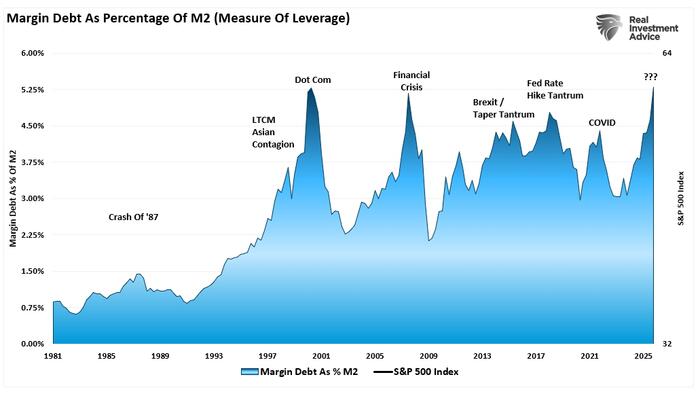
Authored by Lance Roberts via RealInvestmentAdvice.com, 🏛️ Market Brief – Market Volatility Returns Markets ended the week mixed as investors processed the Federal Reserve’s latest policy decision, rising geopolitical tensions, and the early results of the S&P 500 earnings season. The Fed held the federal funds rate steady at 3.50–3.75 percent, as expected. Chair Jerome Powell maintained a neutral stance, noting that inflation is moving toward the target, but the labor market remains tight enough to avoid immediate policy shifts. There was no indication of a near-term rate cut, but Powell left the door open for adjustments later in the year if inflation continues to ease and economic activity slows. The most notable event this week was President Trump’s nomination of Kevin Warsh to succeed Jerome Powell as Federal Reserve Chair. Warsh is viewed as more hawkish, favoring a tighter monetary stance. That nomination led to the most striking market development this past week as precious metals prices collapsed. Silver futures dove over 30% on Friday to settle near $84.63 an ounce, marking one of the largest one‑day drops since …

10 vulnerable wildlife species to watch in 2026

10 vulnerable wildlife species to watch in 2026

Get the Popular Science daily newsletter💡 Breakthroughs, discoveries, and DIY tips sent every weekday. With the turning of the calendar comes a new year and new vulnerable endangered plant and animal species to keep a watchful eye on. As the planet’s biodiversity continues to face enormous amounts of pressure, international nature conservation charity Fauna & Flora is launching its 2026 Species to Watch list.   The list brings together science with field experience and frontline conservation and spotlights some of the world’s most extraordinary and highly threatened species. “Our annual Species to Watch list offers insight into the key challenges facing some of the world’s most vulnerable species, including habitat loss, deforestation, illegal wildlife trade and climate change,” said Kristian Teleki, the CEO Fauna & Flora. “But it also shines a spotlight on the weird and wonderful plants and animals we are working to protect, and on the inspiring people and partners Fauna & Flora works with across the globe to deliver effective conservation action. In challenging times, it stands as a beacon of hope.”  Fauna …