All posts tagged: speak

Speak at Your Own Risk

Speak at Your Own Risk

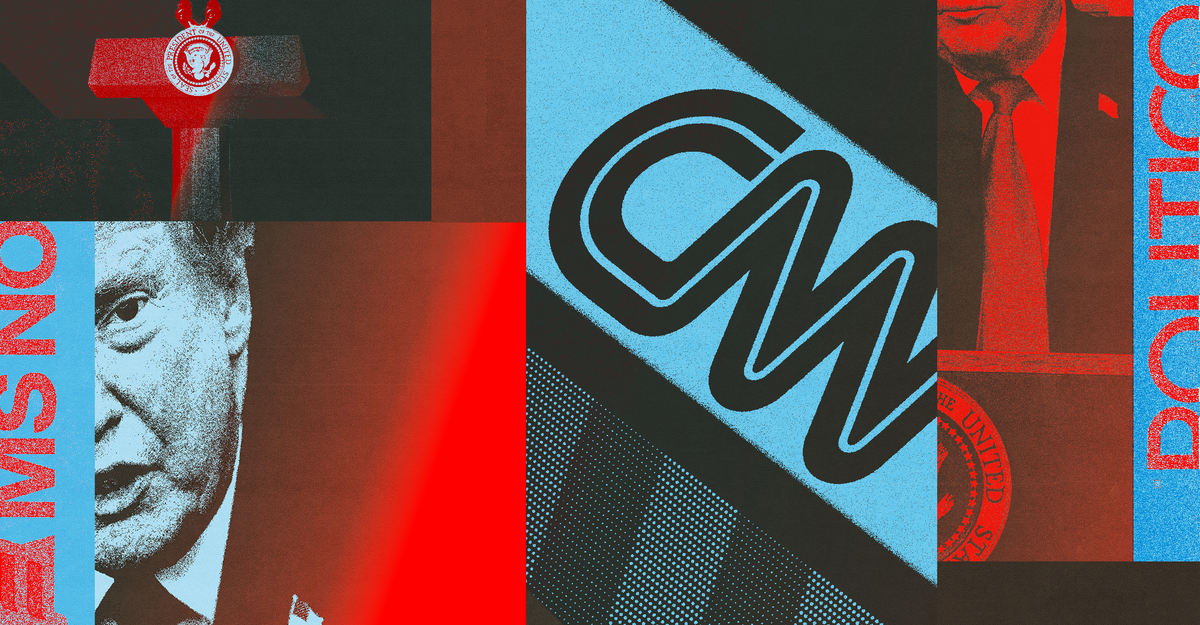
On the first day of his second term in the White House, President Trump signed an executive order on free speech stating that his administration would ensure that “no Federal Government officer, employee, or agent engages in or facilitates any conduct that would unconstitutionally abridge the free speech of any American citizen.” He has gone on to violate that order many times. Trump announced today on his social-media network, Truth Social, that he is banning CNN, MS NOW, and Politico from the White House in retaliation for their reporting, and complained that “outlets shouldn’t be able to constantly write or report FICTION and LIES when they’re covering the President of the United States, the Trump Administration, or the United States of America.” In other words, if media outlets publish stories that Trump does not like, he will punish them. This is far from the first time Trump has tried to pressure the media into giving him favorable coverage or punish those who run stories he does not like. As The New York Times has documented, …

Your Dog Presses a Button and … Poof! He Can Speak?

Your Dog Presses a Button and … Poof! He Can Speak?

At the McGill Office for Science and Society, science communicator Jonathan Jarry takes after a long overdue target — claims that animals are being taught (or even can be taught) to speak. He asks, “On social media, dogs press buttons that talk for them. But can they even make out the words coming out of these speakers?” Buttons on the floor Bunny, a sheepadoodle, is also a social media celeb with 8.5 million TikTok followers. Using the buttons on the floor, she can signal humans about various matters. “Dog parents” are buying these buttons at US$16 each, hoping to communicate with their pets at a deeper level than the ones we take for granted: The way they work is simple. The human records themselves saying a single word into the button’s microphone—practical words like “OUTSIDE” and “PLAY”, but also more abstract ones like “STRANGER” and “SAD”—and train their dog to tap it when that is what they want. When pressed, the button plays back the owner’s recorded word on its built-in speaker, giving the dog …

How to Listen and Speak to Symptoms in Psychotherapy

How to Listen and Speak to Symptoms in Psychotherapy

This post is Part 4 of a series. There are certain types of psychotherapy that, unlike cognitive behavioral therapy (CBT) or dialectical behavior therapy (DBT), consider signs and symptoms to be a way of communicating with ourselves and others and, therefore, encourage patients to carefully listen to what such sometimes seemingly senseless phenomena might have to say about how we are really feeling and what we can do if we wish to feel better. Here are a few examples. Gestalt therapy Famed and flamboyant psychiatrist and Gestalt therapist Frederick “Fritz” Perls (1893-1970) considered symptoms to be the consequence of “unfinished business” (i.e., unexpressed, suppressed, or unresolved emotions or impulses of which we are unaware that manifest themselves in sundry symptoms and signs). His rather theatrical, dramatic, and existential approach to such affective or somatic symptoms might be to encourage the patient to become more keenly aware in the present moment of what and how they are physically and emotionally experiencing the symptom as it is happening right now—sometimes urging them to intentionally amplify or exaggerate …

Descendants of the enigmatic Shabbatai Sevi (1626-76) finally speak

Descendants of the enigmatic Shabbatai Sevi (1626-76) finally speak

This is the first book of its kind written from within the tradition. Publishing on October 6, 2026, Uluc Ozuyener’s Born in Secrecy—Maaminim: The Practical Kabbalah of Shabbatai Sevi (Paperback original, ISBN 978-1966608516, 350 pages, $35.00) tells a remarkable story never-before heard firsthand. This the first book of its kind written from within the tradition.  Shabbatai Sevi (1626–76) was a 17th-century Ottoman Jewish rabbi and kabbalist who claimed to be the long-awaited Jewish Messiah, inciting a massive, worldwide messianic movement. Forced to convert to Islam in 1666 to avoid execution by Sultan Mehmed IV, his public actions then caused widespread disillusionment. Yet he maintained a clandestine following. Ozuyener tells the fascinating story of belief, culture, ritual, and the descendants—called Maaminim—who continued to carry the spark of faith in the enigmatic Sevi behind closed doors, through gestures and coded language.  Ozuyener’s book is both a personal journey and scholarly exploration—to reveal how a faith could survive, and even flourish, through exile, contradiction, and concealment. It weaves together theological analysis, archival research, Ladino hymns, Zoharic commentary, and …

American Psychological Association’s Actions Speak Louder Than Its Apology

American Psychological Association’s Actions Speak Louder Than Its Apology

Written by Germine Awad, Ph.D. and Kevin Cokley, Ph.D. This week, the American Psychological Association (APA) informed members of the Commission on Ethnic Minority Recruitment, Retention, and Training in Psychology (CEMRRAT) that it has been disbanded. This recent action calls into question APA’s commitment to increasing the recruitment, retention, and training of psychologists of color. The Significance of CEMRRAT CEMRRAT was established in 1994 after the APA designated ethnic minority education as a priority, with the goal of improving the recruitment and retention of ethnic minorities and addressing systemic barriers to their participation in psychology. CEMRRAT has been important because it devoted resources toward the advancement of ethnic minority issues. For example, historically, CEMRRAT has awarded implementation grants and seed funding to organizations, institutions, and individuals to support projects related to (a) recruitment and retention, (b) multicultural training, (c) mentorship and development, (d) innovation projects, and (e) data and research. CEMRRAT was also known for producing several popular documents designed to support, recruit, and retain faculty of color. These documents included “Surviving and Thriving in …

What Shapes Your Words Before You Speak

What Shapes Your Words Before You Speak

There are moments when something is said, or something happens, and you feel the response almost immediately. It frequently arises before a thought is formed, noticeable as a slight shift in your body. Perhaps a tightening, a change in breathing, a sense of movement in one direction before you’ve consciously chosen it. Often, the words begin to form just as quickly. I’ve noticed this most clearly in conversations that matter to me, where I can feel the response bubbling up before I’ve decided what I want to say. Most of us are familiar with this experience, but what we tend not to notice is how little time we spend with it. We move from that first internal shift into speech or action almost seamlessly, and only afterward, minutes or sometimes hours later, do we recognize that what we said did not quite reflect who we are or how we would have chosen to respond if we had been more fully present. It is tempting to think of this as a problem of language, and for …

Why some people speak up against prejudice, while others do not

Why some people speak up against prejudice, while others do not

When people encounter racism or discrimination, they don’t all respond in the same way. Some calmly challenge the remark, some file a complaint, others confront the offender aggressively – and many say nothing at all. A common assumption is that speaking up against discrimination is a matter of personal courage, political ideology or education. But my recent research suggests that people’s cultural values, shaped by their backgrounds and life experiences, strongly influence how they confront discrimination. Confrontation comes in very different forms. Some choose to confront non-aggressively (such as calmly pointing out prejudice, explaining why it is offensive or sharing how it impacts them emotionally). Others prefer relatively more aggressive confrontation (such as shouting back, threatening or physical retaliation). These responses carry different risks and consequences, both for the person confronting and for wider social relations. My recent study with colleagues Thomas Kessler and Ayşe K. Uskul looked at how people’s cultural views of honour affected how they might respond to an insult or discrimination. Honour is often misunderstood as a personal trait or a …

Jeff Bezos Needs to Speak Up

Jeff Bezos Needs to Speak Up

When the government stomps on some once-inviolable right, it may be carrying out the next step in a concerted plan, or it may just be stumbling clumsily. The proper response in these moments is not to wax hysterical, but instead to draw clear moral lines. That is especially true for powerful people with the ability to make themselves heard. This morning, FBI agents searched the home of the Washington Post reporter Hannah Natanson and seized her devices, allegedly as part of a leak investigation targeting sources she had covered. Journalists are supposed to enjoy legal protections from raids such as this, because courts have recognized that if the government could treat them as criminals for acquiring nonpublic information, their work—protected by the First Amendment—would become impossible. Gray areas do exist, and previous administrations have often tangled with the media over where to draw the line between legitimate investigations of important government secrets and impingement upon the free press. Depending on what facts the FBI produces, the raid of Natanson’s home may lie within that traditional …

When They Speak of Our Time

When They Speak of Our Time

Speech delivered at the No Kings protest at the Lexington Common, MA, October 18, 2025. Good morning to all. My name is Regie Gibson and I am the Inaugural Poet Laureate of the Commonwealth of Massachusetts. I always feel it necessary to say the Commonwealth of Massachusetts in my title. For me, that word: Commonwealth, has resonance – a community convened to promote the common good. But the word commonwealth is only a word. And words don’t have meaning. Words are grunts, sounds, expectorants tions of air we shape with tone and pitch. Words have no meaning. What gives them meaning in when they are embodied and instantiated manifested and womanifested through human action. And this is important because we are a Constitutional Republic – a community held together by a document – a document made of words. And, if those words are to have meaning it is up to us to create it. When I think of how we got here to this place of desolation it’s easy to blame MAGA and Washington. And, …

How generative AI could change how we think and speak

How generative AI could change how we think and speak

There’s no doubt that artificial intelligence (AI) will have a profound impact on our economies, work and lifestyle. But could this technology also shape the way we think and speak? AI can be used to draft essays and solve problems in mere seconds that otherwise might take us minutes or hours. When we shift to an over-reliance on such tools, we arguably fail to exercise key skills such as critical thinking and our ability to use language creatively. Precedents from psychology and neuroscience research hint that we should take the possibility seriously. There are several precedents for technology reconfiguring our minds, rather than just assisting them. Research shows that people who rely on GPS tend to lose part of their ability to form mental maps. London taxi drivers once memorised hundreds of streets before the advent of satellite navigation. These drivers developed enlarged hippocampi as a result of this. The hippocampus is the brain region associated with spatial memory. In one of his most striking studies, the Russian psychologist Lev Vygotsky examined patients who suffered …