All posts tagged: shipping

Tanker Rates Nearly Halve As Hormuz Shipping Normalizes

Tanker Rates Nearly Halve As Hormuz Shipping Normalizes

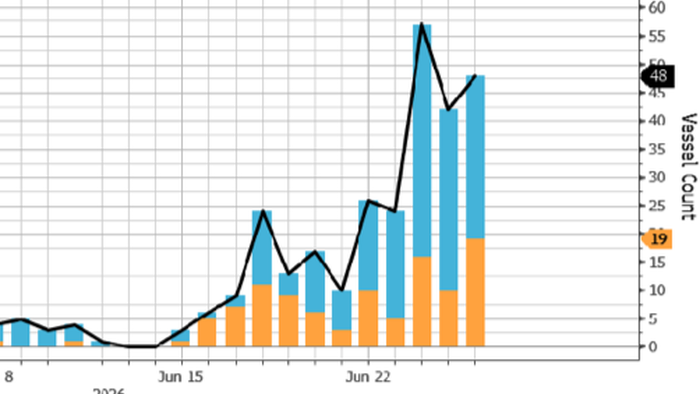
The recent spike in the cost to hire a supertanker carrying 2 million barrels of crude from Saudi Arabia to China is now being sharply reversed, as more shippers send vessels through the Strait of Hormuz and normalization trends continue to improve. Bloomberg reports that tanker rates for the Saudi Arabia-to-China route tumbled to about $287K on Friday, down 44% from more than $514K on Tuesday. That data came from the Baltic Exchange. Rates remain elevated and still highly profitable for owners, but the sharp drop late in the week suggests the market is beginning to normalize after an interim U.S.-Iran peace deal reduced the war risk premium around the Hormuz chokepoint. Early movers certainly capitalized on lofty rates last week. According to Bloomberg data, 48 vessels have transited the narrow waterway on Friday, though that does not include ships that switched off their transponders. By the end of the week, Brent crude fell below $72 per barrel, while WTI traded around $69, hovering near pre-war levels. A late Thursday note from Arrow Shipping & …

DHL explores familiar shipping option: wind power

DHL explores familiar shipping option: wind power

Get the Popular Science daily newsletterđź’ˇ Breakthroughs, discoveries, and DIY tips sent six days a week. By signing up, you confirm you are 16+, will receive newsletters and promotional content and agree to our Terms of Use and acknowledge the data practices in our Privacy Policy. You may unsubscribe at any time. Your next fancy face cream or bubbly bottle of imported wine may have made its trip across the Atlantic Ocean on a massive sailboat.  Starting next year, international shipping giant DHL plans to transport certain products from Europe to the United States using a new wind-powered vessel designed by French startup VELA. But the 220-foot-long sailboat is a marked step up from Viking longships or the Mayflower in 1620. Inspired by yacht racing, the modernized craft is made primarily of aluminum and carbon fiber and travels at around 14 knots, or roughly 16 miles per hour. Its trimaran (three-hulled design) increases stability and helps it cut through open ocean swells. Though an improvement from sailboats of previous generations, VELA’s massive ship isn’t exactly …

Juiced Bikes now shipping its game-changing electric mopeds in the US

Juiced Bikes now shipping its game-changing electric mopeds in the US

Juiced Bikes says its newly launched Scrambler e-bikes are now officially in stock and shipping, marking the next step in the brand’s return after its acquisition and relaunch under the team behind Lectric eBikes. The announcement comes just weeks after Juiced unveiled the new Scrambler Hardtail and Scrambler Full Suspension models, two moto-style electric bikes that represent the company’s first major product launch since returning to the market. The pre-order period appears to be over, and customers can now actually order and receive the bikes rather than simply reserve them. It also serves as another sign that Juiced’s comeback is moving forward quickly. Earlier this month, we covered the relaunch of Juiced and its new Scrambler lineup, which appears to borrow heavily from the same value-focused strategy that helped turn Lectric eBikes into the biggest name in the North American e-bike industry. The new Scrambler models stay true to Juiced’s performance-oriented roots. Both bikes feature a 750W nominal rear hub motor paired with a genuine 30-amp controller, allowing peak power to exceed 1,700 watts. Riders …

Wind-assisted cargo ships could more than halve shipping emissions

Wind-assisted cargo ships could more than halve shipping emissions

The shipping industry is responsible for around 3 per cent of carbon dioxide emissions, and those emissions are growing – but adding high-tech sailing gear to cargo ships and greater use of wind-favourable shipping routes could cut them by more than half. There is growing interest among shipping companies in exploiting wind power, as it can help cut fuel costs. A wide variety of approaches are being explored. Some companies are building ships with conventional sails from scratch. Others are adding various kinds of automated sails to existing vessels. The technologies include rigid sails resembling aircraft wings, Flettner rotors consisting of rotating cylinders, suction sails that suck in air to maximise lift and even giant kites similar to those used by kitesurfers. “There is a whole spectrum of wind propulsion vessels,” says Gavin Allwright of the International Windship Association, ranging from limited wind-assisted vessels through to those that get more than half of their power from wind. Some wind-assisted ships are still operated like conventional ships, taking a direct route at a set speed, so …

Shipping Antimatter by Truck to Understand the Universe

Shipping Antimatter by Truck to Understand the Universe

A truck makes a historic trip around CERN’s facility on the France-Switzerland border, transporting the world’s most expensive material for the first time. The antimatter inside is made by CERN’s enormous particle accelerator, and then antimatter particles are decelerated and captured for storage, shipment and study. Antimatter is the mirror opposite of matter. The particular type of antimatter transported was 92 antiprotons, the negatively charged equivalent to the positively charged protons found in regular matter. This perplexing and precious material could hold the key to unlocking some of the largest looming mysteries remaining in physics, going back to the origins of our universe. When matter and antimatter meet, they annihilate, turning most of their mass into pure energy. This reaction is the stuff of science fiction, powering spaceships and super weapons. However, with current technology, it would take billions of years to acquire enough antimatter to do any serious damage. Annihilation is routine at CERN’s antimatter factory, happening on a small scale with individual particles and showing up as a line on a graph (pictured …

Asia Pacific Maritime 2026 spotlights next-energy technologies and innovation

Asia Pacific Maritime 2026 spotlights next-energy technologies and innovation

Asia has become a strategic crossroads in energy transition. The region is home to major shipbuilding nations, emerging electric vessel markets, offshore operators, energy exporters, classification societies and financial centres – all the players needed to take next‑energy technologies from concept to open water. The region is also where some of the first commercial-scale electrification and hybridisation projects are being launched. For example, the Coastal Sustainability Alliance (CSA) – a Singapore-based industry initiative aimed at decarbonising the maritime industry – has delivered Voltai, Singapore’s largest electric supply boat, and is pioneering a milk run trial designed to consolidate deliveries and reduce emissions.  Additionally, CSA is delivering its second e-vessel: Singapore and Southeast Asia’s first fully electric tug. Insights from these CSA projects, ongoing trials and critical enablers for scaling marine electrification will be highlighted at APM 2026. The conference will feature close to 100 industry experts who will speak on practical solutions that can optimise vessel operation. The keynote session, The Maritime State of Play and What’s Next for Asia, will examine how new regional …