All posts tagged: Myth

The unpopular truth about the myth of the lone genius

The unpopular truth about the myth of the lone genius

History keeps lying to you about how breakthroughs happen. Mendeleev didn’t dream up the periodic table, Einstein wasn’t riding a beam of light, and Darwin wasn’t a lone visionary on a boat  David Epstein argues that the myth of the lone genius is a story we tell, but the actual history of innovation is far more interesting. This video The unpopular truth about the myth of the lone genius is featured on Big Think. Source link

The truth behind the ‘runner’s waist’ myth

The truth behind the ‘runner’s waist’ myth

Experts are debunking the viral myth that claims running makes your waist bigger. Fitness influencers and social media trolls alike have taken over online discourse with declarations that running as exercise can have an adverse effect to working out by building thicker muscles in the midsection, making the torso more boxy — which would make it more difficult to achieve an hourglass figure. However, science proves that running regularly does not typically cause muscle gain in the midsection. Although running engages your core muscles, including the obliques, the aerobic exercise does not work the muscles in a way that would make them bulky or oversized, according to a medically reviewed article by Healthline. Building a muscle, which is called hypertrophy, often takes specific and consistent work, meaning that it is unlikely that you would grow abdominal and oblique muscles by accident. Runner’s waist is a myth, according to experts (Getty Images) Going into hypertrophy is achieved by working with heavy resistance like weights, and building up intensity. On the other hand, running is known as …

The Violence Myth – TheHumanist.com

The Violence Myth – TheHumanist.com

Religious violence is often presented as a distinct, more dangerous category of violence—one that flows from absolutist beliefs, irrational passions and primordial hatreds. Humanists have sometimes accepted this framing, opposing themselves to “religious fanaticism” in the name of rational peace. Yet this dichotomy is deeply misleading: Violence labeled “religious” is typically co-produced by multiple institutional spheres—polity, economy, law, kinship—as well as religion and its narratives. A humanist analysis committed to clear thinking and equal concern for all persons cannot afford to ignore these institutional entanglements. From this perspective, the “myth of religious violence,” as described by William Cavanaugh, is not merely a conceptual error; it is a moral and political problem. It legitimates the secular nation-state as rational and peacemaking, while casting religious others—often Muslims—as uniquely prone to irrational violence. A humanist ethics grounded in universal dignity should resist this asymmetry, subjecting both “religious” and “secular” violence to the same critical scrutiny. Consider for a moment that when a bomb hits a mosque, a synagogue or a church, people often call it “religious violence.” When …

The false urgency myth, and why we confuse busyness with importance

The false urgency myth, and why we confuse busyness with importance

Excerpted from Anchored, Aligned, Accountable: A Framework for Transcending Bullsh*t and Transforming Our Lives and Work by Aiko Bethea. Published by Random House. Copyright © 2026. All rights reserved. You may have heard about our culture’s or workplace leaders’ strong action bias. We like to do things, not reflect on them. But a false sense of urgency is different, and the distinction is important. For one, action bias is not always bad — sometimes things genuinely need to get done, not waffled over. Project timelines are real, and deadlines and milestones are meaningful. If you don’t get that tax return in on April 15, the IRS is gonna want a word, right? But a false sense of urgency is never a positive, because it’s false. It’s built on empty ideas like “the earlier the better, the faster the better, the sooner the better.” None of these are honest declarations or conclusions drawn based on what a project or goal might actually need. In many ways, they’re grounded in a scarcity mindset about time. The result …

Why the dangers of Mythos AI may be a myth | Science, Climate & Tech News

Why the dangers of Mythos AI may be a myth | Science, Climate & Tech News

👉 Listen to This Is Why on your podcast app 👈 AI giant Anthropic has chosen not to release its latest model, Mythos Preview, to the public. The product was pulled after testing showed its unprecedented strengths in hacking. Instead, Mythos has been made available to a small number of big tech companies, including Amazon and Microsoft, to help protect their software, rather than pick it apart. So, has the day arrived which many have feared – where AI could change the world as we know it? Or are the scare stories around Mythos merely a myth? Niall is joined by Rowland Manthorpe, technology correspondent at Sky News, to discuss the potential dangers as well as how safe the UK is from the threat of AI. Have you got a question for Niall? Email the show – [email protected] Source link

This AI Warning Is A Myth; The Danger Is Not…

This AI Warning Is A Myth; The Danger Is Not…

Authored by Kay Rubacek via The Epoch Times, You know this story. Drop a frog into boiling water, and it will scramble out immediately. But place that same frog in cool water, heat it slowly, and degree by degree, it will never notice the danger until it is too late. Most of us accept this without question. The problem is that the story is not true. It traces back to a German physiologist named Friedrich Goltz, who in 1869 conducted a series of experiments with a rather unusual purpose: to determine whether the soul resided in the brain or the spinal cord. He removed portions of a frog’s brain and observed what the animal could no longer do without it. He found that a frog without its brain would sit placidly in slowly heating water and not attempt to escape. However, a normal frog, with its brain intact, would feel the rising temperature and get out. That finding was passed around over the decades that followed, stripped of its context, and reshaped into the cautionary tale …

Mark Gatiss: ‘The British used to take comfort in the myth that fascism was not to our taste’

Mark Gatiss: ‘The British used to take comfort in the myth that fascism was not to our taste’

I’m a natural optimist… but that’s taken a pounding,” says Mark Gatiss. That might not be surprising given he’s spent the past few weeks preparing to play Adolf Hitler. Well, not technically Hitler. Gatiss, the writer and actor known for TV favourites including Sherlock, Doctor Who and The League of Gentlemen, is donning a toothbrush moustache for a revival of The Resistible Rise of Arturo Ui – Bertolt Brecht’s 1941 parable that reimagines the führer as a vegetable-peddling mobster in 1930s Chicago. Written in two weeks, the play charts Arturo’s rise to power, with events closely mirroring Hitler’s ascent. It is, says Gatiss, “like a big sketch – it’s deliberately cartoony. It’s like if someone suddenly wrote a big play about Trump trying to seize Greenland. But there are parts of it that are chilling.” Arturo Ui is directed by Seán Linnen for the Royal Shakespeare Company; hence, Gatiss speaks to me over video from Stratford. He begins our interview by wafting a sprig of flowers in front of the screen. “I’m just going to …

The books that created the César Chávez myth — and those that brought him down

The books that created the César Chávez myth — and those that brought him down

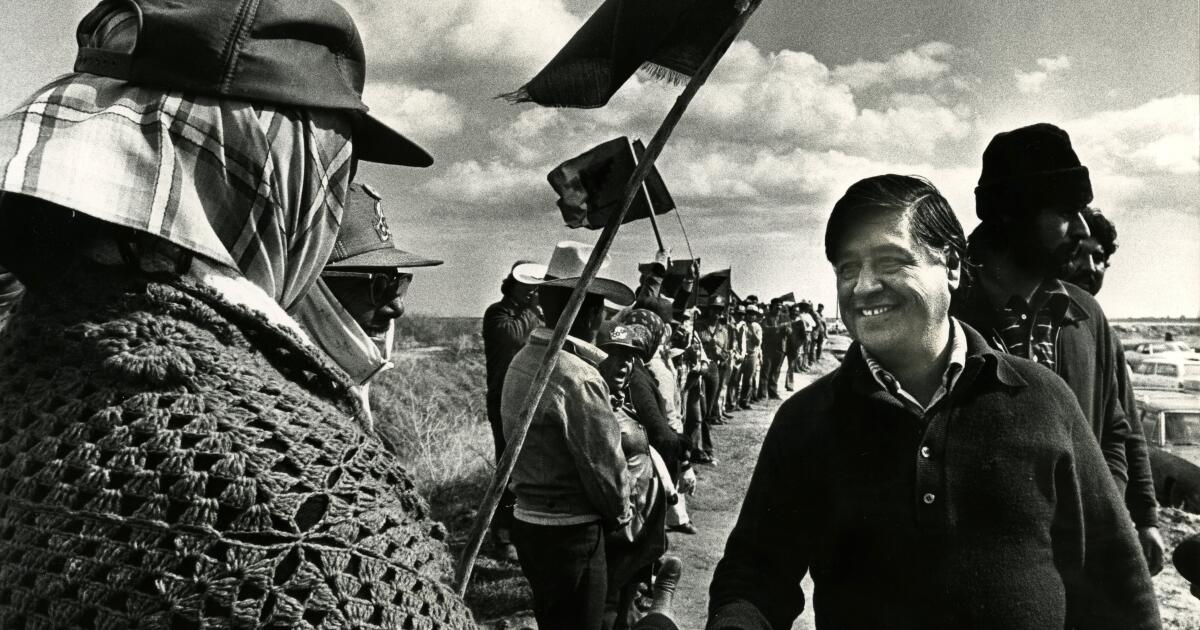
Covered marquees. Downed statues. Painted-over murals. A canceled holiday. California has effectively exorcised César Chávez from the public sphere just weeks after a New York Times investigation found two women who said the legendary labor leader sexually assaulted them when they were teenage girls in the 1970s. Just as explosive was the revelation by his longtime lieutenant, Dolores Huerta, that he raped her in the 1960s. My prediction for the next place we’ll see a Chávez purge: books about him, which number into the dozens and span from academic treatises to children’s tales. But before critics relegate those texts to the banned section, folks should read some of them to see how writers helped establish the Chávez myth and propagated it for decades. The books that created the Chávez legend The tendency to elevate him above other activists was there from the start. In 1967, John Gregory Dunne published “Delano: The Story of the California Grape Strike,” which saw the author (and husband to Joan Didion) capture the essence of el movimiento in its earliest …

Rasputin: Untangling the man from the wild myth

Rasputin: Untangling the man from the wild myth

Grigory Rasputin has long occupied a peculiar corner of the historical imagination. In popular culture he appears as a kind of pantomime villain: a hypnotic monk with burning eyes, drunkenly staggering through the palaces of St Petersburg while manipulating a feeble Tsar and seducing half the Russian aristocracy. Antony Beevor’s brilliant new biography, Rasputin: And the Downfall of the Romanovs, sets out to disentangle the man from the legend. What emerges is not only the story of one extraordinary individual, but also a deeply felt portrait of a ruling dynasty so frightened, isolated and dysfunctional that it placed its faith in a wandering Siberian mystic. Rasputin’s story begins far from imperial splendour. He was born in 1869 in the bleak Siberian village of Pokrovskoe, a settlement on the banks of the River Tura where mud, timber houses and livestock defined the landscape. His father, Efim, was a poor but hardworking peasant who farmed, fished and occasionally drove carts along the post road linking Tobolsk and Tyumen. Nothing about Rasputin’s early life suggested he would one …

The myth of the high-tech heist

The myth of the high-tech heist

The low-tech Louvre maneuvers were in keeping with what heist research long ago concluded. In 2014 US nuclear weapons researchers at Sandia National Laboratories took a detour into this demimonde, producing a 100-page report called “The Perfect Heist: Recipes from Around the World.” The scientists were worried someone might try to steal a nuke from the US arsenal, and so they compiled information on 23 high-value robberies from 1972 to 2012 into a “Heist Methods and Characteristics Database,” a critical mass of knowledge on what worked. Thieves, they found, dedicated huge amounts of money and time to planning and practice runs—sometimes more than 100. They’d use brute force, tunneling through sewers for months (Société Générale bank heist, Nice, France, 1976), or guile, donning police costumes to fool guards (Gardner Museum, Boston, 1990). But nobody was using, say, electromagnetic pulse generators to shut down the Las Vegas electrical grid. The most successful robbers got to the valuable stuff unseen and got out fast. Last year a heist cost the Louvre €88 million worth of antique jewelry, and …