All posts tagged: fish

Best barbecue tips from top chefs for fish, meat and vegetables

Best barbecue tips from top chefs for fish, meat and vegetables

There is a point in every barbecue when enthusiasm gives way to mild panic. The coals are either refusing to get hot or suddenly capable of cremating dinner, the fish has welded itself to the grill and somebody has remembered, slightly too late, that vegetables need cooking too. Fortunately, the people who cook over fire for a living have a few better ideas. This September, Borough Market is staying open after hours for Flame & Smoke, bringing together its chefs, traders and restaurateurs for an evening of live-fire cooking. Taking place on Thursday 10 September from 6.30pm to 9.30pm, the event will feature demonstrations spanning grilling, roasting, smoking and charring, alongside specially created small plates to eat as you go. Ahead of the event, five of the Market’s fire-cooking experts share the techniques worth stealing for your own barbecue – including why hotter coals are not always better, how to stop fish drying out and why the vegetable drawer deserves considerably more attention. Dom McCourt, butcher at Northfield Farm: Treat flame as an ingredient Northfield …
Why we’re all hooked on tinned fish

Why we’re all hooked on tinned fish

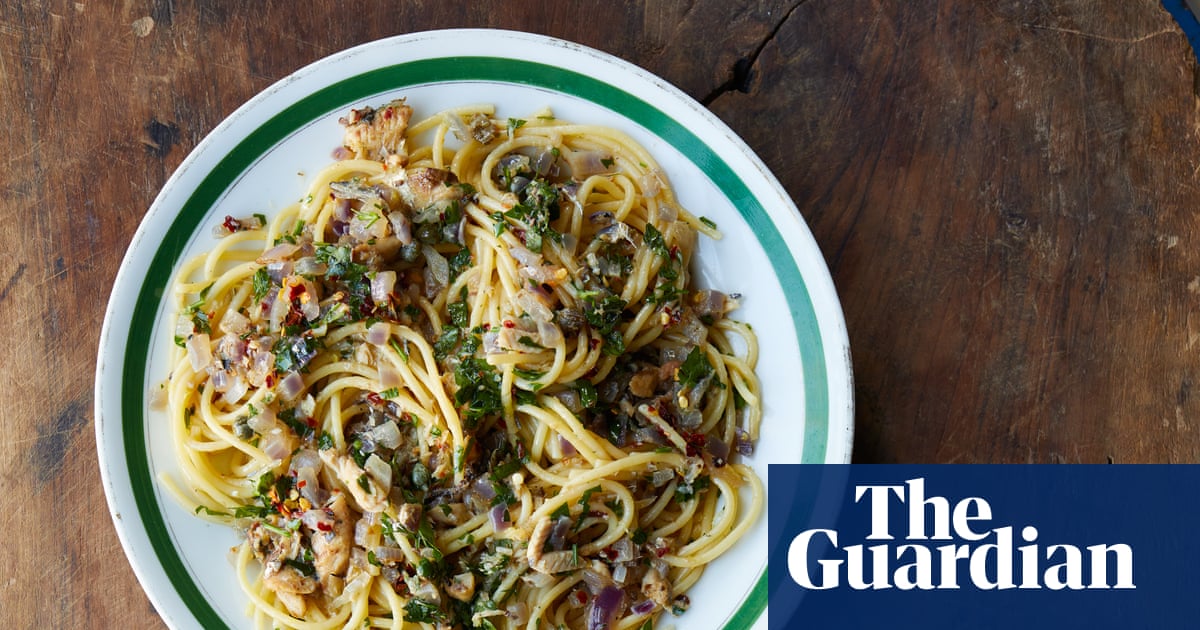
I can’t find it, despite having spent the past 35 minutes looking, but somewhere in the house is The Crisis Cook Book. It’s a standard paperback, postbox-red with white writing on the cover, and full of recipes from chefs including Rowley Leigh, Heston Blumenthal and Jeremy Lee. Not having found it, I needed Amazon to tell me it was published in 2007 and compiled by Nick Lander, at the time the Financial Times’ restaurant correspondent. He asked 28 chefs to donate three recipes – their favourite starter, main course and dessert – and proceeds from the book went to the national homelessness charity Crisis. The reason I needed (and still need – it is now a mission) to find the book is because inside it is Rowley’s recipe for pasta with tinned sardines, fennel, chilli and lemon zest. It’s a recipe that I have made so many times, and for so many years, that I don’t need to look at the book; but, equally, because I’ve made it so many times and so much time …

A promising tale from Senegal of fish, rice and snails

A promising tale from Senegal of fish, rice and snails

Researchers net tilapia, which they’ll transport to the paddies of a rice farm in the Senegal River Valley. Ricci Shyrock for NPR hide caption toggle caption Ricci Shyrock for NPR Momy Seck Ndao has been planning for this day for months. The environmental engineer is standing beside two swimming-pool sized ponds, each lined with a black tarp and full of hundreds of tilapia. Two of her colleagues trudge through the pond in waders, trying to corral the fish with a net. “For this project, we need a lot of tilapia, about 1,900,” says Ndao, as she eyes the horizon. They’re in a race against the rising sun. It’s still relatively low but will soon heat this part of the Senegal River valley to about 100 F, hot enough to bake the fish on the way to their final destination — a rice field. There, these tilapia — and a handful of other fish — are the key ingredients in an ambitious experiment. Ndao and her colleagues are trying to see if adding fish to rice …

El Niño Is Already Wreaking Havoc on Pacific Fisheries

El Niño Is Already Wreaking Havoc on Pacific Fisheries

We’re not even one month into “super” El Niño, the natural Pacific weather pattern characterized by warmer-than-average sea surface temperatures, and fisheries around the world are already getting scrambled. In Peru, government officials have effectively canceled the fishing season for anchovies, one of the country’s most important exports and a leading source of fish oil and animal feed globally. The Indian government is preparing for a season of smaller, less plentiful Indian mackerel. Meanwhile, in Southern California, recreational and commercial fishers have reported some of the most successful months of tuna fishing they’ve ever seen. The divergent situations show how El Niño can create winners and losers across the fishing industry, decimating some species while making others easier to catch. For fishers, the result is instability, with many forced to consider seasonal diversification. And consumers can expect fluctuations in the price of key fish products. “People are worried,” said Juan Carlos Sueiro, an economist and fisheries director for the nonprofit Oceana Peru. As climate change is expected to drive more frequent, stronger El Niños, “our …

Conservationists Install Artificial Reefs Where Corals Once Stood

Conservationists Install Artificial Reefs Where Corals Once Stood

new video loaded: Conservationists Install Artificial Reefs Where Corals Once Stood Miles of coral reef around Pom Pom Island in Malaysia have been ruined by climate change and blast fishing. A conservation group hopes to restore the area by installing concrete structures that mimic natural reefs. By Jon Hazell and Axel Boada May 26, 2026 Source link

Natural sunscreen found in fish eggs can be made by E. coli factories

Natural sunscreen found in fish eggs can be made by E. coli factories

A compound that protects transparent fish eggs from the sun’s rays has been produced in the lab by genetically altering bacteria to create so-called microbial cell factories. Easier production of gadusol brings the chemical one step closer to use as a more eco-friendly, transparent sunscreen for humans. Gadusol is found in the eggs of zebrafish, salmon and sturgeon, as well as coral, where it protects organisms from ultraviolet damage. But it’s only found in small quantities so extracting it from organisms for use as a sunscreen is impractical. A team led by Ping Zhang at Jiangnan University, China, inserted genes from zebrafish into the bacterium Escherichia coli to give it the enzymes needed to synthesise gadusol. Then, by using small RNA molecules to dial up gadusol production in the bacteria and tweaking their growing conditions, they increased the yield by nearly 93 times, from 45.2 milligrams per litre of liquid growth medium to 4.2 grams per litre. In experiments, gadusol displayed antioxidant properties comparable to vitamin C, suggesting it may help neutralise free radicals that …

Why spring smells like semen and rotting fish

Why spring smells like semen and rotting fish

Get the Popular Science daily newsletter💡 Breakthroughs, discoveries, and DIY tips sent six days a week. Ah, spring. The sun is out, the streets are humming, the days are getting longer, and the air smells like… like… um… say, can anyone else smell that? It’s not just me, right? Right?? It’s not just me. All over America, spring is getting smellier every year, and the culprit is the Bradford pear, a tree that gained popularity in the mid-20th century for its ornamental properties. But it has since proven to be kind of a nightmare. As well as its distinctive smell (described as smelling like rotting fish, sweat, or semen), it has a nasty habit of shedding branches during storms. Its hardiness makes it awfully difficult to get rid of, to the extent that it’s now considered invasive in most of North America. Oh, and you can’t eat its fruit, either, because it’s full of cyanide. The tree isn’t just a problem here in the US, either. In my home country of Australia, we have a …

How we worked out a fossilised ‘pterosaur’ was actually a fish – new research

How we worked out a fossilised ‘pterosaur’ was actually a fish – new research

Georges Cuvier, the 19th-century French anatomist who first recognised pterodactyls as flying reptiles, wrote that “of all the beings whose ancient existence has been revealed to us, [they are] the most extraordinary”. Now known as pterosaurs, this extraordinarily diverse, highly successful group lived alongside dinosaurs for more than 150 million years, occupying habitats around rivers, lakes, coasts and even the open ocean. While some species were quite small (no bigger than a pigeon), a few evolved into flying giants with wingspans exceeding ten metres. Pterosaurs are unlike any other animal, living or extinct. Despite this, a surprisingly long list of fossils have been misidentified as pterosaurs – including a specimen of the earliest bird, Archaeopteryx, and an extinct aquatic reptile, Tanystropheus, which had extraordinarily long neck vertebrae like some pterosaurs. One of the most renowned misidentifications occurred in 1939 when Ferdinand Broili, a Munich-based palaeontologist, described a new pterosaur, Belonochasma, based on what appeared to be the remains of jaws bearing hundreds of long, fine teeth. Several decades later, Franz Mayr, founder of the Jura …

These rock-climbing fish can shimmy up a 50-foot waterfall

These rock-climbing fish can shimmy up a 50-foot waterfall

Shellear fish have certain anatomical traits making it possible for them to climb as well as swim. Pacifique Kiwele Mutambala hide caption toggle caption Pacifique Kiwele Mutambala Seventeen years ago, Auguste Chocha Manda, a researcher at the Université de Lubumbashi in the Democratic Republic of Congo, traveled to the Luvilombo waterfall in the south of the country where he saw something remarkable. Thousands of tiny fish — a species called shellear (Parakneria thysi) — were climbing up the 50-foot rockface behind the waterfall. “If you would ask a regular person, do you think fish can climb falls, most of them will tell you: you are crazy,” says Emmanuel Vreven, an ichthyologist at the Royal Museum for Central Africa in Belgium. “Well, it exists, it is out there.” The behavior has been documented in fish in other parts of the world, but Vreven says never in Africa. Manda had filmed the phenomenon 17 years ago but he ended up losing the footage. So beyond his anecdotal observation, there was no hard evidence. And Pacifique Kiwele Mutambala, …

Vital freshwater fish migrations are rapidly collapsing all over the world

Vital freshwater fish migrations are rapidly collapsing all over the world

Hidden beneath the surface of the world’s rivers, some of Earth’s great animal movements unfold – migrations that rival, in sheer biomass, the famous mass movements of zebra and wildebeest across the Serengeti. For centuries, fish migrations were as predictable as the seasons. Salmon, sturgeon, giant catfish and many other species moved through rivers in vast numbers, guided by rising water, flood pulses and evolved biological cues. These species are extraordinarily diverse, ranging from beluga sturgeon – massive fish that can live for more than a century and produce the world’s most prized caviar – to giant river carp, tropical eels, gold-flecked shad and goliath catfish, all of which travel to survive, in some cases over hundreds or even thousands of miles. Their journeys can span continents. But the fish and their migrations are disappearing. For most migratory fish, movement is not optional; it is how they survive. When dams block routes, when fishing intensifies at migratory bottlenecks and when floodplains and spawning grounds are cut off or degraded, most migratory fish do not simply …