All posts tagged: astronauts

Mars astronauts could live in houses 3D-printed from freeze-dried yeast

Mars astronauts could live in houses 3D-printed from freeze-dried yeast

Get the Popular Science daily newsletter💡 Breakthroughs, discoveries, and DIY tips sent six days a week. By signing up, you confirm you are 16+, will receive newsletters and promotional content and agree to our Terms of Use and acknowledge the data practices in our Privacy Policy. You may unsubscribe at any time. In order to survive, the first humans to reach Mars will immediately need a safe and reliable place to set up shop. But building on Earth’s neighbor is immensely more challenging than construction projects at home. The Martian surface is a practically airless vacuum, constantly bombarded with radiation, and regularly reaches temperatures as low as -81 degrees Fahrenheit. However, there is a very specific process on Earth that approximates similar conditions to the Red Planet: freeze-drying. According to researchers at The Hong Kong University of Science and Technology, the same method used to preserve perishable foods could also inspire sturdy and even recyclable 3D-printed houses on Mars. The secret ingredients? Everyday gelatin and yeast. The novel approach is detailed in a study published …

Ask Ethan: Why are astronauts weightless while still in Earth’s gravity?

Ask Ethan: Why are astronauts weightless while still in Earth’s gravity?

If you stand here on the surface of the Earth, whether at the north pole where the acceleration is greatest or at the summit of Huascarán where it’s the smallest, you’ll be pulled towards the center of the Earth with an acceleration of 9.8 m/s²: the acceleration due to gravity, or “1g” on the surface of the Earth. Sure, there are tiny variations that will ensue, as your distance from Earth’s center, the speed of the planet’s rotation beneath your feet, and the density and composition of Earth’s crust and mantle aren’t constant, but those variations only lead to variations in the gravitational acceleration at the less-than-1%-level. That’s why, if you bring a scale to any of those locations on Earth’s surface and stand on it, you’ll find that the reading on that scale gives you your weight from a very simple formula: your mass (m) multiplied by the acceleration of gravity (1g) on Earth’s surface. If you have a mass of 100 kg, that means your weight will be 220.5 pounds, or 980 newtons, …

What if disabled astronauts are just better suited to space?

What if disabled astronauts are just better suited to space?

The UK Space Agency and space startup Vast just signed an agreement to send Paralympic sprinter and below-knee amputee John McFall into orbit as early as 2027. Most coverage framed it as a victory for inclusion. As a space health researcher, I think something far more interesting happened. For 70 years, spaceflight has assumed a rigid archetype: a healthy white man with a military background. The assumption was that physical uniformity minimised risk. As we prepare for Mars, the evidence increasingly suggests the opposite. Star Trek understood this decades ago: exploration rewards difference. The further you travel into uncertainty, the more kinds of human experience you need. It debuted in 1966 with a Black female communications officer, a Japanese helmsman, a Russian navigator, a biracial Vulcan, and a captain who made mistakes and felt his humanity down to the last drop. What strikes me now as a scientist is not how idealistic that vision was, but how practical. Despite decades of spaceflight, we still cannot reliably predict how one person’s health will change in space. …

Astronauts take first X-rays in space

Astronauts take first X-rays in space

Get the Popular Science daily newsletter💡 Breakthroughs, discoveries, and DIY tips sent six days a week. By signing up, you confirm you are 16+, will receive newsletters and promotional content and agree to our Terms of Use and acknowledge the data practices in our Privacy Policy. You may unsubscribe at any time. For more than 40 years, ultrasound has remained the sole medical imaging method in space, but not by choice. Astronauts require extensive training in order to operate the equipment, and the technique relies on soundwave transmission—something particularly difficult to maintain in a cramped, loud environment.  “It’s been a dream for aerospace medicine to have more than one imaging modality for diagnosing illnesses and injuries in space,” explained Mayo Clinic researcher Sheyna Gifford. So why haven’t crews started packing X-ray devices for their missions? X-ray machines are hefty and generate sizable amounts of radiation, while subjects must remain very still during imaging. “Because everything in space is constantly moving, the conceit has been that obtaining a diagnostic image in orbit was too technically challenging,” …

The pen that saved the Apollo 11 astronauts is up for auction

The pen that saved the Apollo 11 astronauts is up for auction

Get the Popular Science daily newsletter💡 Breakthroughs, discoveries, and DIY tips sent six days a week. By signing up, you confirm you are 16+, will receive newsletters and promotional content and agree to our Terms of Use and acknowledge the data practices in our Privacy Policy. You may unsubscribe at any time. Several precious pieces of space history hit the auction block in New York this week. Sotheby’s Space Exploration auction on July 15 features several iconic artifacts, including a life-saving pen, flags flown in the icy vacuum of space, and even a piece of the first cloth to wipe a window in space. You can learn more about some of these historical objects in the gallery below. The pen that saved Apollo II On July 20, 1969, astronauts Neil Armstrong and Buzz Aldrin collected rock and dust samples from the moon’s surface for about three hours. As the pair were climbing back into the Lunar Module to prepare to fly home to Earth, Aldrin hit the module’s circuit breaker switch with the life support …

Mars astronauts may do laundry by blasting clothes with a plasma beam

Mars astronauts may do laundry by blasting clothes with a plasma beam

Astronauts in space can’t do laundry – but that may be about to change. And it could mean that those on longer-duration missions will be able to have more of the comforts of home on the surfaces of the moon or Mars. Aboard the International Space Station (ISS), astronauts tend to wear the same clothes for days on end and then pack them up to be thrown back towards Earth where they burn up in the atmosphere. That’s all well and good for missions lasting a few weeks or even months, but it is not a viable solution for missions that last longer and that aren’t regularly resupplied from Earth. That’s where Gabe Xu at the University of Alabama in Huntsville and Chelsi Cassilly at NASA’s Marshall Space Flight Center in Alabama come in. They have developed a sort of “laundry gun” that can be used to blast fabrics with cold plasma, killing off the microbes that cause unpleasant odours. Xu presented this work at the Astrobiology Science Conference in Wisconsin on 21 May. Their …

ISS astronauts pose with fresh fruit in microgravity

ISS astronauts pose with fresh fruit in microgravity

Get the Popular Science daily newsletter💡 Breakthroughs, discoveries, and DIY tips sent six days a week. Astronaut food has come a long way from the freeze dried packets aboard the Apollo missions. During their historic lunar fly-by in April, the Artemis II crew dined on beef brisket, mac and cheese, quiche, and a lot of tortillas. The same can be said for the hungry inhabitants of the International Space Station (ISS). With regularly scheduled restocks, the astronauts don’t have to worry as much about issues like shelf life. That means that even when nearly 250 miles above Earth, ISS residents can still snack on fresh fruit and vegetables. NASA highlighted one such astronaut grocery delivery in a photo released on May 14. Taken on April 19, astronauts Jack Hathaway, Jessica Meir, Chris Williams, and Sophie Adenot are seen in microgravity alongside what are presumably upcoming snacks like oranges, apples, peppers, and one conspicuous onion. Food wasn’t the only precious cargo on the Cygnus XL spacecraft visit that month, however. In addition to the colorful produce, …

Artemis II Astronauts Prepare For Re-Entry, Splashdown

Artemis II Astronauts Prepare For Re-Entry, Splashdown

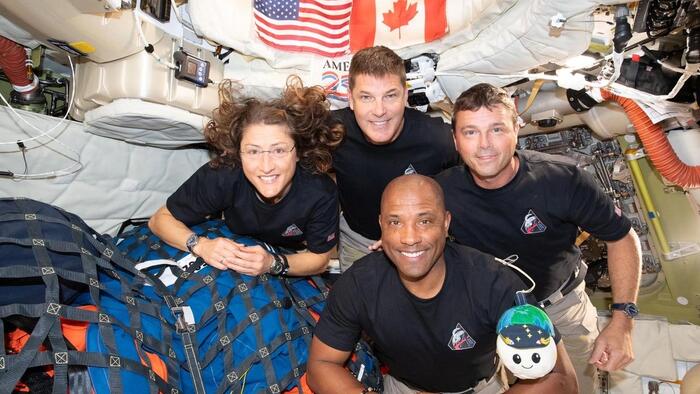
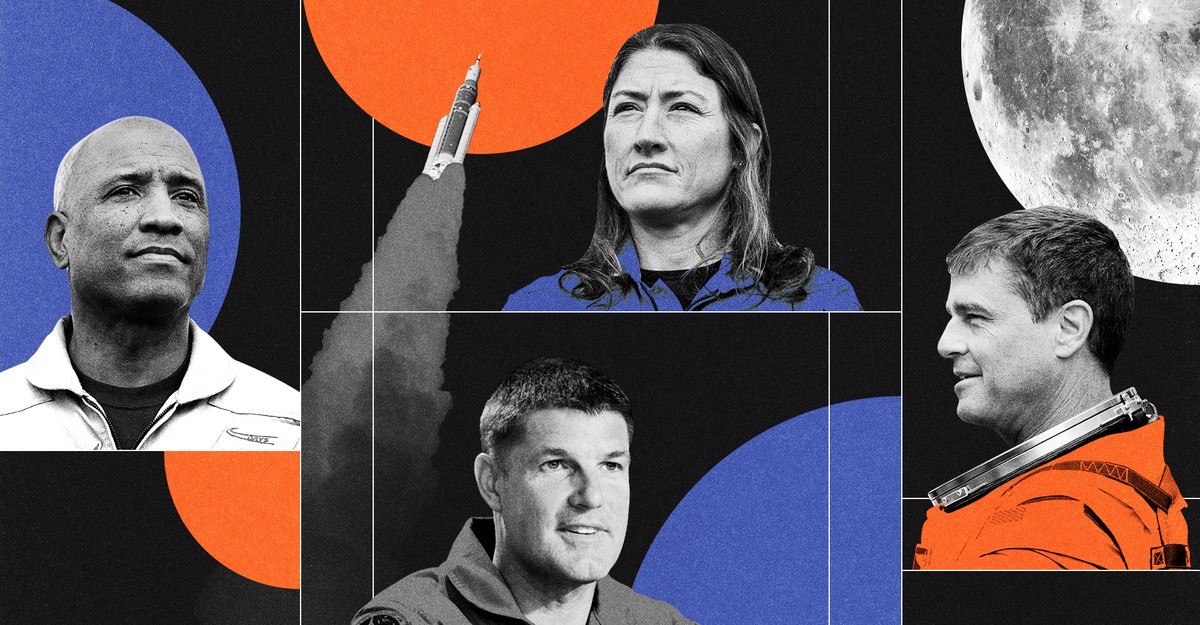
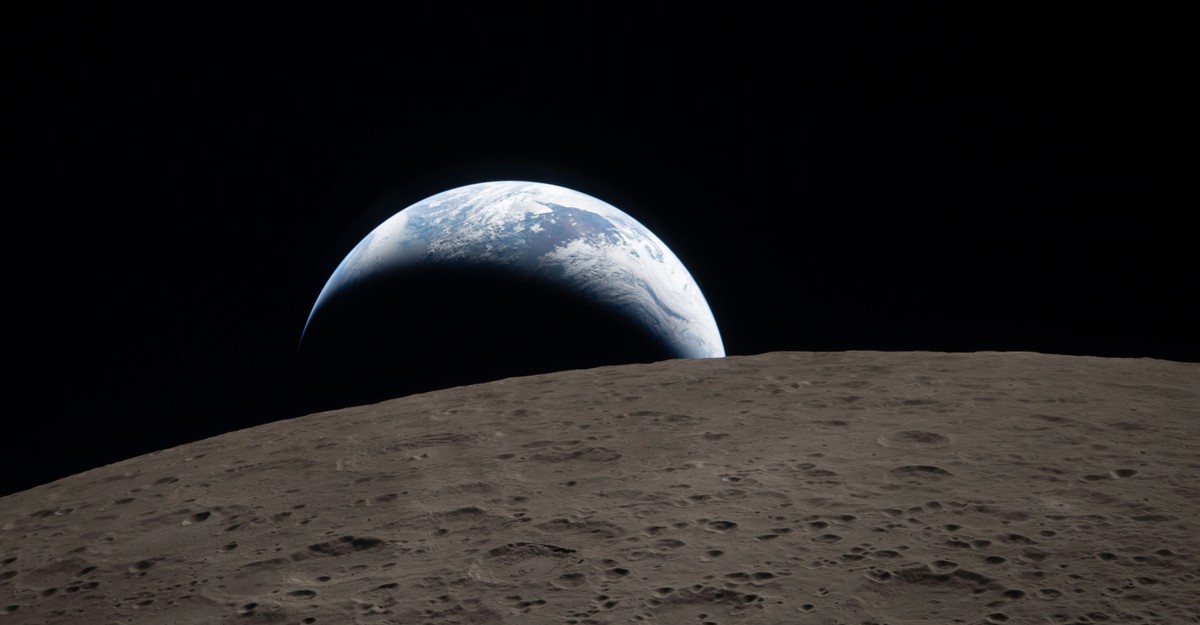
Authored by T.J.Muscaro via The Epoch Times, When Artemis II crew members wake up at 11:35 a.m. ET on April 9, they will begin their last full day in space and start preparing the cabin for their return home. NASA’s Reid Wiseman, Victor Glover, and Christina Koch, and Jeremy Hansen of the Canadian Space Agency, continue to fall back to Earth on a free return trajectory aboard their Orion spacecraft, Integrity, targeting a splashdown in the Pacific Ocean at about 8:05 p.m. ET on April 10. Over the past eight days, those astronauts became the first people in more than 50 years to leave Earth’s orbit and cross the proverbial channel of deep space to fly around the moon. They ventured farther from Earth than any other human expedition in history. They saw areas and aspects of the lunar surface that no other humans had ever been able to see with their own eyes, and they became the first humans ever to observe a full solar eclipse from lunar space. They captured striking images of …

The Astronauts Are Studs

The Astronauts Are Studs

The tendrils of Christina Koch’s flyaway hair swirled about in the gravityless cockpit of the Orion spacecraft, seeming to represent all of the untetheredness of the Artemis II mission. As her mane eddied, like its own separate creature, throughout the record 252,756-mile journey to the radio-silent black side of the moon, it brought a sense of irrepressible aliveness to that dead stone up there. Until this past week, a certain ho-humness had set in about human space flight. The International Space Station has been manned for more than 25 years, with routine trips carrying relatively anonymous men and women to a giant fan doing its repetitive circles in low-Earth orbit. NASA’s Artemis II scanning expedition to the lunar far side, using repurposed space-shuttle engines, at first seemed hardly capable of breaking an audience’s collective yawn. Then it took off: four people arrowing atop what amounts to a bomb bound for the remotest point that man has visited in the cold, splintering sky. As they soared and circuited and sent back stirring images from their 330-cubic-foot …

What the Astronauts See That Trump Cannot

What the Astronauts See That Trump Cannot

I’ve never been to space, but as a young child my ego was obliterated by the short film Powers of Ten. I was at summer camp, on a sticky-hot day that was suddenly interrupted by a thunderstorm. We were all herded into a room, the film projector was rolled out, and red-white-and-blue popsicles distributed. This was normally an occasion for Mighty Mouse or Tom and Jerry cartoons—a much more pleasurable situation for me than trying to catch a ball. On the screen that day, though, was a bell-bottomed couple picnicking in a park in Chicago, shot from above, accompanied by a voice-over explaining that every 10 seconds the camera would be moving outward from them by a factor of 10. Within a minute, Chicago, Illinois, the United States, and then our whole planet, shiny as a gumball, was in sight, and then it became smaller and smaller, subsumed within the solar system, which in turn was subsumed within the vastness of space, our sun “only one among the stars,” the voice explained. This was, on …