


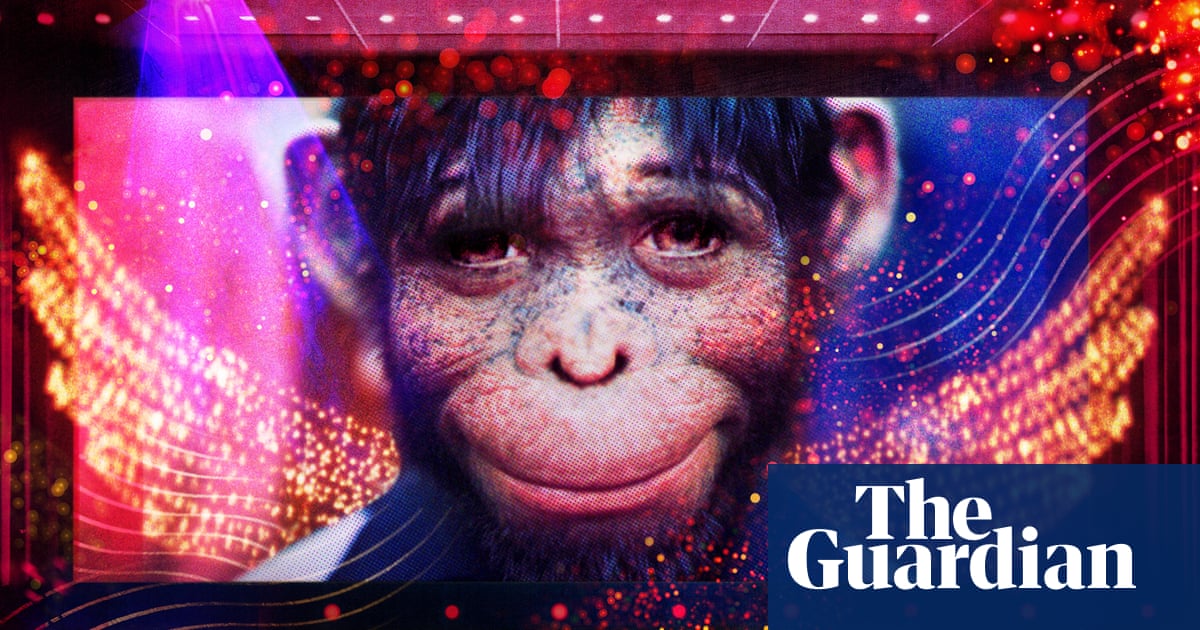
I cannot say I’ve ever been a Robbie Williams fan. When I went to see Better Man, the 2024 biopic in which Williams is played by a CGI chimp, I was tagging along with my wife. To be honest, I was sceptical about the ape but tried to meet the film with an open mind. I wasn’t looking for anything in particular but what I found was something that seemed to explain my life.
I was born two months premature in Winnipeg, Canada, in 1961, with severe hearing loss in both ears that wasn’t diagnosed until I was seven. In 1969 we moved to Woking in Surrey; my father left and my mother descended into alcoholism. I was a misfit in my family, with no support for my deafness, and at school the bullying – from kids and teachers – was something awful. In my desperate isolation, I turned to reading: book reading, lip-reading, and reading the room. Forget TV, forget music – the Beano andBeezer were my survival manuals: the Numskulls taught me how my brain worked with broken ears.
Watching young Robbie, lonely and dreaming, supported by his friend, I thought of my first friend Nick, another misfit, who taught me what banter was. He just nodded his head as I dreamed aloud; I never aspired to sing but certainly aspired to be a great engineer – and I became one, a fact I’m extraordinarily proud of. In the cinema, I was smiling at the memory. Then came Robbie’s grandmother, a formidable presence and formative influence on the aspiring pop star. Mine, on my father’s side, was my biggest fan. From 13 to 18 I walked half an hour to see her every Sunday. We talked about everything while playing Scrabble; I drank her tea from poorly cleaned mugs. She’d greet me with open arms and twinkling eyes: “Aaah, Bobbie!” she’d say. I was getting tearful now.
Bobbie was what my mother called me too, until she had to leave me alone in the Montreal Neurological Institute when I was four. They were investigating my inadequate responses, my large head and my slow development. I felt abandoned. I remember letting out a primal scream as she left. I was collected after two weeks. The results were inconclusive. Afterwards, she said she’d lost her Bobbie, and I became Bobby – same sound, but Bobby the boy, not Bobbie the baby. At 16 I left school and became Bob, a young man who believed he could do anything. What I did was drive a forklift to pay my way through college before going on to study engineering at uni.
At 26, a week into a PhD (which I completed against the odds), I was a passenger in a Ford Granada that spun like a catherine wheel into a gate. Everyone else walked away unscathed; I lost my memory, both hearing aids and the hearing in my left ear. Weeks later, a stubbled, hungover doctor I couldn’t lip-read told me, in under five minutes, that it was permanent.
Driving home to Woking on the M1, in the fast lane, overtaking an articulated lorry, my rage exploded. I felt the invitation to veer my car sideways. I remember the temptation, and, my life on a knife’s edge. Then I remembered my mother’s advice whenever I was inconsolable: wait 24 hours and see if you feel the same. I slowed down and made it home. Years later, as I sat watching Robbie’s fury boil over after Take That sacked him, prompting him to contemplate a similar drastic decision to the one I almost made, I bawled my eyes out. My wife looked worried, but left me to it.
I had met my wife, Birgitte, in Denmark in 1992, on the last day of a job that was meant to last two weeks and ran for two years. We married, and my work took us to the Netherlands, then Canada. My first cochlear implant finally came in 2011, in Ottawa, and for the first time I could hear emotion in voices. A year later, Birgitte was diagnosed with breast cancer and we and our three young children moved back to the UK in 2013 to be near family. Commuting four hours a day to work, I felt my wife and kids slipping away from me, into the family’s care. I fell down a rabbit hole, gambling on my iPhone. My wife survived; I was drowning, with no words to ask for help. When she uncovered the gambling I started counselling, and never gambled again.
I had always been accused of having an “addictive streak” by my wife, which annoyed me. Better Man made me realise it was born of my many traumas. The gambling came from fear and loathing. Like Robbie, I had made my peace with my mother and my father, but not with myself.
We live in Denmark now, and a second implant means I hear 95% in both ears. At the end of the film, Robbie sings into the crowd and sees his younger selves smiling back. I’m learning to do the same: to tell Bobbie it’s OK, to hug Bobby and tell him he’s brave, to marvel at Bob’s confidence. I’m grateful to my amazing wife and my wonderful children, and to Robbie, for showing me the way.
In the UK, support for problem gambling can be found via the NHS National Problem Gambling Clinic on 020 7381 7722, or GamCare on 0808 8020 133. In the US, call the National Council on Problem Gambling on 1-800-MY-RESET. In Australia, Gambling Help online is available on 1800 858 858 and the National Debt helpline is at 1800 007 007.