


Looking back, I’m not sure why I’d expected subtlety from a garment whose name promised to defy physics—especially one that I’d ordered from Kim Kardashian’s shapewear-and-loungewear company, Skims. But when I first tried the “Butt Lifting Short” under the dress I planned to wear to my father’s 80th birthday party, then asked my mother for a second opinion, her eyes widened. “Well, they’re a little bit of a statement,” she said—the same phrase, in the same tone, that she had used when, as a teenager, I had asked her what she thought about nose rings.
This was my first mistake with a Kardashian-branded item, but it would not be my last. I’d wanted to understand just how much America’s most famous influencers had infiltrated American consumption. So for seven days in October, while on a trip to visit my parents in the center of the Kardashians’ universe (Los Angeles), everything I put on and in my body came from companies associated with the Kardashian daughters; their mother, Kris; and their half sisters, Kendall and Kylie Jenner. The family’s dedication to launching brand after brand, in product category after product category, had made it easy to obtain everything I needed to live a life made in their image: Clothes. Food. Drinks. Cosmetics. Supplements. Cleaning supplies. Novelty socks.
My usual aesthetic oscillates between office casual and babysitting casual, so I didn’t expect to covet much from brands whose standout products include lipstick that tries to mimic the look of lip filler and a slip dress that makes everybody look positively bodacious. When I drove to the Skims store to swap my shapewear for something less shapely, I had every intention of making my exchange and leaving. But then I saw the cashmere sweatpants. And the silky pajamas. And the leggings—a genre of clothing plucked from the depths of hell to make women insecure about their thighs—which somehow looked nice on the women modeling for their friends outside the dressing rooms. One reason I’d never bought into the Kardashians’ world was that I had no interest in looking like Jessica Rabbit. But I was interested in these delicious cashmere sweatpants. Hours into accepting the Kardashians into my life, did I already want what they were selling?
These days, the Kardashians are somewhat less visible than they were in the 2000s and 2010s, when Keeping Up With the Kardashians was still airing on E!, and millions of Americans knew by osmosis that Kourtney was on-again, off-again with Scott and that Kylie had finally admitted to using lip filler. Their current reality show—The Kardashians, on Hulu—is less beloved by fans than their original show, and although Kim has 343 million followers on Instagram, she has gone from being the most-followed person on the platform, circa 2014, to the eighth. (According to one account that tracks such metrics, Kylie is neck and neck with the Rock for the No. 5 spot.) “But it doesn’t matter anymore,” MJ Corey, the author of Dekonstructing the Kardashians, told me. Even if the Kardashians are themselves less omnipresent, because of their many product lines, they’re more ubiquitous than ever.
For my week living in the Kardashian brandiverse, I wore clothes from Skims and Khloé’s Good American brand; did my makeup with Kylie Cosmetics’ Kyliner, Kylash, and Kybrow; and even pulled my hair back with hair ties from Skims’s collaboration with the mulberry-silk company Slip. I swapped my morning coffee for Kim’s energy drinks, sprinkled Kylie’s K2O “skin hydration mix” into my water, snacked on Khloé’s Khloud protein popcorn, and ate meals from the L.A. fast-casual restaurant chain Health Nut, which Kris has invested in. At night, I washed my face with 111Skin products—another investment—only because Kim’s skin-care line won’t launch until next year. I thought oral care was the last product vertical that the Kardashians hadn’t touched, so I used Crest—only to learn later that I could have been using purple color-correcting toothpaste from Moon, an oral-care company that Kendall has invested in.
In an attempt to reach a moment of peak Kardashian-ness (at least as I imagined it), I drove to Health Nut later that week in the bodacious Skims dress. Before I left the car, I applied my Kylie Cosmetics lip kit duo of lip liner and lipstick; its patented HotFlux technology temporarily plumped my lips by essentially burning them, but I told myself that a true Kardashian would know that beauty is pain. (Kim once wore a corset so tight, she described breathing in it as an “art form.”) By the time I’d ordered my salad—a romaine, mozzarella, and sprout concoction straight out of 2007—I looked, for better or worse, like I’d gotten some Juvéderm lip filler. When I returned home, I donned a complimentary face mask included in my 111Skin order, because in the Kardashian world, one can never have too much skin care. In my bedazzled Skims claw clip, Kylie lip products, Good American T-shirt, and Skims hoodie and yoga pants, I felt precisely how the slogan on my Rob Kardashian novelty socks described me: a “Classy Bitch.”
From the beginning of Keeping Up With the Kardashians, the family has been working the same hustle: They sell a view into their world, and then use that screen time to advertise their products. Even in Season 1, the sisters’ boutique, Dash, served as a key setting and occasional plot driver. As the show scaled, so did Dash: A spin-off series, Kourtney and Khloé Take Miami, revolved around the sisters opening a new location, and the spin-off to the spin-off, Kim and Kourtney Take New York, was about opening one in SoHo. Dash became a fan pilgrimage site; it was also one of the Kardashian ventures criticized for being insultingly expensive. Similarly, SKKN by Kim shut down after getting ridiculed for its $600 skin-care routine; the Kardashian Kard, a prepaid debit card that cost $99.95 to activate for a year, was scrapped the same month it launched. The family also developed a bit of a snake-oil-salesman reputation for making sponsored Instagram posts about QuickTrim weight-loss supplements (basically caffeine pills) and Flat Tummy teas (basically laxatives).
But over the years, the family has found more reputable products to sell at a lower price point—often with the help of business leaders such as Emma Grede, who has worked with them on several of their most successful brands. The daughters have concentrated on launching companies that represent their archetypes: Kim, the curvy one, has shapewear; Kendall, the enigmatic tomboy, has 818 Tequila; Kylie, famous for her voluptuous lips and meticulous makeup, has Kylie Cosmetics; Khloé, who was subjected to ceaseless comments about her weight, launched a size-inclusive clothing company. And Kourtney, who is so health-conscious that she once objected to candy being served at her child’s Candyland-themed birthday party, has a supplement line, Lemme. (Kourtney declined to be interviewed for this story; the rest of the Kardashian-Jenners did not respond to interview requests.)
Some of these brands have been extraordinarily successful. Another beauty company bought 51 percent of Kylie Cosmetics for $600 million in 2019; Skims is worth $5 billion (four times as much as Spanx, which essentially invented modern shapewear). The day that Skims announced a collaboration with Nike, the athletic brand’s market value went up by $6.7 billion. Kim became a billionaire in 2021, and the entire family, at least according to some estimates, has amassed a net worth roughly equivalent to the GDP of Belize.
Which is to say, the Kardashians have long since become so wealthy that the people they’re selling products to have zero chance of keeping up with their lifestyles (if that was ever possible). What they’re selling instead is a splurge for the middle-ish class. To anyone who shops at J.Crew or Madewell, Good American prices would feel comparable; Skims products generally sell for about the same as Spanx’s. Many Kardashian brands are carried at Walmart, Target, and Ulta, a Sephora competitor with a slightly lower price point. A full Kardashian transformation wasn’t cheap: It cost me about $3,000, enough that my credit-card company sent me fraud alerts twice because its algorithms could not comprehend why I—a person who doesn’t spend much on clothing or cosmetics—had suddenly dropped so much on Skims and skin care. But for many Americans, buying just a bit of the family’s world is within reach.
Because of their early days hawking Flat Tummy teas online, I hadn’t expected much from the Kardashians’ products, but some of them were indeed superior to my norm. As someone who doesn’t take a multivitamin and just hopes for the best, I looked forward to taking my citrus-flavored immunity gummies from Lemme, every morning. Several people complimented my Good American jeans, and the Kylie Cosmetics’ products really were long-lasting—plus, for those wanting to look like they’d gotten Juvéderm, the lip kit is a cheaper alternative. I wouldn’t say shapewear by any brand is actually comfortable, but Skims did make being encased, sausage-like, in nylon relatively painless.
But that was the good stuff. My order from Kris’s cleaning company, Safely, never arrived, so I gave up and used Dawn. I did not expect Kylie’s K2O drink mix to actually “increase skin elasticity & reduce wrinkles & fine lines,” as the package claimed, but I did expect it to be drinkable. I never figured out how to get the powder to fully dissolve, so I periodically swallowed peach-flavored clumps of trademarked “bioactive collagen peptides.” Consuming Khloud’s white-cheddar protein popcorn was worse: Imagine chewing Styrofoam coated in pulverized drywall. (A couple of my friends have told me that the kettle-corn variety isn’t as bad.) At least I had Khloud Plus protein chips, also featuring collagen. The nacho flavor was good enough, in a nacho-flavored-tree-bark sort of way.
Anyone who wanted to go to a restaurant with me knew that the meal would need to be at Health Nut. I made the 30-minute drive there a few times a week to stock up on salads, sandwiches, and a delightful iced green-tea drink known as the Mango Greentini. I became the restaurant’s most devoted regular, except perhaps for the Kardashian-Jenners, who regularly consumed the salads on Keeping Up With the Kardashians. But it did not save me from the times when I had to watch my parents drink coffee while I sipped Kim’s Update energy drinks. Desperate for a warm morning beverage, I tried heating the drinks up, but that didn’t help much: They still tasted of Pez and contained a caffeine alternative that gave me the urge to clench my jaw. I couldn’t tell if my loss of appetite meant that my Lemme supplements, which supposedly “promote your body’s GLP-1 production,” were actually working, or that I simply dreaded the Khloud popcorn.
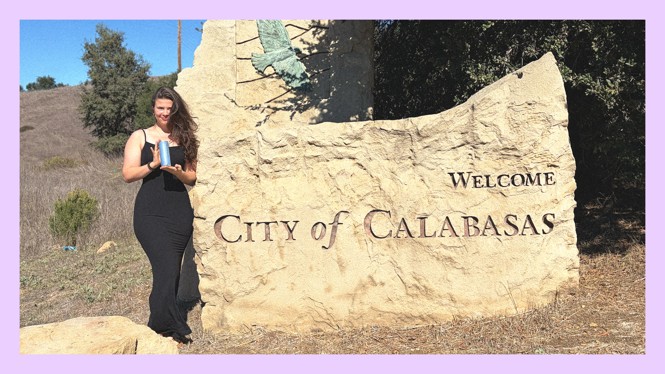
But soon enough, I settled into my Kardashian routine. My parents started alerting our loved ones to my project before family gatherings, to ward off any concerns that I’d suddenly developed a penchant for dressing like a Mafia wife on her way to Pilates. The distance between my life and that of some of the most successful influencers of our era seemed slightly smaller, because now I was someone who relaxed in dedicated loungewear and not just a sweatshirt from her high-school softball team. Like the Kardashians, I now went out in public dressed, for work, in clothes so tight that they might as well have been body paint—and, yes, those clothes did get me more stares than I was used to. And while I was driving back and forth to Health Nut on canyon roads overlooking the Pacific Ocean, I was reminded that—like Kim—I might rent in New York City, but California was my forever home. In fact, my parents’ house is close enough to the Kardashians’ in Calabasas that when a wildfire caused a power outage during my visit, both areas were affected, according to an outage map. Do they have a full-house generator? I wondered, as I sat in the dark in my Kylie lip liner.
By the end of day seven, when I took a shot of Kendall’s 818 Tequila to celebrate my release from the Kardashians’ grip, it didn’t feel like much of a finale. The Kardashian brand ecosystem had been easy enough to inhabit. The bodacious Skims dress—which, like the Butt Lifting Short, proved too powerful for its own good—had mostly stayed in my closet. (My mom had also forbidden me from wearing it to church.) Good American’s more casual offerings had meant that I could wear jeans and T-shirts as usual, and the family’s skin-care products, cosmetics, and salads had fit fairly seamlessly into my routine. I had even started to sort of like the Khloud popcorn—although maybe that was just Stockholm syndrome, which science tells us can set in after six days.
In the weeks since that tequila shot, I’ve still used Kardashian products and have frequently found myself forgetting that they’re Kardashian products at all. Some of their brands, such as Khloud, still trade on the family members’ fame by featuring them in ads and on packaging, but many of them don’t. I’d expected the Los Angeles Skims store to be a shrine to Kim, but I didn’t see an image of her anywhere. The store’s minimalist, curvaceous design was meant to highlight beige shapewear and beige shapewear only. In a way, that’s a testament to Skims’s success: Over the past five years, Google searches for the brand have occasionally outnumbered searches for Kim herself.
Maybe the family is quietly coming to accept that they are no longer the cultural centerpiece that they were in the 2010s. The Kardashians have spent two decades vying for people’s attention, and now they have to fight a new generation of YouTube and TikTok creators. But if there is any logical end point to influencing, it may be in the same playbook that Chip and Joanna Gaines have used to build their home-goods juggernaut and that Gwyneth Paltrow has used for Goop: merchandise. By that measure, the Kardashian product empire is the best outcome that any influencer could aspire to. The family has monetized their fame to the point that people still buy their products even if those customers are no longer paying as much attention to them. Instagram likes are fleeting, but Khloud popcorn could probably survive a nuclear blast.
The Kardashians do seem to be giving viewers less of themselves than they used to. Keeping Up With the Kardashians went off the air in 2021, and even the title of their Hulu show, The Kardashians, seems to acknowledge that viewers can’t really keep up with them anymore. Fans tend to complain that the new series is boring. The eighth season, currently airing, is basically product placement for the girls’ businesses: Kim debuts NikeSKIMS; Kendall does an event for 818 Tequila; Khloé feels awkward during a steamy photoshoot with a male model for her new perfume line, XO Blue by Khloé Kardashian. (While shooting, she and the model, Brandon, discuss how the line is going to be available at Sephora.)
Hulu did not reply when I asked for viewership numbers, but I can’t imagine that a show in which a major plotline involves Kourtney’s stepson getting his driver’s license gets as many eyeballs as Season 8 of Keeping Up With the Kardashians. Yes, that one included a photoshoot for their brother’s sock company, but it was mostly about Kim having a baby with the rapper Kanye West (now known as Ye). The Kardashians’ shows were always a business endeavor, but more and more, part of what they’re selling is the ability to watch them sell us things.
For now, the Kardashians are still grinding. They have a show and several spin-offs; they post pictures and videos of themselves on social media. They still trade on the idea that their lives are glamorous enough—or at least strange enough—that we should both pay attention to them and purchase bits of their lifestyles. If more of the sisters’ products reach Skims-level heights, they may no longer need to spend half their time advertising their merchandise. But would they really want that? Kim has presented herself for years as a businesswoman first and foremost: Her recently released authorized biography, Citizen Kim, includes a family history of the several generations of mother-daughter duos who started antique shops, beauty parlors, and children’s-clothing boutiques and grew them into local retail dynasties. The Kardashians love attention, yes, but they really love to sell—their image, their drama, their products.
Some of those products, it turns out, are pretty good. I wouldn’t recommend that you build your life around them, and I definitely wouldn’t recommend K2O. But after a week inside the family’s brandiverse, I am surprised to feel more impressed than terrified when I consider that America may never escape the Kardashians.