


What happens when you put really stupid clever people in charge of the world? Not as presidents (they currently trend mostly towards the merely stupid) or prime ministers (generally neither really stupid nor really clever), but in charge of the real world, which is to say the online world, the one that really governs us? We are watching that play out day by day, but if you have enough slack left in your dread-system, a cortisol spike yet to execute, why not add a warning from history to your consumption of horrors?
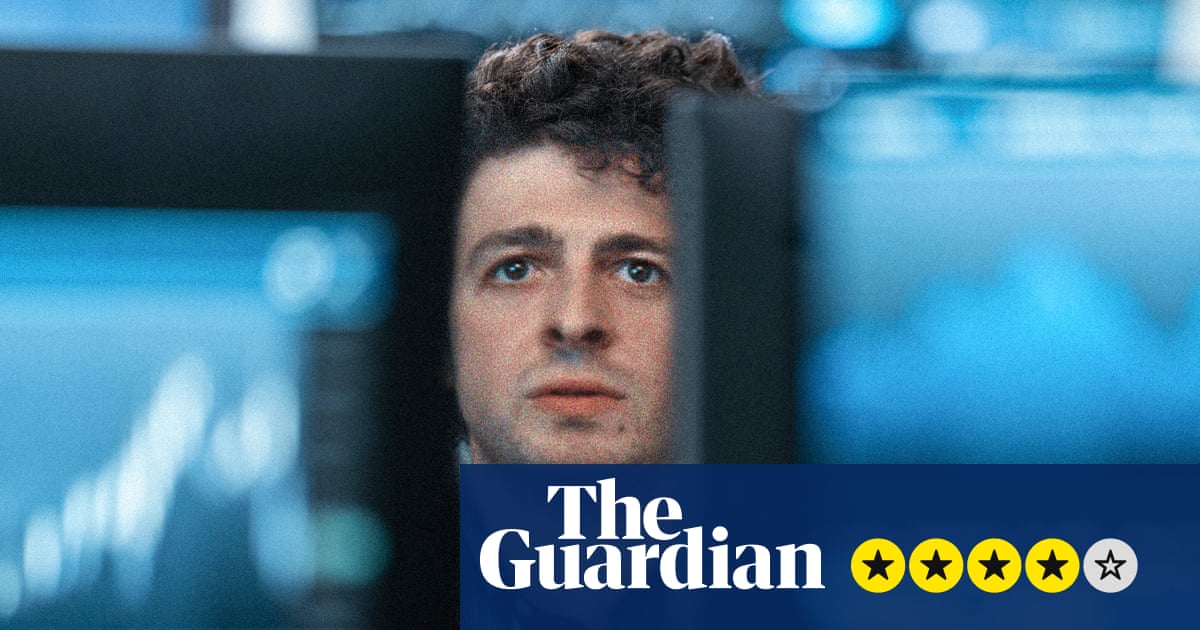
Welcome to The Altruists, a breakneck breakdown of the brief career of Sam Bankman-Fried (played by Anthony Boyle) who, with his on-off girlfriend Caroline Ellison (played by Julia Garner), set up the cryptocurrency exchange FTX with the belief that it would revolutionise finance and – as the increasingly absurd/dishonest/knowingly satirical Silicon Valley mantra has it – make the world a better place. A very few years later, FTX – worth $36bn (£27bn) at its peak – collapsed and in 2023 the pair were convicted of various charges deriving from what the trial judge called “the greatest financial fraud ever perpetrated in this country”. Ellison was sentenced to two years in prison after testifying against Bankman-Fried. Bankman-Fried is serving 25 years and was ordered to forfeit $11bn (£8.3bn). He says he is innocent and is applying to the supreme court to review his conviction.
The Altruists opens in 2016 with an untraditional meet-cute between SBF (as Bankman-Fried was known) and Ellison when she joins the trading firm he works at. They bond over mathematical strategies, their Ivy League professor parentage, veganism and their commitment to effective altruism. The last was a movement that invited people to apply utilitarian principles – where could your money do most practical good – and divorce charitable donation decisions from emotion and irrationality. Thus it followed that the best thing you could do was make as much money as possible and then give it all away. Many in the tech industry approved this message, whether through genuine belief or as a sop to conscience. It is surely a phenomenon that deserves a thorough examination of its own – the mix of good intentions, self-righteousness, skewed entitlement, scope for monstrous egos, misuse and hypocrisy it combines is an almost overwhelmingly delicious prospect and I hope someone has it in their sights.
Our so far relatively endearing pair of number monkeys begin a relationship – almost entirely on Caroline’s polyamorous terms – while SBF co-founds his first company, Alameda, in 2017, from which he then forces out his business partner. Caroline comes on board instead and together they start making profits.
The timeline then starts to split between the rise (2016 in New York), the precarious peaking (2018, Hong Kong) and the fall (the Bahamas, 2022). Not for the first time I find myself thanking the Mike Judge sitcom Silicon Valley for giving me at least a small purchase on what the hell is happening, and wishing that a drama could follow its lead in integrating explanations for the minimally computer- and fiscally literate lay audience seamlessly into the action so we can properly appreciate what is going on.
Because – it’s a lot. At the heart of the downfall is an $8bn (£6bn) hole in the Alameda/FTX finances, whose funds should never have been mixed, where customer deposits should be. Before then, there are technical challenges, clever plays by more experienced (and more corrupt) players, risk-averse investors and regulatory issues to deal with. This could be simplified without too much loss to the drama, because the meat of that is really to do with the messy humanity that SBF and Ellison – and, by inference, the rest of the tech titans – are trying to banish from the trades and the models they think could be perfect.
At its best, The Altruists is about the ineffable; it’s about trust, about understanding yourself and others, about being able to gauge moods as well as markets and how inextricably and infuriatingly they can be linked. Above all, it is about how important self-image and a belief in that self-image can be, and how much people can lie to themselves and others to protect it. SBF recruits his friends and betrays them. The pair donate huge amounts to charity but live bounteously in the Bahamas and are planning to build the $200m (£151m) complex FTX “needs” as bankruptcy looms.
Anchored by brilliant performances from Boyle and Garner, two of the best young screen actors working today, and supported by fine turns elsewhere (especially from Karan Soni as the most emotionally brutalised of SBF’s victims), The Altruists stays just the right side of coherent. In the end, it manages to evoke the chaos, the insubstantiality of the algorithmic economy we all depend on now, and the insanity of the idea that any handful of people in whom such vast amounts of wealth and power are concentrated could ever be up to the task, without quite itself collapsing. But it’s a high-wire act and you mustn’t lose focus for a moment. And I recommend a Silicon Valley rewatch to prep before you begin.