


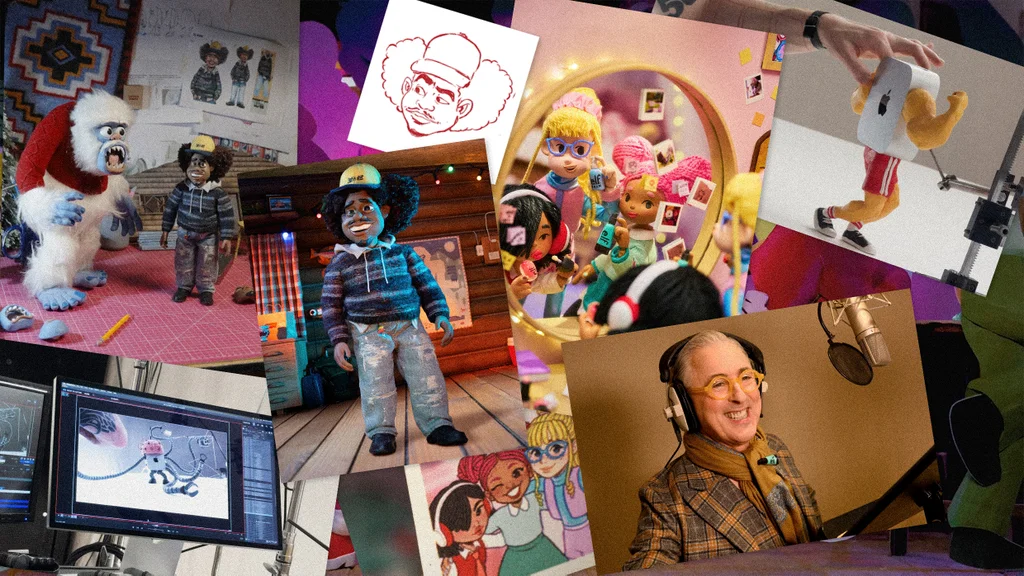
“You almost want to make sure that you can show some of the verification and receipts for the hard work, effort, and craft that you’re putting in,” Mitchell says. “When we first posted our campaign on TikTok, one of the comments was like, ‘AI slop.’ And literally the next comment underneath it was, ‘No, this is stop motion.’”
For Mitchell’s team and animation partners at the production studio Blinkink, who spent four hours on every second of animation in “Let’s Get Fuzzy,” the behind-the-scenes film served a dual purpose: giving fans more access to the brand’s design efforts, and defending against inevitable AI accusations.
Recently, it’s a strategy that a host of brands seem to be adopting. Apple, Anthropologie, Prada, Dior, E.l.f., and Loewe are just a few of the major names that have recently debuted claymation, stop-motion, or hand-drawn ads with accompanying behind-the-scenes videos. As AI-finger pointing reaches a fever pitch, brands are spending more time and resources on behind-the-scenes footage, which has arguably become more important than the campaigns themselves.
The behind-the-scenes renaissance
Greg Lotus, global head of production at the creative company VML, remembers an era about 10 years ago when his clients began asking for behind-the-scenes content en masse. Often, he says, this content was more geared toward applications for advertising awards than public consumption. It lived on brand YouTube channels or on agency case study pages, where it often languished in obscurity.
“It just always seemed kind of silly to me,” Lotus says. “Nobody really cares about the fact that you had a couple days on a set and shot this toothpaste commercial.”
This modern wave of behind-the-scenes content is different for a few reasons. First, Lotus says, it’s coming from craft-forward brands that already have devoted fan bases. Second, it highlights mediums that, unlike the toothpaste commercials of yore, play especially well on film. Prada detailed how the former Disney animator John Pomeroy drew its holiday campaign “Drawing Prada” frame by frame; E.l.f. filmed the actor Alan Cumming reading narration over three adorable stop-motion characters; and Levi’s documented how it designed a tiny red sweater for an equally tiny yeti. It’s undeniable eye candy.
Notably, brands are now posting this content on their main social media pages. It’s a move that elevates the behind-the-scenes (BTS) video from an industry-facing proof point to an integral part of the campaign itself.
“Before, BTS was something that sometimes the agencies and clients did just to have documented the process,” says Saulo Rocha, an executive creative director at Apple’s bespoke global agency TBWA\Media Arts Lab (MAL). “It was more of an internal thing, and it very rarely went to YouTube. Even YouTube is far from being what Instagram or Twitter or even TikTok can be to this kind of content.”
From brands’ perspective, the current moment couldn’t be more primed for behind-the-scenes content to hit the main feed. Mitchell, the CMO at Levi’s, says that in the era of “brand entertainment,” when consumers have ever more access to the stories that brands are intending to tell, behind-the-scenes videos give fans a way to feel like a part of the company’s design decisions. Simultaneously, the format gives brands an opportunity to prove their commitment to human creativity—and to avoid AI accusations.
“There’s been so much conversation around AI, but what you actually see is a focus from some of the best brands and sharpest minds on creative excellence being one of the big differentiators,” Mitchell says. “There’s a lot of things that AI can do, but we believe strongly—and I think you’re seeing it from others around the marketplace—that this human creativity and the craft connected to it is something that drives a tremendous amount of value for companies. It’s what our fans want to see.”
‘No slop = will shop’
To introduce its new Mac mini device this August, Apple decided to make a spot entirely using claymation. MAL, its agency, partnered with Blinkink on a 43-second spot called “The Mighty Mac mini.” As a tidbit for fans, it also posted a behind-the-scenes video to Apple’s secondary Instagram account, @helloapple. That video massively outperformed the actual spot, amassing 197 million views (compared to the spot’s 32 million on YouTube). It’s now the most-watched video ever posted by @helloapple and also one of the broader brand’s most popular social posts of all time.
Apple is no stranger to behind-the-scenes content. The brand, alongside MAL, has always been ahead of the curve on using creative advertising to hammer home its focus on craft: Recall the 2019 airpod spot “Bounce,” which used practical effects to make a cityscape act like a trampoline park; or “Fuzzy Feelings,” a 2023 holiday spot featuring a quaint stop-motion town. Both of those spots came with a behind-the-scenes video posted to Apple’s YouTube channel. This year, though, the public reaction to the work seems to have shifted.
Take a look at the comments under the Mac mini @helloapple video, and you’ll find hundreds of users congratulating the brand. “Thank you for hiring human animators to make this,” one viewer wrote. “In a world full of ai commercials, thank you for this apple,” another said. “who else enjoys BTS more than the video itself??” a third added.
Greg Greenberg, another executive creative director at MAL, directed Apple’s 2025 holiday spot “A Critter Carol,” which was based on puppets in a handmade forest. At the time, Greenberg says, it wasn’t meant to be a statement. Still, there was an awareness that the ad might become “part of a conversation online,” he says. It did. The spot became Apple’s most-viewed holiday film ever, racking up 141 million social views. As in the case of “The Mighty Mac mini,” much of the public reaction was tinged with gratitude.
“Seeing brands go, ‘We know at the core what makes us human; we still believe in the creativity of people,’ that’s a comforting feeling,” Greenberg says. “I think that’s probably why you’re seeing a lot of people respond so positively. And a lot of other brands are probably making very deliberate decisions to go, ‘We need to make our work like this,’ because even if it’s not AI, but for some reason somebody confuses it for that, the internet will have its way with you if it thinks you’ve gone awry from what is the right way to do things.”
Prada, Levi’s, E.l.f., and others’ holiday campaigns certainly seem to prove Greenberg’s point. Prada’s behind-the-scenes video, which has 2.8 million views and more than 2,300 comments, is flooded with users thanking the brand for not using AI. Under Levi’s behind-the-scenes, one user wrote, “Yes!!!! Real art!!! I respect this so much.” An E.l.f. follower wrote, “No slop = will shop!”
In an email to Fast Company, E.l.f.’s CMO, Oshiya Savur, explained the brand’s reasoning for using no generative AI or computer-generated imagery (CGI) in its spot: “We’re human first, human last at E.l.f. AI can be a useful tool, but the ideas and the taste come from people. For this story, we wanted you to feel the care in every frame, because the care is part of the story.”
The internet’s general fatigue with AI-generated imagery is resulting in a positive pile-on effect for most brands’ behind-the-scenes content. For brands that miss the mark, though, the opposite is also possible.
Dior’s 7-minute animated “Christian Dior’s Night in Color” holiday ad was directed by the French animator Sylvain Chomet, who stars in the brand’s behind-the-scenes video. In it, he says, “Technically, we work just as they did in the 1940s. It’s exactly the same technique.” But, as commenters were quick to point out on Dior’s Instagram, the ad shows several signs of AI-generated imagery. Viewers spotted warped lettering, a lazy eye, and a misplaced finger bone. The film’s creators have rebutted the claims that the ad used AI-generated imagery, instead relying on an “automated interpolation” system to generate the in-between frames of the film. Fast Company reached out to the press department at LVMH, Dior’s parent company, for comment and did not hear back.

Regardless of whether the ad did indeed use AI, fans have turned against Dior, leaving thousands of comments across its campaign videos demanding that the brand hire real artists. Right now, says Lotus at VML, marketers need to be aware that there’s a broad bias against AI. “People don’t like to be fooled,” he adds.
In a moment when major brands could theoretically churn out an endless stream of assets using AI, audiences interpret craft as evidence of a brand’s corporate values. The behind-the-scenes video is the ultimate proof of authenticity—as long as it’s done right.
What’s next for the hand-crafted ad
For the past several years, plenty of creatives in the ad industry have worried that AI might make their jobs obsolete. And, certainly, many agencies are relying more and more on AI technology throughout their workflows. Still, all of the creatives I spoke with for this piece agreed that as AI oversaturation increases, so does the public demand for human creativity. At a moment when advertising content can theoretically be automated in a matter of seconds, many brands are swinging all the way back to mediums that require the most human intervention.
“There’s always an extreme to every extreme, and there’s been an extreme increase in AI and in questioning what is real and what’s not real,” Greenberg says. “That leads to an extreme on the other side, which is a proliferation of things made by hand. I don’t think that’s going to go away, but I do think, just in general, stuff always evens out.”
Greenberg thinks that we’re reaching a peak of stop-motion ads, but it’s not the end of the craft resurgence. Ultimately, he says, brands that want to develop strong fan relationships will continue investing in human-made art, whether that’s through hand-drawn animation or a live-action ad shot on film. When it comes to behind-the-scenes content, MAL’s Rocha predicts that consumers are about to become more discerning.
“We might get more judgmental,” he says. “I think the more you see of something, the more you become empowered to critique it.” Truly great behind-the-scenes content will win out, leaving brands behind if they’re only there for the trend. “Some brands will tap into it, but for the wrong reasons. That’s going to be evident, because now we’ll feel smart enough to tell the difference,” Rocha says
Like any trend in advertising, viewers are likely to lose a bit of enthusiasm for the behind-the-scenes video in the coming months. Still, its renaissance has felt like a ray of light for many creatives; an affirmation that the public still values their work, and that brands—at least some of them—are still willing to pay for it.
“The future may be full of perfectly generated AI content, but I suspect people will continue to gravitate toward work that bears the fingerprints of the makers,” Lotus says. “Maybe it’s the Gen X in me, but I think there’s a chord in everyone that gets struck when they encounter art made by people who cared deeply about the details. The work is great not ‘despite the imperfections,’ but because of them.”