


This newsletter is free and goes out to over 26,000 subscribers, but it’s only able to sustain itself due to the support I receive from a small percentage of regular readers. Would you please consider becoming one of those supporters? You can subscribe via Patreon or the Subscribe button below! You can also make one-time donations through Venmo, CashApp, or PayPal.
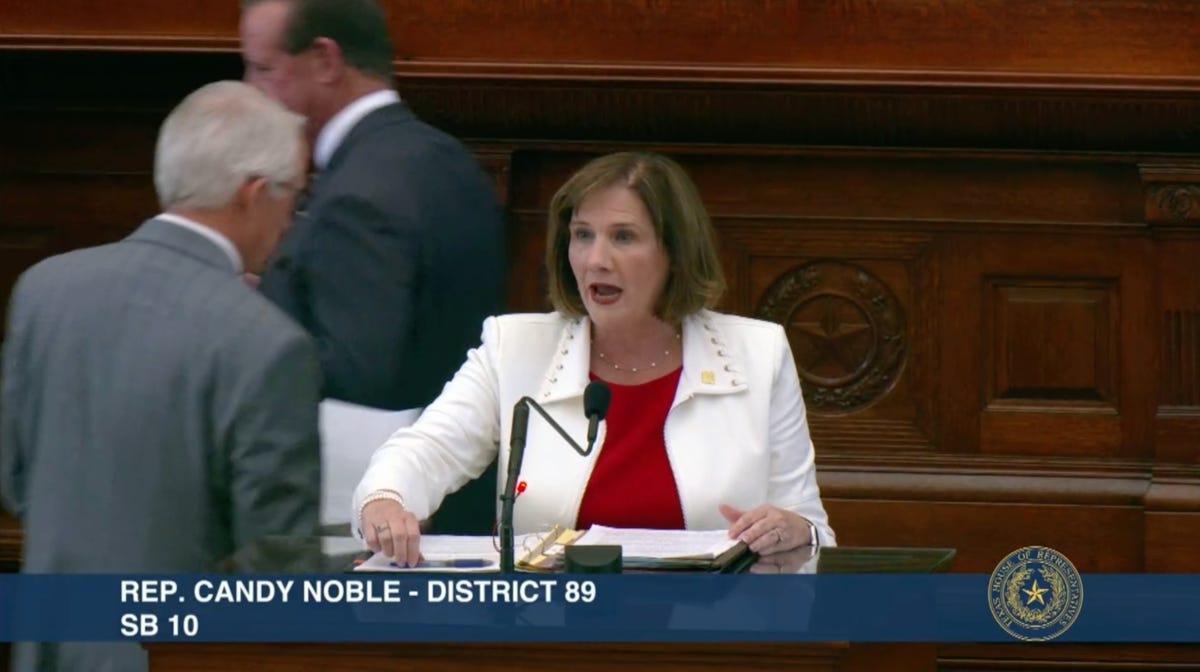
When the Blue Tsunami hit Texas last week, a lawmaker who was instrumental in forcing public schools to place the Ten Commandments in every classroom was quietly defeated. State Rep. Candy Noble was first elected in 2018 and undoubtedly expected to sail to victory in her Trump +17 district.
Her loss, though, gives us a perfect opportunity to remind everyone about how her religious extremism helped fuel the rise of a little-known Democrat named James Talarico.
In 2023, Noble filed a Ten Commandments bill that received attention but didn’t go anywhere. It was her next attempt, in 2025, that got signed into law and is now the subject of ongoing litigation.
When it was first introduced, Democrats had very little recourse to stop it. Their best bet was pointing out why the bill was completely unnecessary and hope that some Republicans would join their side.
Democrats wanted to point out how the Ten Commandments wouldn’t solve any real problems. (No potential school shooter has ever plotted out a path of destruction only to reconsider after reading “Thou shalt NOT kill.”) Several of the Commandments were also flat-out useless since they included mandates against believing in false gods, not making “graven images,” taking God’s name in vain, and keeping the Sabbath day holy.
Making that case was a young seminarian who had entered the state legislature in 2019 alongside Noble.
During a House Public Education Committee meeting, when Noble attempted to defend her bill and urge the committee to push it through, Talarico had a chance to question her. And he made good use of that time.
Here’s the relevant portion of the hearing along with the transcript:
TALARICO: … I have lots of questions about this bill. One, I want to first acknowledge that the Ten Commandments are important to me personally. Important to my faith. I’m sure they’re important to many people here on the dais. And, in fact, I think the Ten commandments are hard to obey, and they’re meant to be hard to obey. And I don’t always think that the legislature obeys the Ten Commandments. So I just want to walk through a couple.
“Remember the Sabbath day to keep it holy.”
Are you aware the legislature is scheduled to meet this Saturday?
NOBLE: I am aware of that.
TALARICO: So that would be violating the Ten Commandments.
NOBLE: I contend that that is a hard… you’re right.
TALARICO: “Thou shalt not kill.” Are you aware the legislature has refused to outlaw the death penalty?
NOBLE: Again… we’re using the words that are on the monument [outside the Texas Capitol] because it has been upheld by the Supreme Court. But we’re talking about murder here and not justice and certainly not war.
To be clear, The Ten Commandments monument outside the Texas Capitol was upheld by the Supreme Court in 2005, on a 5-4 vote, only because it was not erected in isolation. The Court said it was part of a larger display (including 17 monuments and 21 historical markers) showcasing “history” and moral ideals. Whether or not you agree with their assessment, the point is that the Christian monument wasn’t the only game in town, and it was not placed there because the Court felt there was something special about that religious list.
Indeed, the same day that decision came down, the Court ruled in a different 5-4 split that a stand-alone Ten Commandments display was illegal in Kentucky precisely because it was not placed in any context and was therefore a violation of the Establishment Clause.
The classroom posters in Texas would not be placed in any secular context. For Noble to argue that the Supreme Court has already deemed these posters legal was a complete misreading of what SCOTUS had said nearly two decades earlier.
Talarico then made the argument that few people took these Commandments seriously, including Republican members of the state legislature:
TALARICO: The translation that I’m looking at in your bill is “Thou shalt not kill.”
NOBLE: Absolutely. The reason we are using that language, again, is because that is the language that has been upheld by the Supreme Court.
TALARICO: “Thou shalt not commit adultery.”
NOBLE: Be true to the one you love!
TALARICO: And the Second Commandment, which I think is the most important, “Thou shalt not make to thyself any graven image,” meant to prevent idolatry, the creation of idols. The idea that some people would try to make an object, maybe two tablets to worship, rather than worshipping the God behind those two tablets. Are you worried that this bill is idolatrous?
NOBLE: I do not.
TALARICO: Why not?
NOBLE: This bill is reflective of the principles that we need in our classrooms. And as a former school teacher—I know you are, too—what do we need more than the reasons why we are doing the things that we’re doing? Why do we not celebrate the need to respect others, to respect authority? I contend that this is absolutely needed, and I get where you’re going with that particular Commandment, but it’s there, and it is historical, and it is foundational.
TALARICO: Would you be open to an amendment to the bill saying that if a member of the legislature violates these commandments, that we can no longer mandate public school teachers put it in classrooms?
NOBLE: It is my intention to keep this bill clean as it came over from the Senate.
Already, Talarico noted four Commandments that are regularly broken by Republican members of government. None of that mattered to Noble, and she didn’t even bother justifying the hypocrisy. How could she? There was no way to make it make sense. But Christian Nationalists have a habit of saying one thing and doing another; the rules never apply to them.
Noble didn’t care if Republicans broke the Commandments. She just wanted to shove her supposed morality in the faces of children while remaining silent every time her own colleagues turned their backs on them.
Talarico wasn’t done noting the hypocrisy.
TALARICO: I want to talk about religious inclusion. The Supreme Court case that you [cited, Bremerton v.] Kennedy, was about a football coach who prayed on the football field. And the Supreme Court said that the Establishment Clause—the First Amendment in our Constitution, which prohibits the state, a government, like all of us, from establishing a state religion—doesn’t apply to that because it’s his personal faith, a personal expression of his faith.
Your bill doesn’t do that, though. It mandates that every single teacher put the Ten Commandments in their classroom. Is there a difference between…
NOBLE: Yes, there’s—
TALARICO: … prohibiting an individual school employee or teacher from practicing or expressing their faith versus the state now mandating that one particular faith be expressed in a classroom?
NOBLE: So are you referring to the faith of Judaism? Because that’s where this comes from.
TALARICO: Sure. Yes.
NOBLE: Is that what you’re referring to? I contend that the historic and foundational reference of the Ten Commandments in our nation’s history is what we’re looking at here, and not the bunny path that I think you’ve taken us on. I am not an attorney, and I do not play one on TV, but I do have an attorney here that can speak to that better than I can. And so I would like to defer to let them answer that, if that’s okay with you.
TALARICO: That’s fine. And I can ask the attorney these questions too. But as the bill author, I want to drill down. Would you be open to an amendment that would allow schools to post the five precepts of Taoism?
NOBLE: Again, that is not foundational to our American judicial and educational system. That does not fit into that criteria which the Supreme Court has set forth.
TALARICO: There are many, many documents that have influenced the American Constitution, including the Code of Hammurabi, the Magna Carta. Would you be open to a teacher posting one of those instead of the Ten Commandments?
NOBLE: I am… Today? That is not my bill.
TALARICO: And so the major world religions, in addition to Judaism and Christianity—Buddhism, Hinduism—which are represented at our schools, you’re not willing to allow one of those Commandments or one of those religious doctrines to be posted in the classroom?
NOBLE: Again, we are talking about something that has historically been in our education system. In our earliest textbooks in America were these Ten Commandments. And, actually, lots of Bible references were our earliest American textbooks. That’s what we’re talking about here.
I’m not familiar with what you’re talking… I am familiar with the Magna Carta, but the others, I’m not familiar with, and so I can’t speak to those.
TALARICO: But do you see why if our First Amendment is forbidding the state from establishing a state religion, that mandating that one tradition be elevated above the rest would be a violation of that First Amendment?
NOBLE: I disagree with that because, again, our judicial system and our educational system, this is foundational to them…
TALARICO: I’ve listed other things that are foundational as well…
NOBLE: If we don’t know where we’ve been, how do we know where we’re going? I love history, and this is very foundational to the history of our nation.
TALARICO: But I’ve just listed other documents that are also foundational, and you’re not willing to include those in the bill. It’s only…
NOBLE: I am not… in this bill. It is my intention to keep this bill clean.
TALARICO: So it’s only the Ten commitments.
NOBLE: Absolutely.
As John Adams famously noted, “the government of the United States of America is not in any sense founded on the Christian Religion.” Anything that’s worth respecting in the Ten Commandments is echoed by countless other religions, and anything unique to the Ten Commandments is, to put it bluntly, sectarian nonsense that doesn’t belong in public schools.
Even though Noble couldn’t defend the individual Commandments, she still claimed the full list needed to go up in public schools while everyone else’s beliefs needed to be kept out. Why? Because her preferred list was “foundational” to our history. Who says that? Nobody except perhaps Christian pseudo-historian David Barton and his gullible followers. Certainly not experts in American history.
Noble was lying about the reason the Commandments needed to go up in classrooms. Her entire premise was a falsehood. Nothing in her religion apparently ever taught her that lying is a sin.
That’s when Talarico went for the kill.
He called out the fact that Texas Republicans have constantly demanded that parents be allowed to override whatever educators believe is best for kids. If a subject could violate someone’s religious beliefs—sex education, for example—then ”parental rights” must triumph no matter what.
So why, Talarico wondered, shouldn’t parents get to override literal religious propaganda in the classroom?
TALARICO: And tell me about—because every time on this committee that we try to teach students values like empathy or kindness, we’re told we can’t because that’s the parents’ role. Every time on this committee that we try to teach basic sex education to keep our kids safe, we’re told that’s the parents’ role.
But now you’re putting religious commandments—literal Commandments—in our classrooms, and you’re saying that’s the state’s role. Why is that not the parents’ role?
NOBLE: [Long pause] That’s really an interesting rabbit trail that you’ve gone on with that. Because, really, what we’re talking about here is a historical, foundational document to our nation’s education history and our judicial history. Those other things are great and interesting, but they’re not foundational to us, educationally and judicially.
TALARICO: Would you be comfortable with adding language to receive parental consent from all the parents of students in the classroom before putting it up?
NOBLE: I would not. I am, again, gonna keep it clean as it came over.
TALARICO: So you don’t want parental consent when it comes to students receiving religious commandments?
NOBLE: I don’t believe that… Again, I think that these are foundational to being a good citizen and being a good member of a classroom. I know that our teachers are more and more and more having to fight for classroom management over the behavior of students. And I don’t think that these Commandments would, in any way… I think these Commandments would help with that classroom management need.
That’s where Noble gave away the game. She pretended this wasn’t really about forcing Christianity on kids; it was all about classroom management.
How would having these Commandments in the classroom help teachers? No clue. You’re never going to find a single teacher in the country whose rowdy students start behaving just because they see a sign that says they need to keep the Sabbath holy or not commit adultery. (If kids listened to whatever the motivational posters in their classrooms said, everything would be glorious. That’s not how reality works.)
If that was the best argument Noble had, then she had nothing. There was no rational, secular argument for putting Christian Commandments in the classroom. Noble was grasping at straws.
Talarico finished his comments by alluding to his own Christian faith. He implied that he was no less Christian than Noble, but he was still strongly opposed to this forced religion bill: “A religion that has to force people to put up a poster to prove its legitimacy is a dead religion,” he claimed.
He added that if they really cared about pushing Christianity on kids, there were more pressing issues.
TALARICO: I want to make a comment and thank you for answering my questions. I’ll probably have more later. And I say this to you as a fellow Christian, representative, I know you’re a devout Christian and so am I.
This bill to me is not only unconstitutional, it’s not only un-American, I think it is also deeply unchristian.
And I say that because I believe this bill is idolatrous. I believe it is exclusionary. And I believe it is arrogant. And those three things in my reading of the Gospel are diametrically opposed to the teachings of Jesus.
You probably know Matthew 6:5, when Jesus says, ‘Don’t be like the hypocrites who love to pray publicly on street corners. When you pray, go into your room and shut the door, and pray to your Father who is in secret.”
A religion that has to force people to put up a poster to prove its legitimacy is a dead religion. And it’s not one that I want to be a part of. It’s not one that I think I am a part of.
You know that in Scripture it says faith without works is what? Is dead. My concern is instead of bringing a bill that will feed the hungry, clothe the naked, heal the sick, we’re instead mandating that people put up a poster.
And we both follow a teacher, a rabbi, who said, “Don’t let the law get in the way of loving your neighbor.” Loving your neighbor is the most important law. It is the summation of all the law and all the prophets.
I would submit to you that our neighbor also includes the Hindu student who sits in a classroom, the Buddhist student who sits in a classroom, and an atheist student who sits in a classroom. And my question to you is: Does this bill truly love those students?
NOBLE: I’m going to go a different direction than I think you’re trying to lead me, and that is that a very great wrong was done in our classrooms with that 1980 decision, because this document was in classrooms prior to that. In fact, I think that this bill actually rights a wrong that was done all those years ago based on what has now been considered a failed decision by the Supreme Court. So I contend that we are righting a wrong, not causing one.
TALARICO: Last thing I’ll say, and I know we have other questions of the witnesses, is I just worry this is what gives us religious people a bad name. That instead of living out the way of Jesus, we’re instead imposing our beliefs on other people. Instead of leading by example, we’re leading by mandates. And so I’m very offended by this legislation. I know you and I have worked together, and I’m not casting aspersions on you, and I would love to work with you, but as it is currently written, I find this to be a deeply offensive bill. Thank you, Mr. Chairman.
Noble was referring to a 1980 case in which the Supreme Court struck down a similar bill in Kentucky placing the Ten Commandments in classrooms because they said it lacked a secular purpose. That was the right move. No legal scholar says that’s a “failed decision.” There’s nothing to “right” because that decision wasn’t wrong.
But Talarico was correct that this sort of bill gives Christians a bad name. When Christianity becomes synonymous with conservative Christianity and Christian Nationalism, it’s a branding problem for the entire faith. Talarico was genuinely upset that his colleagues weren’t just ruining public education, but dragging his own religion through the mud in the process. This bill wasn’t going to lead kids to Christianity. It was bound to backfire and push kids away from organized religion altogether.
Incredibly, that bill stalled in the State House and didn’t get passed that year. Like I said, it wasn’t until 2025 that a similar version of the bill was signed into law.
And when that more recent bill came in front of Talarico’s committee, he once again had the chance to question Noble about it. (The video below attempts to condense about 25 minutes of back-and-forth—that took place at 4:00 a.m., no less—into a shorter exchange.)
TALARICO: … Is there a separation of church and state in this country?
NOBLE: That’s an interesting question that has been debated a great deal, but…
…
TALARICO: … Do you think the… Constitution is foundational to our country?
NOBLE: I do. I believe all of those [documents] are foundational… and I’ve loved visiting them in the archives in Washington, D.C.
TALARICO: I guess, what I’m trying to figure out, if that’s the most foundational document, why doesn’t your bill mandate that the Constitution be posted in every classroom?
NOBLE: Well, if you want to carry that bill, you can. I’m carrying the bill that I chose to carry.
TALARICO: Yeah, and I’m not interested in micromanaging what posters are put up in classrooms, which is why I would never carry a bill like this. But I’m asking why, since you are in the business of deciding what posters are up in a classroom and which ones aren’t, why is the Constitution not taking that prime spot because it’s the most foundational document?
NOBLE: [Long pause] I’m so tired. I’m just in a brain fog…
…
TALARICO: How do you think it makes a Hindu student feel to have a poster in every classroom that says, “Thou shalt not worship any God before me”?
NOBLE: I don’t know. I haven’t asked one. Have you?
TALARICO: I have, actually…
NOBLE: But again, they’re here and they’re Americans. I assume they’re Americans now. And I think that they would find it interesting to see what was important and foundational to our forefathers, that made this nation a place that they wanted to come and live and raise a family and be part of it. And I really think that you’re taking offense that someone wouldn’t take from a historical perspective.
TALARICO: Well, again, we’ve established that our Founding Fathers wanted a separation of church and state.
NOBLE: I did not establish that. I absolutely did not establish that.
TALARICO: Sorry. Yes. Historical fact established that…
NOBLE: I disagree with that…
…
NOBLE: … I do want to point out one thing to you, though, that I just learned about. Did you know that we have faith-based prisons that prisoners can choose, here in Texas? And did you know that the recidivism rate in a regular prison is 68%, but the recidivism rate in a faith-based prison is 8%?
TALARICO: … Based on that analogy, this is a faith-based proposal for schools?
NOBLE: No, not at all! I just wanted to explain…
TALARICO: … I think Representative Noble… there’s a switching back and forth of saying this is historical. But then, through your comments, the religion comes through, right?
…
TALARICO: … I do want to close out what I was saying, which is that I hear from young people, Gen Z, my fellow Millennials, all the time who really do long for genuine faith communities, but they see modern religion as performative. They see religious leaders who are all about power, all about being better than others. And my worry is that by leveraging our power as legislators to elevate one religion over the rest, especially in front of our children, that that’s the stuff that gives religion a bad name. And in this country, it’s what gives Christianity a bad name.
… But I think for those whose goal is, with this bill, to create a new generation of Christians, I think it will actually have the opposite effect. And I worry that these kinds of bills will actually create a new generation of atheists who think our religion is more about power than love. And that’s my primary concern with this bill.
Not bad for a Christian politician in the dead of night who was defending church/state separation against a colleague who, along with her entire party, firmly denied the historical record.
He was polite yet forceful, respectful yet firm. He didn’t go in there with an axe to grind, but he wanted to point out how bad this bill was in doing precisely the things Republicans say it would do. In the process, he highlighted all the ways this was promoting religion over non-religion, and Christianity over non-Christianity, and a specific brand of Christianity over all the other kinds of Christianity (including his own).
No matter how much Noble insisted this wasn’t about religion, her own comments said otherwise.
But this time, the bill made it past all the hurdles.
Just before the final vote was taken, though, Talarico had one more chance to ask Noble about it. He ended up stumping her with his first question: What’s the Fourth Commandment?
Just watch this incredible exchange:
TALARICO: What is the Fourth Commandment?
NOBLE: Are you referring to… the way it’s written in the bill?
TALARICO: Yes.
NOBLE: [Long pause while she searches] Keep the Sabbath… It’s about us being here on Saturday? [Laughs] Is that ironic or what?
TALARICO: So what does it mean to keep the Sabbath holy?
NOBLE: Well, I think it’s… You want to get into theology here? I’d love to, if you’d like to. I think it’s really important that we take a day of rest… I think God, who founded the world, didn’t need rest, and yet He took a day of rest after He did creation, and I think He was a good example to us to take a day of rest. That is enshrined in our rules and our Constitution, where it says “excepting Sunday” in our very early documents as a nation.
TALARICO: And so part of keeping the Sabbath holy is not working on the Sabbath?
NOBLE: That is… That is… uh… yeah, a day of rest.
TALARICO: And what is the… The Ten Commandments come from Judaism. What day is the Jewish Sabbath?
NOBLE: It is on Saturday.
TALARICO: And what day is it today?
NOBLE: It is Saturday. Here we are…
TALARICO: The Christian Sabbath is what day?
NOBLE: Sunday, in honor of the day that Jesus rose from the dead.
TALARICO: And we’re scheduled to give this bill a final vote on what day of the week?
NOBLE: It’s ironic, isn’t it?
It was not “ironic.” It was deeply hypocritical. Republicans didn’t give a shit about obeying the Commandments. They just wanted to shove Christianity down everyone’s throat. And that point was made again, just minutes later, by Talarico:
TALARICO: The Ninth Commandment is “Thou shalt not bear false witness.” Are you aware of any legislators who have lied about anything?.
NOBLE: [Long pause]… You know, there might be one coming up in a minute if you keep talking, we’ll see.
TALARICO: The Seventh Commandment is “Thou shalt not commit adultery”?
NOBLE: Yes.
TALARICO: Do you think that members of the legislature should focus more on trying to follow the Ten Commandments rather than telling others to follow them?
NOBLE: … You know, it is incumbent on all of us to follow God’s law, and I think that we would be better off if we did.
I don’t know if those were subtle digs at Attorney General Ken Paxton (a liar and an adulterer) or other Republican members of the legislature, but the point was obvious: The very people voting for this bill include plenty of Republicans who didn’t care if their own party leaders broke the Commandments. (Just ask anyone who voted for Donald Trump.)
That bill later became law. It was struck down by a lower court judge, upheld by the entire Fifth Circuit, and is awaiting a decision from the Supreme Court as to whether or not they’ll even consider the case.
But it was that bill that helped turned Talarico into a national figure. A Christian fighting against Christian Nationalism. An intelligent young man who wasn’t about to give up his voice even though he was in the minority.
And now Candy Noble has been defeated while Talarico has been elevated to the U.S. Senate as a national political superstar. The Texas House has also flipped to Democratic control.
The woman who defeated Noble is Angie Carraway, a schoolteacher who launched her campaign to help undo the harmful vouchers Texas Republicans were giving to private schools. During a rally last month, Carraway even pointed out how the Ten Commandments poster in her middle school classroom became a problem: A student asked her what adultery was.
“We are trained, trained, trained, and not once have I been trained to teach religion,” she told supporters.
…
“I am a Christian,” she told the audience. “I believe that faith is very personal and should be taught at home, not in my classroom.”
Carraway said in her follow-up response that she referred the student’s question about adultery to the student’s parents.
“It isn’t part of my curriculum, and it isn’t my place to answer it,” she said.
Noble lost to a woman whose religious and career profile is eerily similar to Talarico’s. Seems appropriate.
Whether the Ten Commandments law will be repealed by the new legislature is anyone’s guess. (The Texas Senate is still controlled by Republicans.) But the election was a reminder that, even in Texas, people are fed up with the sort of religious extremism we’ve seen from people like Noble.
Good riddance.
(Portions of this article were published earlier)