


No one talks about the left in Israel anymore. The label itself is essentially a curse word, something spat out by an angry taxi driver after he’s swerved around a guy on a scooter. A measly 12 to 15 percent of Israelis identify as such. But democracy has a much better reputation, at least in cosmopolitan, beachy Tel Aviv, which is maybe why the leftmost party running for parliament in this week’s election gave itself the name the Democrats.
A liberal ethos lives here, alongside excellent coffee, delicious salads, and fashion boutiques. The city has been the epicenter of protest against Benjamin Netanyahu’s government over the past four years. Itamar Ben-Gvir, Netanyahu’s far-right interior minister, has taken to calling it “the state of Tel Aviv,” and its population of tech workers, baristas, and academics “anarchists”—enemies whose openness threatens the purer Jewish state he dreams about.
The state of Tel Aviv, not exactly an inaccurate sobriquet, girded itself for the election this week and then got battered. The results can’t be called anything other than inconclusive. Cobbling together a new governing coalition, for either Netanyahu or his main opponent, Gadi Eisenkot, looks near-impossible. But Netanyahu’s right-wing bloc got 53 seats to the 48 for Eisenkot’s “change” bloc, and this was far from the win much of Tel Aviv expected and badly needed.
I’ve heard the same refrain over and over this week. How could voters possibly elect Netanyahu again? After October 7. After the abandonment of the hostages. After the corruption. After his naked pursuit of power at all costs. The lies. The racism. And, in the days before the election, the proud embrace of the country’s increasing isolation. The world economy wants to boycott us? Fine, he said. We’ll shift to crypto. After all that. But there is also all the energy the city has put into rejecting Bibism (a shorthand as useful and yet nondescript as Trumpism). Starting with the protests against the proposed changes to the judicial system after Netanyahu took power in 2022 and then the struggle to free the hostages in Gaza, Tel Avivians are so accustomed to protest that most have a kit ready with all they need (flag, water bottle, running shoes) for the Saturday-night gatherings that have become a ritual. Many of them are exhausted, and they expected this election to be a vindication.
[Read: Israel’s latest last chance to save itself]
I’ve spent the past week in Israel, speaking with people in Tel Aviv. The shock they are experiencing is twofold. First is the confirmation of their minority status in the country. Despite being the center of Israel’s economy and its cultural life, Tel Aviv seems even more isolated after this election, even more an exception, more set apart in its values and dreams—and getting ever smaller. “This is a blow, and it will be hard to pick up from this point and understand what the next steps are,” Oded Leshem, a political psychologist at Hebrew University and the author of Hope Amidst Conflict, told me. Others spoke of a moral disappointment in the country. “It should have been a landslide,” one distraught tattooed waiter said at a wine bar near Rabin Square.
But another realization is quickly dawning. Perhaps the biggest story of the election was the success of the Arab parties. They managed to win 19 seats by bringing out voters in numbers never seen before. I experienced the enthusiasm personally the day before the election, standing on the outskirts of Abu Ghosh, an Arab Israeli village near Jerusalem, as people commuted to work. I was with canvassers trying to get out the vote, and for two hours, women in hijabs and large sunglasses and men in pickup trucks rolled down their windows to yell out that everyone they knew was going to vote—their brothers, mothers, grandfathers—and that something had to change. The village ended up having a 78 percent turnout, up from 55 percent in 2022. The anti-Arab policies of Netanyahu’s government had triggered a backlash. One Arab Israeli man in Jaffa told me that a Palestinian friend in the West Bank from Jenin, a man who can’t vote, had called him to make sure he cast a ballot, if only to help stop the settler violence. Every other election had only elicited cynicism from his Palestinian friends.
Looking at the numbers, Eisenkot does have a path to leading a government, but only if he includes the Arab parties in his coalition. Their 19 seats and his 48 add up to a robust 67. This will not be an easy marriage, because most of the Jewish parties in his bloc have vowed to never join a government with Arab parties. This resistance is not based in racism, or not only in racism: Some of the Arab parties are openly anti-Zionist; they include a Palestinian right of return in their platforms; and even the most acceptable and pragmatic of Arab Israeli leaders, Mansour Abbas of Ra’am, is unwilling to explicitly renounce Hamas as a terrorist organization. That said, I’ve seen commentator after commentator laugh at the idea that the preelection vows of any political party, Jewish or Arab, are rock-solid—Netanyahu, the grand strategist, it’s often pointed out, once flirted with the idea of adding Ra’am to his coalition.
The bigger shift will be a mental one. Israelis who want a liberal democracy can no longer afford to sideline the Arab parties. That was the message Arab Israeli communities sent: If liberal Tel Aviv has any hope of bringing its values to bear on the future of the country, it’s going to need those voters in Abu Ghosh. It’s going to need to see their significant inclusion as part of the democracy they are fighting for, even if this also means reopening arguments about the nature of the Jewish state, Palestinian rights, and the occupation.
“You can’t be liberal and deny the Arab Israeli voters,” the screenwriter Avner Bernheimer told me. His film Yossi and Jagger was a breakthrough in the depiction of gay life in Israel, and he has been one of the leaders of the country’s LGBTQ movement. “Most of them feel a part of Israel. They are Israelis. They work; they are doctors and engineers and architects and business owners. We have to accept the fact that they are not our enemy. They want to be a part of the Israeli project. If liberals keep boycotting them, we will lose to the extreme religious right, the most violent groups, and the cult of Netanyahu.”
The next few weeks will determine the shape of Israel’s government. But what may not change is the sense of alienation within the Tel Aviv bubble, the feeling among these Israelis that they might not have a home here anymore.
The stakes are not small. Putting the state of democracy and the worsening situation in the West Bank aside, Israel’s economy largely depends on this demographic. As much as 93 percent of all income-tax revenue comes from just 20 percent of Israel’s workers. And many are already leaving. From 2022 to 2024, according to a government report, Israel experienced a net loss of 140,000 citizens. If highly educated people leave—if they can’t see a future for themselves in a country where they are supporting a mostly unemployed ultra-Orthodox population and sending their children to the army when these religious families are not—then Israel may be headed the way of an impoverished theocracy, forever at war (a “Jewish Iran” is how one commenter put it on election night).
My cousin Gideon, who fits the profile of Tel Aviv’s professional class (he’s a tech executive who likes good wine), put it bluntly to me: “If Bibi is elected, I’m not sure I’m going to stay here. And it’s enough that 100,000 people like me are leaving, and this country is toast.”
The question of staying or going was particularly acute this week in Tel Aviv because about 70,0000 Israelis who live abroad had come back to vote. People bumped into friends from Brooklyn or Berlin on Dizengoff Street. On the Sunday before the election, I went to a storytelling evening called Moadon Ktav—think Moth Radio Hour. It’s a regular event where creative types compete with one another in delivering seven-minute monologues responding to a pair of word prompts. For this particular evening, which drew an audience of 400 young hipsters, the chosen monologuists were Israelis who live abroad, and the chosen words—original versus translation, connect versus disengage—seemed designed to elicit their most emotional feelings about exile.
The host, who wore aviator glasses and a gold chain, began the evening by asking the audience, “Why so stressed? What’s on the line? Only a country.” Heartbreak was a consistent theme: being caught between two existences, not fully comfortable anywhere. One woman living in Germany lamented that she would never be able to help her daughter with her homework. Another talked about leaving Israel to save his young son from being drafted in the future, only to realize that his child would now be a foreigner to him.
[Read: Fighting Israel to the last Palestinian]
Liad Mudrik, a professor of neuroscience and psychology at Tel Aviv University, was part of a group of researchers who saw an opportunity in the influx of expat Israeli academics arriving to “save the country,” as she put it. They suggested a mega-conference to take place just before the election, Mind IL—59 simultaneous conferences in different fields, including physics, philosophy, and art, with 5,500 participants, including 2,000 academics living abroad. Mudrik told me that many of these Israelis shared a common experience of feeling both ostracized abroad and ill at ease in Israel. She’s seen colleagues extend a sabbatical year or actively choose to look for work elsewhere. “What worries me is that if Israel doesn’t change its course, many more academics and professionals will decide to leave the country,” she said. “It would have a huge effect on Israel.”
The ones who came back to vote did so because they could never not be Israeli, for better or worse. “I’ve been the Iron Dome of Israel in San Francisco over the past three years,” Hadar Aviram, a law professor at the UC Law San Francisco told me. Students had dropped her classes, and the animal-rights organization where she was doing pro bono work stopped using her as a lawyer. She had no ethical qualms about voting even though she no longer lived in Israel. “My conscience is clear.”
The intellectual who perhaps most symbolized this liberal, democratic Israel—who could be deemed the creator of its source text, in a way—was Amos Oz, the novelist, who died in 2018. He expressed the self-effacing values of the kibbutz, took a consistent moral stand against the occupation after 1967, and deeply loved and exalted the secular Hebrew culture that took shape in the cafés of Tel Aviv. His daughter Fania Oz-Salzberger, a historian, continues to promote these ideas, including the necessity of full Arab participation in Israeli political life. That her main method of communication is posting on X, where she regularly tangles with trolls, says something about today’s world.
I met Oz-Salzberger, who has her father’s crystal-blue eyes, at a café on Allenby Street the day before the election. She was nervous. Even a “dead heat,” she said, would indicate “a terrible failure,” because, as she saw it, “the liberal-democratic muscle is being pushed to the max.” She expressed worries I’d been hearing in many of my conversations—about violence, about the degradation of the country over the past four years, about whether her two sons, both studying at Oxford, would choose to come back. But her response was also more combative than I expected.
Oz-Salzberger was done with compromises with the Orthodox and extreme-right parts of Israeli society. After decades of taking part in cross-cultural conversations—including those her father started—she no longer wanted to make nice, she said. “We’re saying to the settlers, we’re saying to the ultra-Orthodox: ‘We’ve played the game long enough. And there is no longer a common denominator between us.’” She told me she had even contemplated the need for a militia to counter the armed settlers on the right. To hear this from the daughter of Amos Oz, in defense of the “humanist Zionism” she still believes is possible, made clear just how much she feels she has already lost.
Yishai Sarid, a lawyer and novelist, offered even darker prognostications. Sarid is another scion of what he calls “good old Israel”; his father was Yossi Sarid, a leading figure of the left. “I’ve lived with a feeling of being in a minority since a very young age,” Yishai told me.
In 1974, when Yishai was 9, his father, newly elected to the Knesset, moved the family to the northern border town of Kiryat Shmona and began teaching civics at the local high school. He wanted to express solidarity with the town, where 18 people had just been killed in a terrorist attack, and also to try to “heal the rifts” between the center and the periphery by moving his family to a place where Tel Aviv elites of his sort don’t usually live. (Hezbollah still regularly attacks the town with missiles, but its population just voted for Netanyahu by nearly 50 percent, an astounding figure given how much it has suffered under him.) The time in Kiryat Shmona was lonely and difficult for Yishai. His father’s politics—especially his early and definite stance on the necessity of making peace with the Palestinians—always made him feel marginal.
The big turning point in Yishai Sarid’s life came in 1995, when Prime Minister Yitzchak Rabin was assassinated shortly after negotiating the Oslo Accords. He understood right away that the country would never be the same. For years, he could not bear to walk by what is now known as Rabin Square, where the prime minister was killed. Many of the novels he’s written since explore the darkness that was let loose that day and has come to dominate Israel, as he sees it. The Third Temple, published in 2015, imagines that the dreams of the religious fanatics have been fulfilled and the Jewish temple in Jerusalem has been restored, along with ritual sacrifice. He laughed when his agent told him that it had been nominated for a science-fiction award.
I asked Sarid whether he thought the country’s religious extremists actually wanted to bring back sacrifice. “Of course they do,” he said. “They’re training for it.” In Jerusalem, he said, religious groups have taken to wearing ancient priestly garments and every Passover rehearsing the ritual slaughter of sheep. He has no doubt that this is where Israel is headed. “The temple,” he said. “Everything leads there.”
Fundamentalism and sectarianism have become the baseline in Israeli society for the past three decades, the reality that the liberal democrats of Israel find themselves pushing back against. The only way to change this dynamic, Itamar Weizman told me, is to change the culture of the left from one of reaction to something “fun, cool, and sexy.” Answer the temple, in other words, with the allure of the Tel Aviv beach.
Weizman is a political activist wunderkind who, at only 34, has had a few careers already—in politics working for various politicians on the left, including Ehud Barak; in business as a venture capitalist and with a start-up focused on climate tech. Five years ago he started a nonprofit called Beit Radical (“Radical House”), a book publisher and an all-purpose community center in an abandoned fish market in an industrial section of south Tel Aviv. The design is brutalist chic: lots of concrete and native plants. There’s a café outside and a nightclub in the basement. A rooftop garden is in the works. Weizman sees his role as making engagement in Israeli society attractive for those who would leave. “I want them not to go to Berlin,” he said. “I want Berlin to come to them.”
Weizman showed me around Beit Radical before the election. He moved and talked quickly, emptying ashtrays and picking up dirty coffee cups as we went along. Back in 2015, when he was 21, Weizmen headed a grassroots initiative called V15, through which he attempted to bring community organizing to Israel. Netanyahu tried to ban the group because it was funded in part by foreign nonprofits. Weizman said he shifted his focus to culture. The center hosts multiple events and activities every week, including lectures and concerts.
“I missed the future,” Weizman said. What brings young people to the center—multiple teenagers and 20-somethings told me that Beit Radical was their place—is a desire to feel confident again, to not always be reacting to the right, to begin to think ahead. And, crucially, to smile while doing it.
This all sounded great, but I was struck by how homogeneous the young people hanging out at the café smoking cigarettes seemed, and I wondered out loud how Weizman planned to expand beyond the circle of upper-middle-class Ashkenazi Jews who frequent the center. He told me about plans to open up new Beit Radicals in places such as Haifa, which has a large Arab population, and Beer Sheva, a poorer town in the south. This seems a step beyond the bubble, which, given Israel’s demographics, will be necessary if Weizman hopes to move these young people past talking to themselves.
I chose to watch the election returns at Beit Radical, and, as Weizman promised, the night was indeed joyous—until 10 o’clock. The center’s courtyard was full: A crowd of about 2,000 was loudly singing, jumping up and down, under a glowing sign with a lyric from an old peace anthem, “Bring on the Day.” Rami Fortis, a Billy Idol–ish punk rocker famous since the 1970s, now 72, bald, and wearing glasses, was growling from the stage.
But at 10 o’clock, the election-night broadcast was projected on a stuccoed wall of a neighboring building, and it was as if someone had pressed a mute button on the party.
Unlike in American elections, with their slow drip of state-by-state results, in Israel, exit polls projecting how the votes have been apportioned to the various parties are released all at once. These numbers can turn out to be wrong, but they provide a rough immediate snapshot and begin a battle over the narrative. The first piece of information was that Netanyahu’s Likud party was projected to win 25 seats, which would give him the most votes in the next Parliament (the final number would be 27); no one quite seemed to notice just then how well the Arab parties had done. Within five minutes, the courtyard cleared out. People made for the exit with their heads bowed or glancing back painfully at the screen. In no time at all—only enough to take a few breaths—cautious hope had disintegrated into disappointment.
“It can’t be. It can’t be,” one woman with a pixie haircut was crying into her phone. A shaggy-haired young guy with a mustache, a stranger, put his hand on her shoulder and said quietly, “It happened.”
Many of the Arab Israelis I spoke with expressed pride in the numbers that came out to vote. And in the current limbo a few days past the vote, as backroom deals are being struck between various parties, they are waiting to see what happens, maybe more than any other demographic in Israel. The 19 seats the Arab parties won has forced a question that the mainstream Israeli political establishment has sought to ignore: How serious is it about Arab integration and shared political power? It’s one thing to point with pride at Israeli democracy (“the only democracy in the Middle East,” detractors are often reminded); it’s another thing to actually hand out ministerial portfolios to Arab citizens. The Arabs I talked with said they have always felt a little gaslit by this democracy talk. Now comes a moment of truth.
This wasn’t entirely expected, and the change bloc still seems to be reeling from the understanding that its only path to power will be doing something dramatic and brave on this particular front. The fight it expected, and the issue largely responsible for getting more people involved in the liberal-democratic cause, was over the conscription of ultra-Orthodox men into the army. Polling data show that 72 percent of Israelis support the idea. (The Arab parties also oppose mandatory conscription to the army, but some, like Ra’am, are open to the idea of a national service program.) The debate over this matter always points back to citizenship, to what an individual owes to society. Now a different but related citizenship question is going to dominate: What does a society owe to its citizens?
[Graeme Wood: Israel can’t postpone its reckoning forever]
The language for talking about Arab Israeli citizenship is already there. You could hear it in the way that Yoav Segalovich, a Jewish former police commissioner, explained his decision to join Ra’am. In an X post, he conjured the image of a hospital. “There, one sheds narratives and identities; there, first and foremost, people meet. Patients, doctors, nurses, administrative staff, families—everyone is equal. That is the place where we are all human beings, and that is where we will begin.”
Segalovich is trying to normalize the sharing of political power with Arabs, to bring them into full partnership as citizens, something Israel’s Declaration of Independence demands. In the hours after the results showed a significant majority for the change bloc plus the Arab parties—in other words, a 67–53 majority for ousting Netanyahu—Segalovich declared victory, countering the glumness. “My intention is to break the lines between Arabs and Jews,” he said in an interview just after the results were reported.
Whether the politicians he hopes to share a coalition with feel likewise, and whether Eisenkot is capable of making the case for Arab inclusion, may not depend on idealism— a desire for coexistence, or an appreciation of Arab citizenship. It may demand that Israeli Jews to set aside some of their most deeply held convictions about the Jewish character of the state in favor of realpolitik. Simply put, if Eisenkot and his partners want to lead Israel and oust Netanyahu, then for their own sake, they must join with the Arabs.
I heard this self-interested approach in something that Raef Zreik, the Arab Israeli jurist and scholar, told me in the days before the election. He was generally skeptical that the results would change the lives of Palestinians in Israel or the West Bank, but he did see the possibility of improvement by focusing on pragmatism. Only a priest can look into the inner state of mind of a political actor, he told me. As a Palestinian, he was not going to wait for the hearts of Jewish Israelis to change. More important was whether they could be convinced that change served their own interests. “Sometimes it doesn’t matter what you think; what matters more is the way you act,” Zreik said. If you’re a member of the Ashkenazi Tel Aviv elite and pursuing your own interests, you might feel threatened by extreme-right forces in your own society, he said, and “in order to save yourself, as a side effect, you might want to enlarge the space for liberal individual democratic freedoms along the way.”
At least some Israeli Jews are seeing this as an opportunity. President Isaac Herzog will soon have the task of deciding whom to appoint to form a new government: the candidate whose party got the most votes (Netanyahu) or the one who has the greatest potential of forming a coalition (arguably Eisenkot, if he includes the Arab parties). A long list of prominent Israeli legal scholars, former judges, academics, and public intellectuals have signed a petition asking that the president consider what Israel’s Arab citizens have expressed through their vote: a desire to play a full and equal role in the political process. Affirming this desire, they write, could be essential “to the future of democracy and the fabric of Israeli society.”
On election day, I wandered the shady boulevards of Tel Aviv, past the kiosks selling espressos and fresh juice. Occasionally, I would check in on Asaph Polonsky, a filmmaker whose movies have been in competition in Cannes. He lives in Los Angeles and had come to Israel to vote, but also to make a feature film called In Person.
[Graeme Wood: Israeli election results hazy, try again]
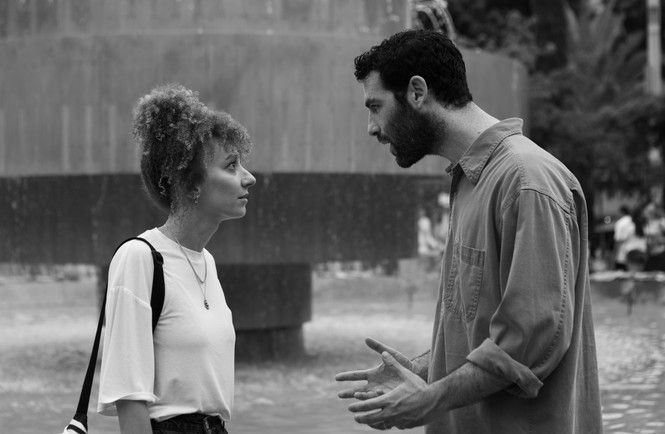
The concept reminded me of Before Sunrise, the Richard Linklater movie. In Polonsky’s story, Mili and Or, two Israelis, are exes who no longer live in Israel but have returned to vote. They run into each other on the street and begin a conversation that will last throughout the day as they walk the city and end up in Jaffa, where they will watch the election returns together.
Polonsky was filming in Dizengoff Square, at the center of the city’s shopping district, when I caught up with him. The giant fountain there is ringed by photos of hostages and memorials to dead soldiers. Photos of these young people also dangle from the branches of trees bordering the square. Mili and Or sat on a bench arguing. She was worried about raising a child in Israel and was glad to be gone. He has a child and told her that parenting is a worrisome business wherever you are. Polonsky stood behind the camera’s monitor with headphones on. Around him swirled the chaos of Tel Aviv, which seems so vibrant that it’s hard to imagine it ever ending—groups of teenagers taking selfies, canvassers dressed all in pink and yelling at people through megaphones to go vote, strangers petting one another’s dogs. Polonsky told me that all of this noise would be part of the film and that it was only roughly scripted. How it concluded would depend largely on what actually happened with the vote.
He didn’t want to give too much away, understandably, and wasn’t looking for easy analogies, but it wasn’t hard to picture a will-they-won’t-they storyline being as much about this couple as about the relationship with a country. Polonsky said he had been hoping for the sake of his plot that the change bloc would win. “It would make for a happy ending,” he said. But instead something much harder to film happened: a continuation of unresolved tension, deadlock.
Maybe this was good for the story, Polonsky said. The film was ultimately about what can be changed and what cannot be changed. Could these old lovers rekindle a flame, or had too much happened? At that moment in Jaffa, though, the cameras trained on Mila’s and Or’s faces as they watched the news revealed no ambiguity, at least as Polonsky saw it. “Their eyes looked the way you do when you don’t get what you want,” he said. “Which happens a lot.”