All posts tagged: Earths

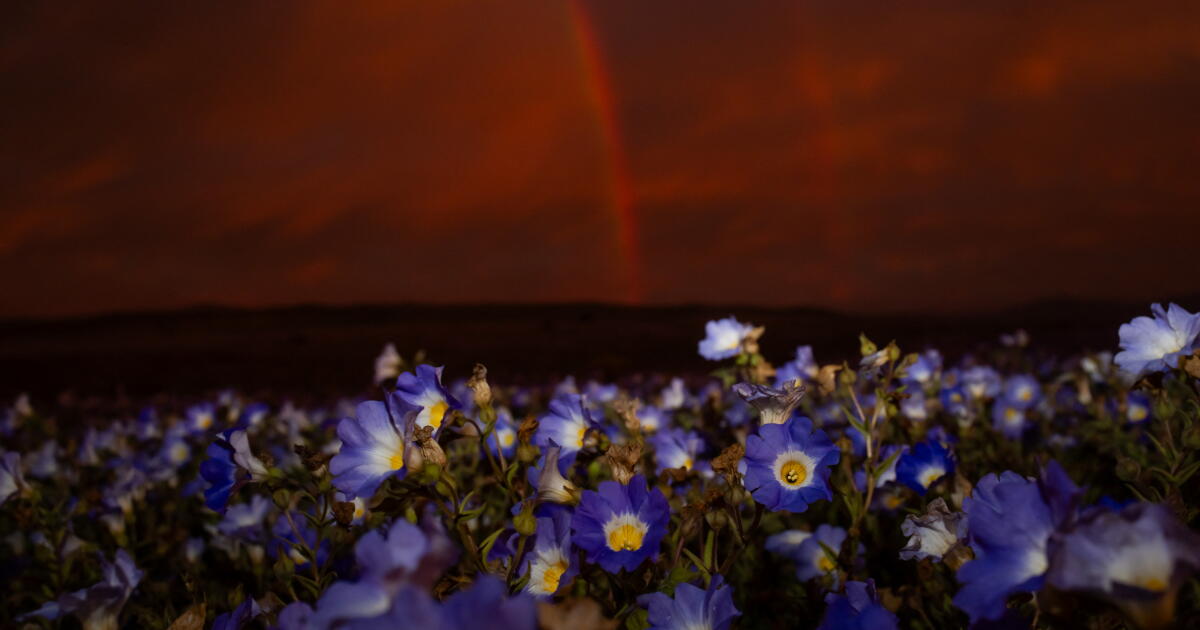
Earth’s driest desert is covered in wildflowers right now

Earth’s driest desert is covered in wildflowers right now

THE ATACAMA DESERT, Chile — Spring has finally arrived in the Southern Hemisphere and, in Chile, even the desert is blossoming. Known as the driest nonpolar desert on Earth, a massive portion of the Atacama Desert has been covered in flowers after the El Niño weather pattern brought heavy rains to the region earlier this year. The unusually large amount of water allowed millions of seeds and bulbs to sprout and bloom, many of them after remaining dormant for decades. “It is a unique phenomenon; there are more than 200 plant species,” Jorge Carabantes, head of the Protected Areas Department at the National Forest Corp. (CONAF), told the Associated Press. “This is a flowering event that is obviously extraordinary and unusual, very different from other blooms that occur elsewhere on the globe.” The Atacama lies between the Pacific Ocean and the Andes Mountains, stretching some 1,000 miles all the way down the northern coast of Chile. Although flowering is common during the transition from winter to spring, this year the rocky, brownish dunes that make up the …

Ask Ethan: Why are astronauts weightless while still in Earth’s gravity?

Ask Ethan: Why are astronauts weightless while still in Earth’s gravity?

If you stand here on the surface of the Earth, whether at the north pole where the acceleration is greatest or at the summit of Huascarán where it’s the smallest, you’ll be pulled towards the center of the Earth with an acceleration of 9.8 m/s²: the acceleration due to gravity, or “1g” on the surface of the Earth. Sure, there are tiny variations that will ensue, as your distance from Earth’s center, the speed of the planet’s rotation beneath your feet, and the density and composition of Earth’s crust and mantle aren’t constant, but those variations only lead to variations in the gravitational acceleration at the less-than-1%-level. That’s why, if you bring a scale to any of those locations on Earth’s surface and stand on it, you’ll find that the reading on that scale gives you your weight from a very simple formula: your mass (m) multiplied by the acceleration of gravity (1g) on Earth’s surface. If you have a mass of 100 kg, that means your weight will be 220.5 pounds, or 980 newtons, …

How Earth’s night lights became our most honest economist

How Earth’s night lights became our most honest economist

Don’t believe the Kremlin. It claims that from 2020 to 2024, the Russian economy grew by 13%. Instead, believe the lights Russians leave on at night. They reveal the country’s GDP actually shrank by 8% over that period. So says Sweden’s foreign minister Maria Malmer Stenergard in a New York Times op-ed. Stenergard wasn’t entirely guessing. Sweden’s intelligence services arrived at that figure by measuring nighttime luminosity, an increasingly mature and rigorous branch of economic geography. Because unlike the Kremlin, night lights don’t lie. Artificial light at night (ALAN) provides strangely honest data on GDP, poverty, war, and many other things governments would rather scientists didn’t measure. Recent analyses of NASA satellite data have made the field even more relevant, revealing the night side of the planet to be a subtle fact-checker of misinformation. An accidental science born in the Cold War Like many useful things, ALAN began as an accident — specifically, a Cold War one. In the 1960s, the U.S. Air Force launched a constellation of weather satellites under the Defense Meteorological Satellite …

5 gnarly plants in the Okefenokee Swamp, from digestive slime to Earth’s fastest predator

5 gnarly plants in the Okefenokee Swamp, from digestive slime to Earth’s fastest predator

Get the Popular Science daily newsletter💡 Breakthroughs, discoveries, and DIY tips sent six days a week. By signing up, you confirm you are 16+, will receive newsletters and promotional content and agree to our Terms of Use and acknowledge the data practices in our Privacy Policy. You may unsubscribe at any time. It may be a habitat more fit for alligators, mosquitoes, and a banjo-strumming frog, but Georgia’s Okefenokee National Wildlife Refuge (aka the Okefenokee Swamp) is officially a UNESCO World Heritage Site. It is the 27th World Heritage Site in the United States, the first in the Peach State, and the first new natural World Heritage Site in the U.S. added in over 30 years. North America’s largest blackwater swamp, the Okefenokee is a biodiverse wonderland. Thirty-nine fish, 37 amphibians, 64 reptiles, 234 birds, and 50 mammal species call it home.  The refuge’s 353,981 acres are also dotted with 620 species of plants. Some of those plants truly fit the definition of bizarre and beautiful. Here are five plants that you may stumble upon …

What has more power: Earth’s aurorae or fireworks shows?

What has more power: Earth’s aurorae or fireworks shows?

Here on Earth, brilliant spectacles occasionally illuminate our night skies. The peak of January 19, 2026’s auroral display was brief, and visible in spectacular fashion only for the short period of time where the Earth’s and Sun’s relevant magnetic fields were anti-aligned during the intense solar radiation storm that sent charged particles rapidly from the Sun to Earth. The resulting photograph, from northern Scotland, is one of the best views of this brief light show. Credit: Phil Hawley/Met Office UK Naturally, our planet’s aurorae create moving curtains of color. During a trip to Iceland, mobile astrophotographer Sadeq Hayati captured this 1st-place-winning photo of a multicolored, dancing aurora with a large rock formation (and a human beneath it) silhouetted in front of the night sky. Credit: Sadeq Hayati Greens, reds, and purples grace the skies as solar electrons strike our atmosphere. One of several award-winning photos involving aurorae in a 2025 photo contest, this photograph, titled “Whispers of the Dancing Auroras,” was taken in Iceland and won 2nd place in the “Capture the Dark” category. The …

A volcano has erupted remnants of Earth’s primordial magma ocean

A volcano has erupted remnants of Earth’s primordial magma ocean

A rising underwater volcano off the coast of Madagascar has been spewing up chemical traces of material from a primordial magma ocean in the first 100 million years of Earth’s history. Scientists generally suspect that Earth’s mantle – the thick layer of hot rock beneath the crust – has been steadily churning for more than 4 billion years, gradually erasing most chemical traces of the planet’s earliest history. “This is going to change a lot of things [in earth science], because now we have proof that materials dating back 4.5 billion years – from the very beginning of Earth’s history – still exist in sufficient quantities to be sampled in a volcano,” says Catherine Chauvel at the French National Centre for Scientific Research (CNRS) in Paris. During the Hadean eon, a Mars-sized object collided with Earth, breaking off debris that scientists believe later formed the moon. The impact heated the young planet so intensely that it became covered by a global magma ocean. Over the next few million years, the molten rock cooled and crystallised, …

Pigeons use their livers to sense Earth’s magnetic field

Pigeons use their livers to sense Earth’s magnetic field

Get the Popular Science daily newsletter💡 Breakthroughs, discoveries, and DIY tips sent six days a week. By signing up, you confirm you are 16+, will receive newsletters and promotional content and agree to our Terms of Use and acknowledge the data practices in our Privacy Policy. You may unsubscribe at any time. For decades, scientists have known that Earth’s magnetic field helps migratory birds and homing pigeons navigate. Just how our feathered friends sense the invisible sphere around the Earth, however, has been less clear.  At least part of the answer appears to be hiding inside a seemingly random organ. Immune cells inside pigeon livers called macrophages are sensitive to the planet’s magnetic field. These cells function like an internal compass, according to a new study published today in the journal Science.  Macrophages destroy old red blood cells, which makes them accumulate iron. The iron makes the macrophages  superparamagnetic, a kind of magnetism that takes place in particular nanoparticles. The nanoparticles can then be magnetized if a magnetic field is applied to them.  “When pigeons …

Northumbria Uni secures £4m to decode Earth’s radiation belts

Northumbria Uni secures £4m to decode Earth’s radiation belts

Researchers at Northumbria University have been awarded £4 million to investigate one of space science’s most persistent mysteries: why Earth’s radiation belts behave so erratically. The five-year project aims to improve forecasting of space weather and strengthen protections for satellites that underpin modern life. Leader of the project, Professor of Space Physics Clare Watt, explained its importance: “Despite decades of research and sophisticated NASA missions that have sampled these harsh environments directly, the radiation belts have remained frustratingly unpredictable. “This project will help us understand whether that’s because we don’t fully grasp the physics involved, or because parts of the system are inherently chaotic and sensitive to tiny changes in conditions.” Understanding radiation belts Radiation belts are zones encircling Earth where charged particles become trapped by the planet’s magnetic field. Within these regions, particles can accelerate to near-light speeds, creating a hostile environment for spacecraft. For operators of satellite systems, the stakes are high. Fluctuations in radiation belts can damage electronics, degrade solar panels, and disrupt services such as GPS navigation, telecommunications, and weather monitoring. Yet despite …

Jupiter’s lightning is 100 times stronger than Earth’s bolts

Jupiter’s lightning is 100 times stronger than Earth’s bolts

Get the Popular Science daily newsletter💡 Breakthroughs, discoveries, and DIY tips sent six days a week. It only takes one close encounter with a lightning strike to get the full sense of its power. At around 1 gigaJoule of energy, a single electrical discharge during a thunderstorm is more than enough to rip apart a tree, knock out an entire city’s energy grid, or kill an unfortunate bystander. But based on recent observations of the planet Jupiter, our biggest neighbor in the solar system features lightning so intense that it makes Earth’s bolts seem like tiny static shocks. According to a study recently published in the journal AGU Advances, the gas giant regularly sees lightning flashes as much as 100 times more powerful than those seen here on planet Earth. Although Jupiter’s composition and atmosphere share very little in common with our home planet, astronomers say analyzing those distant electrical discharges may help us better understand the lightning experienced on Earth. Hundreds of millions of lightning strikes occur around Earth every year, but apart from …